Simpsons One Third Rule Problem No 1 - Numerical Integration - Diploma Maths II
TL;DR
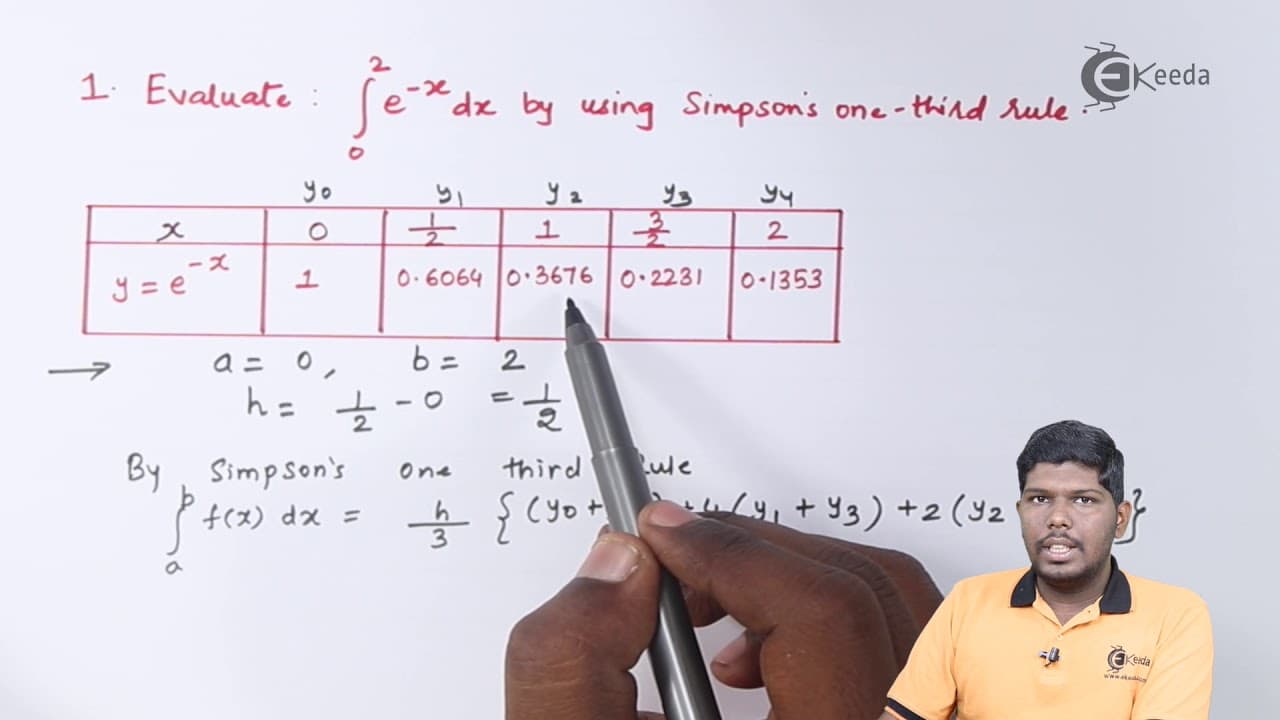
This video discusses how to evaluate the integral of e^-x using Simpsons 1/3 rule with given values of x and y.
Transcript
click the bell icon to get latest videos from equator hello friends in this video we are going to see problem which is based on Simpsons 1/3 rule let us start with problem number 1 evaluate is 0 to 2 e raise to minus X DX by using Simpsons 1/3 rule given that the values of X are 0 1/2 1/3 by 2 n 2 & 4 that and the values of Y or you can say the giv... Read More
Key Insights
- 📏 Simpson's 1/3 rule is used to approximate the value of definite integrals.
- ❣️ The formula involves using the given x and y values to calculate the integral.
- ☺️ The difference between consecutive x-values (h) is important in the calculations.
- 😀 The formula includes separate terms for even and odd positions of the y values.
- 😀 Following the correct order and not including the first and last y terms is crucial for accurate results.
- ❓ The final answer for the integral is obtained after solving the calculated values.
- 📏 Simpson's 1/3 rule can be a useful method when calculating the definite integral of functions.
Install to Summarize YouTube Videos and Get Transcripts
Explore YouTube Video Summarizer or Get YouTube Transcript Extractor
Questions & Answers
Q: What is the problem discussed in the video?
The problem involves evaluating the integral of e^-x from 0 to 2 using Simpsons 1/3 rule.
Q: How do you find the value of h?
To find the value of h, subtract any two consecutive values of x (0.5 - 0 = 0.5 or 1 - 1/2 = 1/2), resulting in h = 1/2.
Q: What is the formula for the Simpsons 1/3 rule?
The formula is integral of f(x) dx = (h/3)[y0 + 4(y1 + y3) + 2(y2 + y4) + yn], where y0 and yn are the first and last terms, and the rest are even and odd position terms respectively.
Q: How do you substitute the values of y into the formula?
In the formula, y0 is the first term, yn is the last term, and the remaining even and odd position terms are y1, y2, and y3. Y4 is not considered for this problem.
Summary & Key Takeaways
-
The video explains how to solve a problem that involves evaluating the integral of e^-x using Simpsons 1/3 rule.
-
The lower limit (a) is 0 and the upper limit (b) is 2. The values of x are given as 0, 1/2, 1/3, 2, and 4, and the corresponding values of y (e^-x) are given.
-
The first step is to find the value of h (the difference between consecutive x-values). Then, the Simpsons 1/3 rule formula is used to calculate the integral.
-
By substituting the given values into the formula and solving, the final answer for the integral is found to be approximately 0.86475.
Read in Other Languages (beta)
Share This Summary 📚
Summarize YouTube Videos and Get Video Transcripts with 1-Click
Try YouTube Summary with ChatGPT & Claude or YouTube Transcript Generator
Explore More Summaries from Ekeeda 📚





Summarize YouTube Videos and Get Video Transcripts with 1-Click
Try YouTube Summary with ChatGPT & Claude or YouTube Transcript Generator