How to Use the Quadratic Formula to Solve Equations
TL;DR
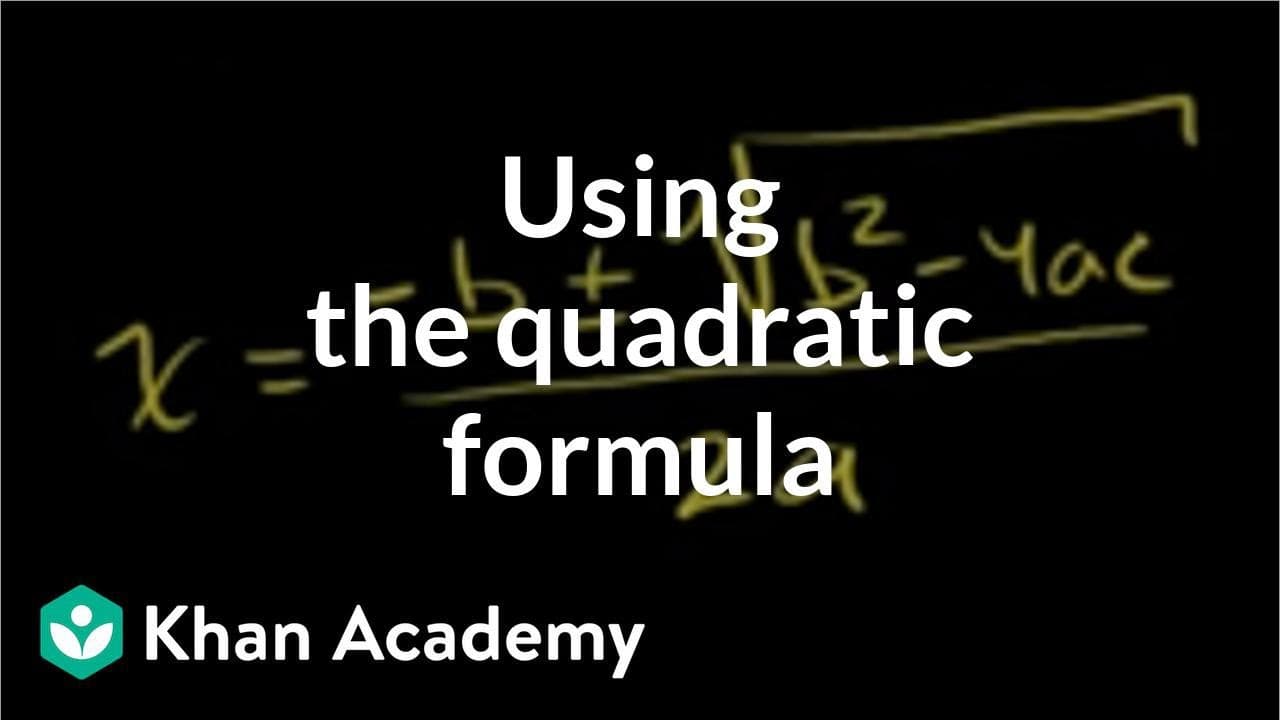
To use the quadratic formula for solving ax² + bx + c = 0, substitute the values of a, b, and c into the formula x = (-b ± √(b² - 4ac)) / 2a. This yields two solutions based on the ± sign, providing both the positive and negative roots of the equation.
Transcript
Use the quadratic formula to solve the equation, 0 is equal to negative 7q squared plus 2q plus 9. Now, the quadratic formula, it applies to any quadratic equation of the form-- we could put the 0 on the left hand side. 0 is equal to ax squared plus bx plus c. And we generally deal with x's, in this problem we're dealing with q's. But the quadratic... Read More
Key Insights
- 👔 The quadratic formula can be used to solve any quadratic equation of the form ax^2 + bx + c = 0.
- 😃 The values a, b, and c correspond to the coefficients in the equation.
- ☺️ The solutions provided by the quadratic formula are the values of x that make the equation equal to zero.
- ❓ The discriminant, b^2 - 4ac, determines the nature of the solutions (real, complex, or none).
- 🫚 When calculating the solutions, it is important to consider both the positive and negative roots.
- 🧑🏭 The quadratic formula is derived using methods like completing the square or factoring the quadratic equation.
- ❓ Verifying the solutions by substituting them back into the original equation is necessary to ensure their accuracy.
Install to Summarize YouTube Videos and Get Transcripts
Explore YouTube Video Summarizer or Get YouTube Transcript Extractor
Questions & Answers
Q: What is the quadratic formula?
The quadratic formula is a mathematical formula that provides the solutions to quadratic equations of the form ax^2 + bx + c = 0. It is given by x = (-b ± √(b^2 - 4ac))/(2a).
Q: How many solutions does a quadratic equation have?
A quadratic equation can have either two real solutions, one real solution (if the discriminant, b^2 - 4ac, is zero), or no real solutions (if the discriminant is negative). The solutions can also be complex numbers.
Q: Why do we have a ± symbol in the quadratic formula?
The ± symbol accounts for the fact that a quadratic equation can have two solutions. By using both the positive and negative roots, we cover all possible solutions for the equation.
Q: How can the quadratic formula be derived?
The quadratic formula can be derived using completing the square or by solving the quadratic equation through factoring. Both methods lead to the same formula: x = (-b ± √(b^2 - 4ac))/(2a).
Summary & Key Takeaways
-
The quadratic formula can be used to solve quadratic equations of the form ax^2 + bx + c = 0.
-
The formula calculates the solutions of the equation, which are represented by the values of x.
-
By plugging in the values of a, b, and c into the quadratic formula, the solutions for the given quadratic equation can be determined.
Read in Other Languages (beta)
Share This Summary 📚
Summarize YouTube Videos and Get Video Transcripts with 1-Click
Try YouTube Summary with ChatGPT & Claude or YouTube Transcript Generator
Explore More Summaries from Khan Academy 📚



Summarize YouTube Videos and Get Video Transcripts with 1-Click
Try YouTube Summary with ChatGPT & Claude or YouTube Transcript Generator