Functional groups | Properties of carbon | Biology | Khan Academy
TL;DR
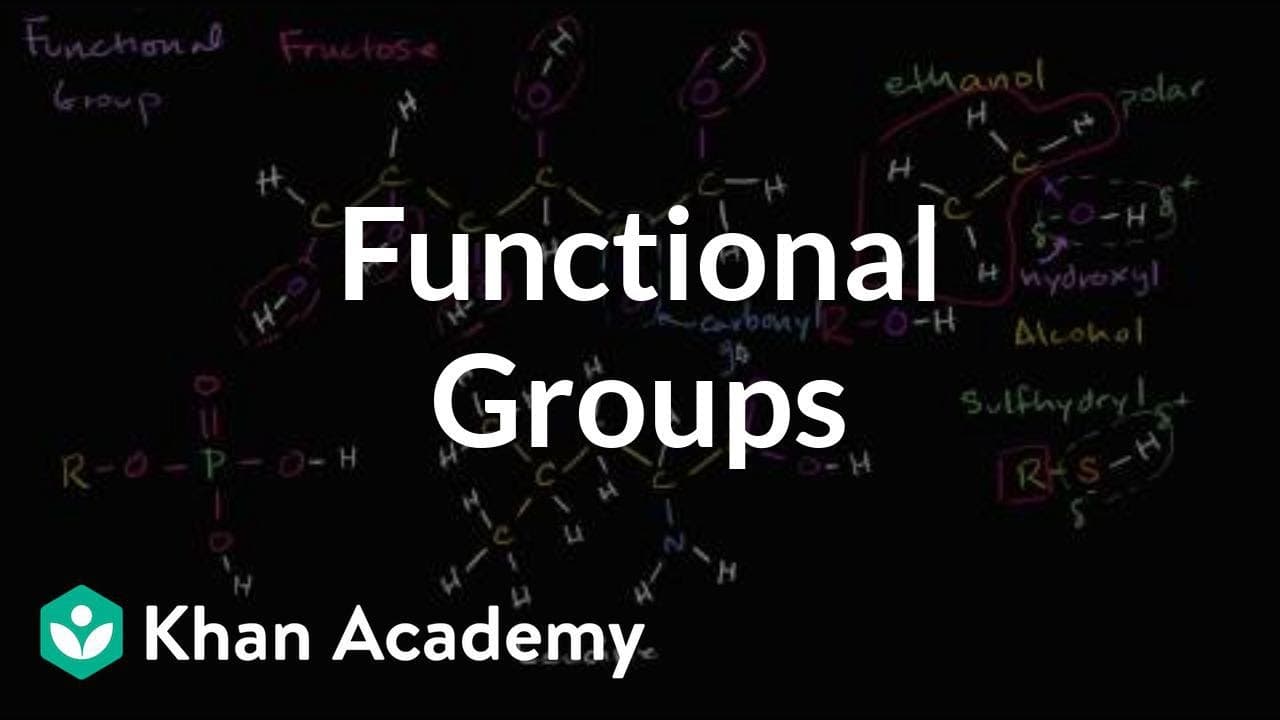
This video provides an overview of various functional groups found in organic molecules and their properties.
Transcript
- [Voiceover] We spent some time talking about hydrocarbons and hydrocarbons are interesting especially if you want to combust things, if you want some fuel, but now we're going to make things a little bit more interesting by adding things to the hydrocarbons and the things we're gonna add we call functional groups. Functional groups. And my goal i... Read More
Key Insights
- 👻 Hydroxyl groups make a molecule polar and hydrophilic, allowing it to dissolve in water.
- 👥 Sulfhydryl groups have lower polarity compared to hydroxyl groups but can still form polar bonds.
- 👊 Carbonyl groups in sugars make them polar and susceptible to nucleophilic attack.
- 👥 Carboxyl groups in amino acids are acidic and can donate hydrogen protons.
- 😑 Amino groups in amino acids are basic and can pick up hydrogen ions.
- 💦 Hydrocarbon groups are hydrophobic and do not dissolve in water.
- 👥 Phosphate groups are acidic and can donate protons.
Install to Summarize YouTube Videos and Get Transcripts
Explore YouTube Video Summarizer or Get YouTube Transcript Extractor
Questions & Answers
Q: How do hydroxyl groups affect the properties of a molecule?
Hydroxyl groups make a molecule polar and hydrophilic, allowing it to dissolve in water. This is because of the electronegativity difference between oxygen and hydrogen.
Q: How does the polarity of a sulfhydryl group compare to that of a hydroxyl group?
The polarity of a sulfhydryl group is lower compared to that of a hydroxyl group due to the lower electronegativity of sulfur compared to oxygen. However, it can still form polar bonds and interact with other molecules.
Q: Why are carbonyl groups important in sugars like fructose?
Carbonyl groups in sugars, like fructose, make the molecule polar and susceptible to nucleophilic attack. This allows for various chemical reactions and reactions with other molecules.
Q: What is the significance of carboxyl groups in amino acids?
Carboxyl groups in amino acids are acidic and can donate hydrogen protons. They are involved in the acidity of amino acids and can participate in reactions and bonding with other molecules.
Summary & Key Takeaways
-
Hydroxyl groups, such as the one found in ethanol, make a molecule polar and hydrophilic, allowing it to dissolve in water.
-
Sulfhydryl groups, similar to hydroxyl groups but with sulfur instead of oxygen, are less polar but can still form bonds with other molecules.
-
Carbonyl groups, found in sugars like fructose, make a molecule polar and susceptible to nucleophilic attack.
-
Carboxyl groups, as found in amino acids, are acidic and can donate hydrogen protons.
-
Amino groups, also found in amino acids, are basic and can pick up hydrogen ions.
-
Hydrocarbon groups, like methyl groups, are hydrophobic and do not dissolve in water.
-
Phosphate groups, commonly found in ATP and DNA, are acidic and can donate protons.
Read in Other Languages (beta)
Share This Summary 📚
Summarize YouTube Videos and Get Video Transcripts with 1-Click
Try YouTube Summary with ChatGPT & Claude or YouTube Transcript Generator
Explore More Summaries from Khan Academy 📚



Summarize YouTube Videos and Get Video Transcripts with 1-Click
Try YouTube Summary with ChatGPT & Claude or YouTube Transcript Generator