Extra Widening - Highway Geometric Design - Transportation Engineering 1
TL;DR
Extra widening is the increase in width of pavement by adding lanes to accommodate increased traffic volume and address issues like off-tracking, driver safety, and visibility at curves.
Transcript
hello students today we are going to study extra widening extra whitening is defined as the increase in width of pavement by increasing the lane is called widening here we just increase the width of the lane by increasing the number of lanes this is called as extra widening now it is done just to resolve the problem of increase in traffic volume no... Read More
Key Insights
- 🦺 Extra widening is primarily done to address issues like off-tracking, driver safety, and visibility at curves.
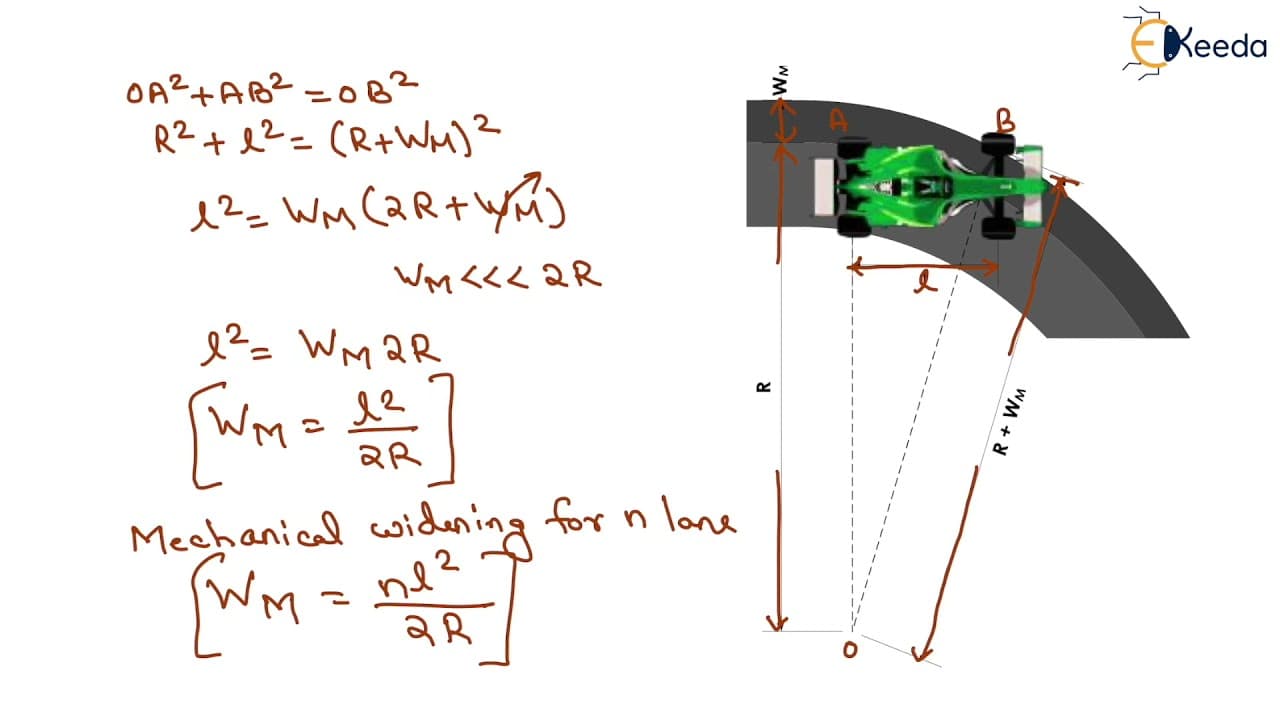
- 🦾 Mechanical widening helps to avoid off-tracking due to the rigidity of the wheelbase.
- 😚 Psychological widening accounts for the tendency of drivers to move their vehicles close to the edge of the pavement on curves.
- 🚙 Extra widening is calculated using the lengths of the vehicle, radius of the curve, and velocity.
- 🤒 If the radius of the curve is greater than 300 meters, no extra widening is needed.
- 🤒 Extra widening is provided on both edges of the pavement for curves with a radius between 50 meters to 300 meters.
- ✈️ For single lane roads, psychological widening is typically not required.
Install to Summarize YouTube Videos and Get Transcripts
Explore YouTube Video Summarizer or Get YouTube Transcript Extractor
Questions & Answers
Q: What is extra widening in pavement design?
Extra widening is the process of increasing the width of a pavement by adding lanes to accommodate more traffic, resolve issues like off-tracking, and improve driver safety and visibility at curves.
Q: Why is off-tracking a concern in pavement design?
Off-tracking occurs when the path traversed by the front axle is not the same as the path traveled by the rear axle. It can lead to safety issues and structural damage. Extra widening is provided to avoid off-tracking due to the rigidity of the wheelbase.
Q: How does psychological widening improve driver safety?
Psychological widening is provided to account for the tendency of drivers to move their vehicles close to the outer edge of the pavement. By providing additional space, it helps to improve safety and prevent the overturning of vehicles.
Q: How is extra widening calculated for multiple lanes?
The mechanical widening for one lane is calculated using the equation: wm = l^2 / (2r), where l is the length of the vehicle and r is the radius of the curve. For n lanes, the formula becomes: wm = (n * l^2) / (2r). Psychological widening is calculated using the empirical equation: wp = v / (9.5 * √r), where v is the velocity in kilometers per hour and r is the radius of the curve.
Summary & Key Takeaways
-
Extra widening is the process of increasing the width of a pavement by adding lanes to accommodate more traffic.
-
It helps to address issues such as off-tracking, which occurs due to the rigidity of wheelbase, and the psychological tendency of drivers to negotiate curves closely to the outer edge of the pavement.
-
Extra widening also improves visibility at curves and reduces the impact of lateral skidding.
Read in Other Languages (beta)
Share This Summary 📚
Summarize YouTube Videos and Get Video Transcripts with 1-Click
Try YouTube Summary with ChatGPT & Claude or YouTube Transcript Generator
Explore More Summaries from Ekeeda 📚


Summarize YouTube Videos and Get Video Transcripts with 1-Click
Try YouTube Summary with ChatGPT & Claude or YouTube Transcript Generator