How does react context help improve your code?
TL;DR
This video explains how to manage state in React using context instead of prop drilling.
Transcript
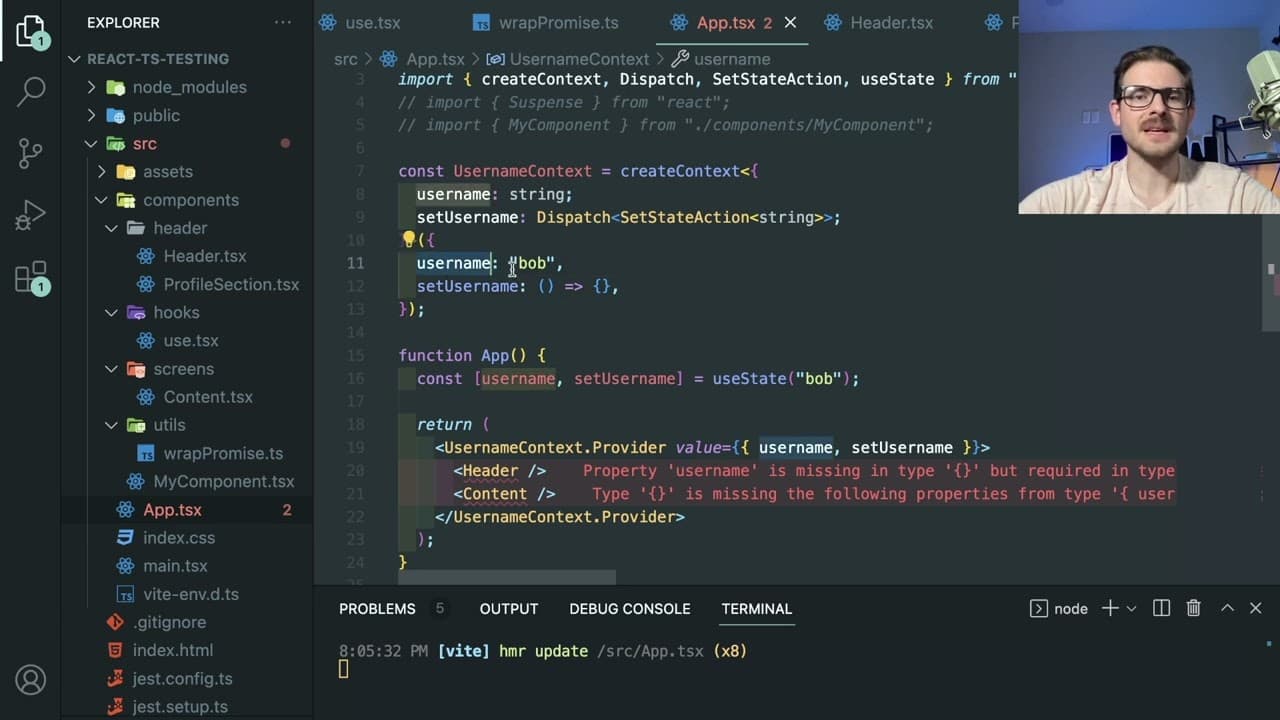
all right how's it going everyone so someone on my Discord asked if I could kind of explain a little bit about how context works and I think I have videos like this on my channel that kind of already explained this but I figured I'd just make another one in case anyone missed any of my videos in the past so I have a react application set up here th... Read More
Key Insights
- 🌲 Prop drilling can complicate state management in React, especially in deeply nested component trees.
- 🥺 Lifting state up to a common ancestor component can help share data but may lead to cumbersome prop passing.
- 🔠 The context API offers a clean solution for managing shared state across components without extensive prop drilling.
- 🥺 Using context can lead to a performance overhead, as changes to the context affect all consuming components.
- 🌥️ While context is beginner-friendly, more advanced solutions may be required for large-scale applications.
- 👨💻 Developers should balance the benefits of context with its potential pitfalls, especially regarding performance and code clarity.
- ❓ It's important to structure components thoughtfully to minimize unnecessary re-renders when using context.
Install to Summarize YouTube Videos and Get Transcripts
Explore YouTube Video Summarizer or Get YouTube Transcript Extractor
Questions & Answers
Q: What is prop drilling in React, and why is it a problem?
Prop drilling refers to the practice of passing state or props through multiple layers of components that do not directly need that data. While this works, it can become cumbersome as the component tree gets deeper, leading to increased complexity and maintenance issues. It makes it harder to track where certain data is coming from and can clutter component interfaces.
Q: How can state be shared between components without prop drilling?
One way to share state without prop drilling is to use React's context API. By creating a context and wrapping the components that need access to that state, you can eliminate the need to pass props explicitly down through every level of your component tree, simplifying the data flow and reducing redundancy.
Q: What are some drawbacks of using context in a React application?
A major drawback of context is that when the context's value changes, it causes a re-render of all components that consume that context. This can lead to performance issues, especially if the application has a lot of components or expensive render operations. Additionally, using context can obscure component dependencies, making it harder to understand data flow.
Q: When should developers opt for external state management solutions instead of context?
Developers should consider external state management solutions like Redux or Zustand when dealing with complex applications that have significant state management needs. These libraries often provide more efficient ways to manage state changes, reducing the performance hit from unnecessary re-renders and making it easier to track and maintain application state.
Summary & Key Takeaways
-
The video introduces the concept of state management in React applications, emphasizing the challenges of prop drilling when passing state through multiple components.
-
It demonstrates how to lift state up to a parent component and then introduces context as a solution to avoid excessive prop drilling, making the code cleaner and more manageable.
-
Viewers are informed about the benefits and drawbacks of context, with recommendations on when to use it versus other state management solutions.
Read in Other Languages (beta)
Share This Summary 📚
Summarize YouTube Videos and Get Video Transcripts with 1-Click
Try YouTube Summary with ChatGPT & Claude or YouTube Transcript Generator
Explore More Summaries from Web Dev Cody 📚





Summarize YouTube Videos and Get Video Transcripts with 1-Click
Try YouTube Summary with ChatGPT & Claude or YouTube Transcript Generator