Saltatory conduction in neurons | Human anatomy and physiology | Health & Medicine | Khan Academy
TL;DR
This video explains how signals spread through neurons and highlights the importance of the neuron's anatomy in facilitating this process.
Transcript
Now that we know how a signal can spread through a neuron, through an electrotonic potential and action potential and combinations of the two, let's put it all together by looking again at the structure of a neuron, the anatomy of a neuron, and thinking about why it has that anatomy and how it all can work. So we've already talked about the dendrit... Read More
Key Insights
- ℹ️ Dendrites receive inputs from multiple sources, allowing the neuron to integrate information.
- 😑 The entry of positive ions, particularly sodium ions, generates an electrotonic potential that spreads along the neuron.
- 🥺 The axon hillock is the site where action potentials are triggered, leading to signal transmission.
- 👻 The myelin sheath serves as an insulator, while nodes of Ranvier allow for signal boosting and efficient transmission.
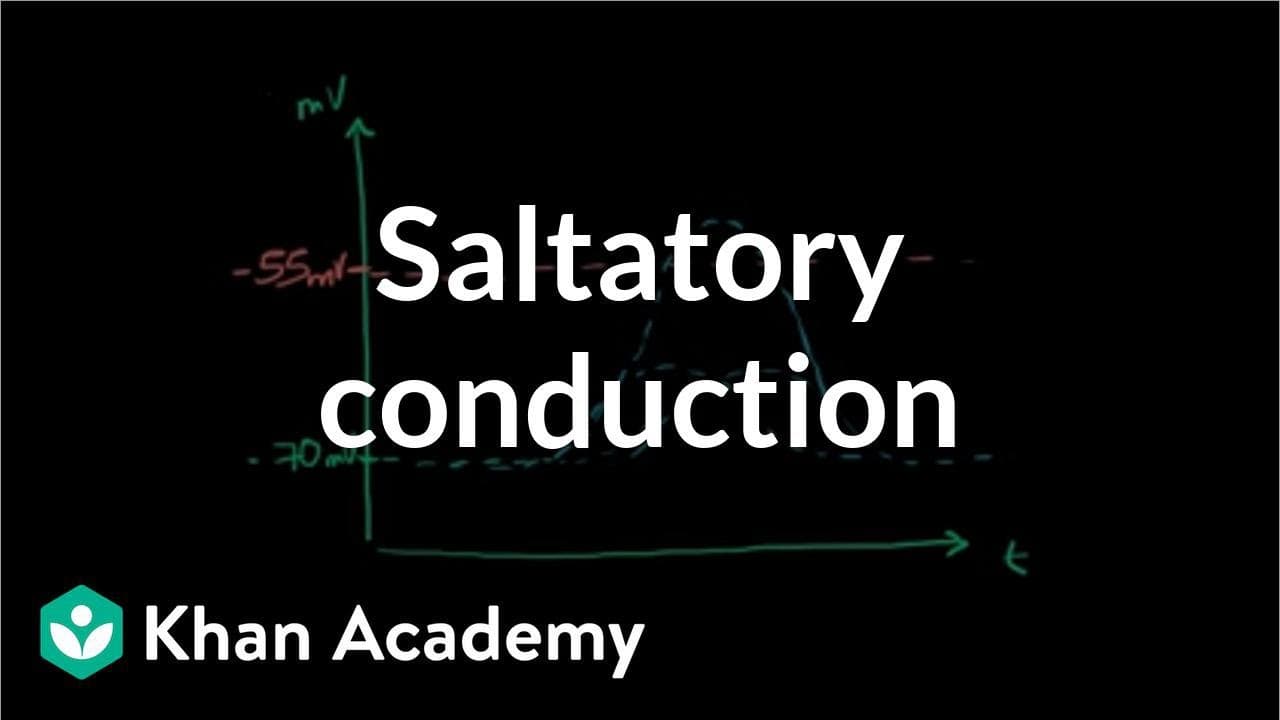
- 📡 Saltatory conduction refers to the boosted transmission of signals between nodes of Ranvier.
- ⚖️ Efficient signal transmission requires a balance between insulation and boosting mechanisms.
- 💁 The neuron's anatomy is crucial for effective information processing and transmission.
Install to Summarize YouTube Videos and Get Transcripts
Explore YouTube Video Summarizer or Get YouTube Transcript Extractor
Questions & Answers
Q: How are signals generated in a neuron?
Signals are generated in a neuron when its dendrites are stimulated by inputs from other neurons or sensory cells, allowing positive ions to enter the neuron.
Q: What is the role of the axon hillock?
The axon hillock is the site where a combination of electrotonic potentials can trigger an action potential, initiating the transmission of signals along the neuron's length.
Q: How does the neuron ensure efficient signal transmission?
The neuron's myelin sheath serves as an insulator, preventing signal loss, while nodes of Ranvier enable signal boosting through the activation of voltage-gated channels.
Q: What is saltatory conduction?
Saltatory conduction refers to the boosted transmission of signals between nodes of Ranvier, where the signal appears to jump or hop due to the combination of electrotonic spread and action potential triggering.
Summary & Key Takeaways
-
Signals in a neuron are initiated by stimulation of its dendrites by multiple inputs, whether from other neurons or sensory cells.
-
Stimulation allows positive ions, particularly sodium ions, to enter the neuron, creating an electrotonic potential that spreads along the cell.
-
The axon hillock is the critical point where a combination of electrotonic potentials can trigger an action potential, leading to the transmission of signals.
Read in Other Languages (beta)
Share This Summary 📚
Summarize YouTube Videos and Get Video Transcripts with 1-Click
Try YouTube Summary with ChatGPT & Claude or YouTube Transcript Generator
Explore More Summaries from Khan Academy 📚



Summarize YouTube Videos and Get Video Transcripts with 1-Click
Try YouTube Summary with ChatGPT & Claude or YouTube Transcript Generator