Sn2 reactions | Substitution and elimination reactions | Organic chemistry | Khan Academy
TL;DR
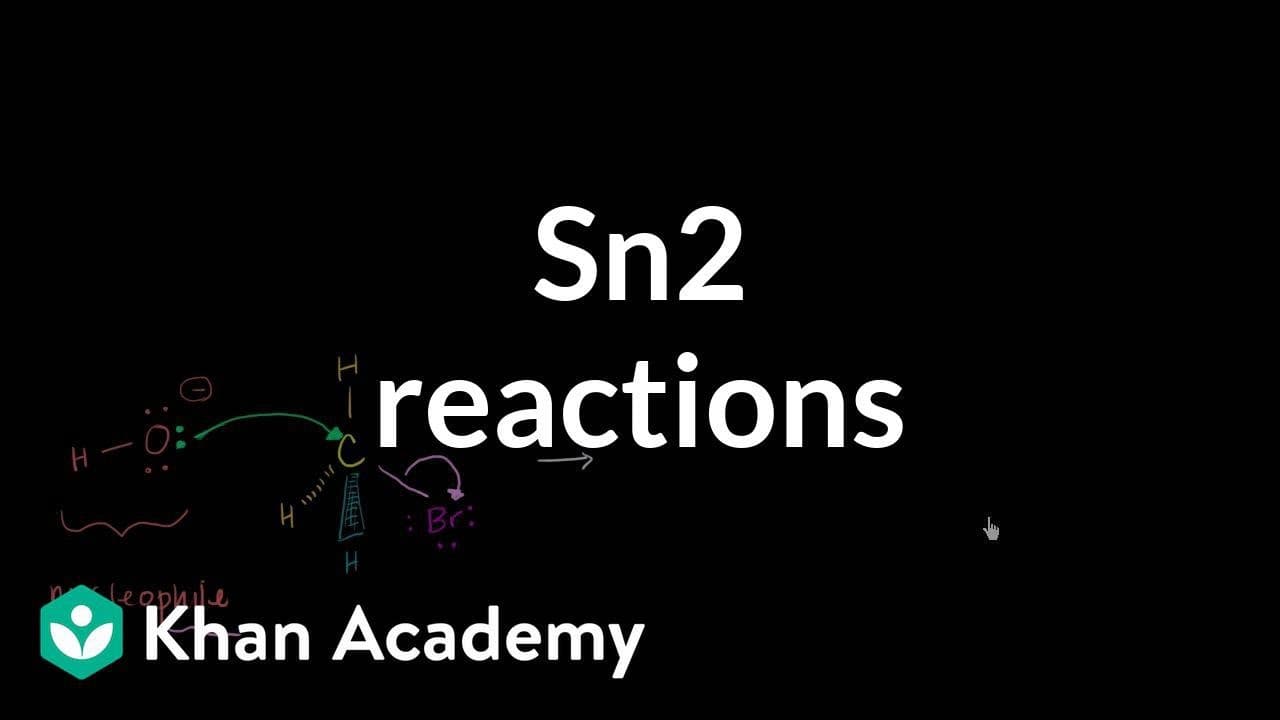
This content explains the Sn2 reaction, also known as substitution with nucleophile, where both reactants are involved in the rate-determining step.
Transcript
We're now going to explore one of the most fundamental reactions in organic chemistry. And first, let's look at what are the things that are going to react. So over here, I have a hydroxide anion. It has a negative 1 charge. And that negative 1 charge comes from the fact that oxygen is neutral if has six valence electrons. But this has one, two, th... Read More
Key Insights
- 🧑🏭 A hydroxide anion acts as a nucleophile, attracted to the positive charge of a carbon nucleus in a Sn2 reaction.
- 💁 The bromine group leaves as the hydroxide anion forms a bond with the carbon, resulting in a substitution reaction.
- ☠️ The rate of the Sn2 reaction is determined by the collision and interaction between the nucleophile and the substrate.
Install to Summarize YouTube Videos and Get Transcripts
Explore YouTube Video Summarizer or Get YouTube Transcript Extractor
Questions & Answers
Q: What is the role of the hydroxide anion in a Sn2 reaction?
The hydroxide anion acts as a nucleophile, attracted to the positive charge of the carbon nucleus. It shares a pair of electrons with the carbon, forming a bond and facilitating the substitution process.
Q: Why does the bromine group leave in a Sn2 reaction?
The bromine group leaves because bromine is more electronegative than carbon, causing it to hog the electrons in the bond. When the hydroxide anion shares its pair of electrons with the carbon, the bromine group takes back the electrons it was hogging.
Q: What determines the rate of a Sn2 reaction?
The rate of a Sn2 reaction is determined by the involvement of both reactants (hydroxide anion and bromine) in the rate-determining step. They need to collide in the right way for the reaction to occur.
Q: Why is the reaction called an Sn2 reaction?
The shorthand name "Sn2" refers to the fact that this is a substitution reaction (S) with a nucleophile (n) where both reactants (2) are involved in the rate-determining step.
Summary & Key Takeaways
-
This content discusses the key components of a Sn2 reaction: a hydroxide anion (nucleophile) and a carbon with a bromine group (substrate).
-
The hydroxide anion, with its negative charge, acts as a nucleophile that is attracted to the positive charge of the carbon nucleus.
-
In the reaction, the hydroxide anion shares a pair of electrons with the carbon, forming a bond, while the bromine group leaves, resulting in a substitution of the bromo group with a hydroxyl group.
Read in Other Languages (beta)
Share This Summary 📚
Summarize YouTube Videos and Get Video Transcripts with 1-Click
Try YouTube Summary with ChatGPT & Claude or YouTube Transcript Generator
Explore More Summaries from Khan Academy 📚



Summarize YouTube Videos and Get Video Transcripts with 1-Click
Try YouTube Summary with ChatGPT & Claude or YouTube Transcript Generator