Natural selection and evolution | High school biology | Khan Academy
TL;DR
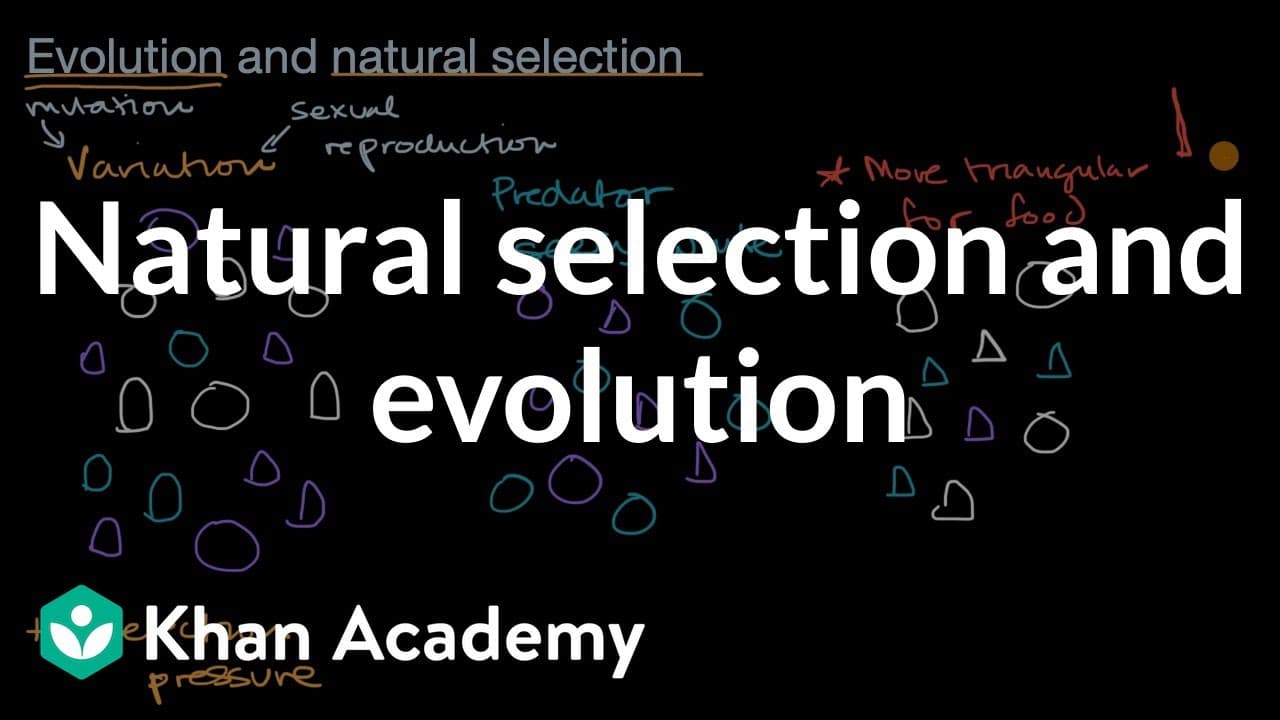
Natural selection is the process that drives evolution, where variation in a population combined with selection pressures leads to changes in traits over time.
Transcript
- [Instructor] Many of you all are probably familiar with the term evolution, and some of you all, I'm guessing, are also familiar with the term natural selection, although it isn't used quite as much as evolution. And what we're going to do in this video is see how these are connected, but we're also going to address some potential misconceptions ... Read More
Key Insights
- 🪛 Evolution does not represent linear progression but is driven by adaptability to the environment.
- 🥺 Natural selection is the mechanism behind evolution, where variation in a population and selection pressures lead to changes in traits over time.
- 😳 Evolution can happen rapidly, as observed with the evolution of flu viruses and the emergence of new Coronavirus variants.
- ❓ Variation, caused by mutation and sexual reproduction, is essential for evolution to occur.
- 🖐️ Selection pressures, such as predators or limited resources, play a crucial role in shaping the evolution of a population.
- ♻️ Evolution is not a magical process but a result of genetic variation and the interaction between organisms and their environment.
Install to Summarize YouTube Videos and Get Transcripts
Explore YouTube Video Summarizer or Get YouTube Transcript Extractor
Questions & Answers
Q: How is evolution commonly misunderstood by people?
Evolution is often misunderstood as a linear process, with organisms progressively becoming more advanced. However, evolution is about adaptability to the environment and changes in traits based on selection pressures, not linear progression.
Q: How does natural selection drive evolution?
Natural selection occurs when there is variation in a population, caused by mutation and sexual reproduction, and selection pressures favoring certain traits. Over time, individuals with advantageous traits survive and reproduce, leading to evolutionary changes.
Q: What are some examples of rapid evolution happening in our daily lives?
Rapid evolution can be observed with the constant evolution of flu viruses, which lead to new strains each year. The emergence of new variants of the Coronavirus, such as different COVID-19 strains, is another example of rapid evolution happening before our eyes.
Q: How does variation contribute to evolution?
Variation in a population is crucial for evolution to occur. It is caused by genetic mutations and the mixing of alleles through sexual reproduction. This variation provides the diversity that natural selection acts upon, leading to the survival and reproduction of individuals with advantageous traits.
Summary & Key Takeaways
-
Many people have misconceptions about evolution, thinking that it represents a linear progression from primitive to advanced organisms, but it is really about continual change based on environmental suitability.
-
Evolution can occur over millions of years, but it can also happen rapidly, as seen with the constant evolution of flu viruses and the emergence of new variants of the Coronavirus.
-
Variation in a population, caused by mutation and sexual reproduction, combined with selection pressures, forms the basis of natural selection and drives evolutionary changes.
Read in Other Languages (beta)
Share This Summary 📚
Summarize YouTube Videos and Get Video Transcripts with 1-Click
Try YouTube Summary with ChatGPT & Claude or YouTube Transcript Generator
Explore More Summaries from Khan Academy 📚



Summarize YouTube Videos and Get Video Transcripts with 1-Click
Try YouTube Summary with ChatGPT & Claude or YouTube Transcript Generator