What Are Inverting and Non-Inverting Operational Amplifiers?
TL;DR
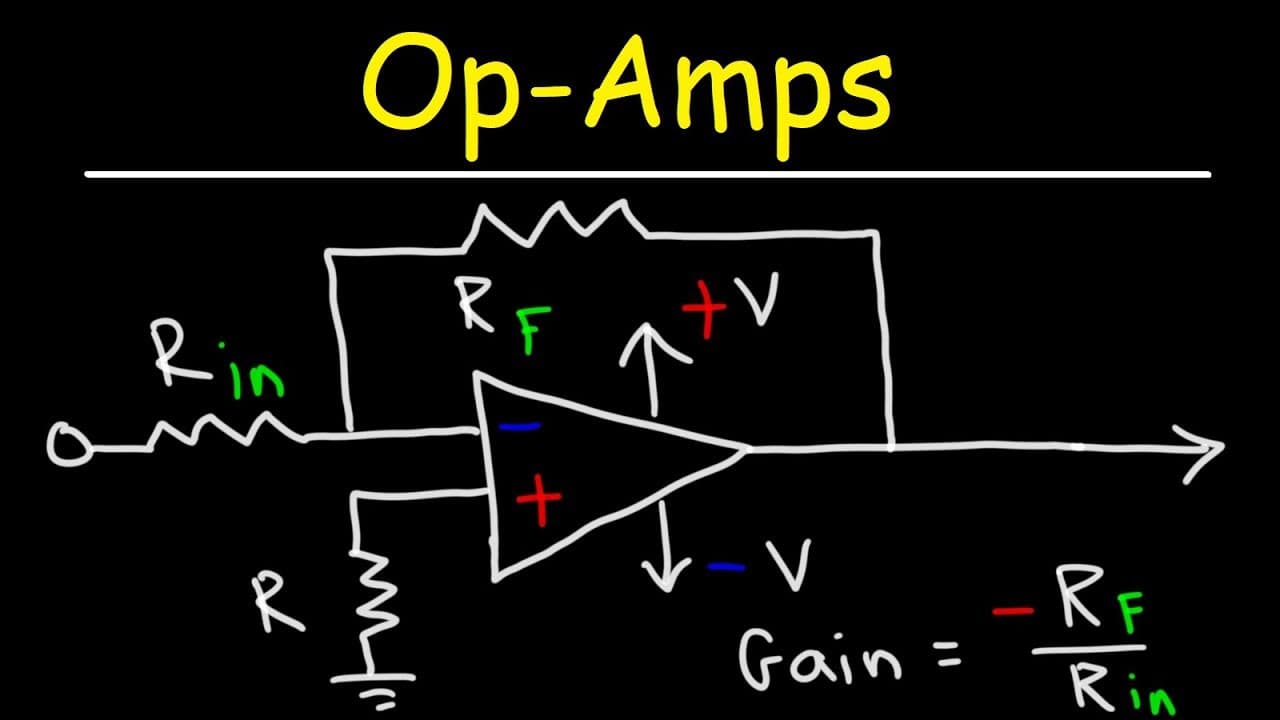
Inverting operational amplifiers invert the input signal, resulting in a 180-degree phase shift, while non-inverting amplifiers maintain the same phase as the input. Both types use feedback resistors to control voltage gain, and operational amplifiers are characterized by high input impedance and low output impedance.
Transcript
in this video we're going to talk about op amps an op amp is short for an operational amplifier op amps are basically high gain differential amplifiers these devices they amplify the difference between the input voltages v1 and v2 now the op amp has a very high input impedance but a very low output impedance the negative terminal here is known as t... Read More
Key Insights
- ✋ Operational amplifiers (op amps) are high-gain differential amplifiers that amplify the difference between input voltages.
- 🔡 Op amps have a high input impedance and low output impedance, with the negative terminal as the inverted input and the positive terminal as the non-inverting input.
- 😒 Inverting amplifier circuits use a feedback resistor to reduce voltage gain, while non-inverting amplifier circuits maintain the same phase as the input signal.
- 🍾 Supply voltage connections for op amps are typically connected to pins 4 and 7, with a series of batteries or power supply.
- 🍾 The slew rate of an op amp determines its maximum operating frequency and can affect its ability to switch between positive and negative cycles of a signal.
Install to Summarize YouTube Videos and Get Transcripts
Explore YouTube Video Summarizer or Get YouTube Transcript Extractor
Questions & Answers
Q: What is an op amp and how does it work?
An op amp is a high-gain differential amplifier that amplifies the voltage difference between its input terminals. It has a high input impedance and low output impedance, and the input terminals are known as the inverted and non-inverting inputs.
Q: How does a feedback resistor affect the voltage gain in an inverting amplifier circuit?
In an inverting amplifier circuit, a feedback resistor is used to reduce the voltage gain. The closed-loop voltage gain can be calculated by dividing the feedback resistor by the input resistance, with a negative sign to represent the inversion of the signal.
Q: What are the supply voltage connections for an op amp?
The supply voltage connections for an op amp are typically connected to pins 4 and 7. They can be connected to a series of batteries, with the positive terminal of one battery connected to the negative terminal of another and the middle point serving as the ground.
Q: What is slew rate and why is it important in op amps?
Slew rate is the rate at which an op amp can switch between positive and negative cycles of a signal. It is important because it determines the maximum operating frequency of the op amp. Op amps with limited slew rate may not work well at high frequencies.
Summary & Key Takeaways
-
An op amp is a high-gain differential amplifier that amplifies the difference between input voltages.
-
The op amp has a high input impedance and low output impedance, with the negative terminal being the inverted input and the positive terminal being the non-inverting input.
-
Inverting amplifier circuits use a feedback resistor to reduce voltage gain, while non-inverting amplifiers maintain the same phase as the input signal.
Read in Other Languages (beta)
Share This Summary 📚
Summarize YouTube Videos and Get Video Transcripts with 1-Click
Try YouTube Summary with ChatGPT & Claude or YouTube Transcript Generator
Explore More Summaries from The Organic Chemistry Tutor 📚




Summarize YouTube Videos and Get Video Transcripts with 1-Click
Try YouTube Summary with ChatGPT & Claude or YouTube Transcript Generator