Type 4 Effect of Division By t Problem 3 - Laplace Transform - Engineering Mathematics 3
TL;DR
This video discusses the effect of division by t in Laplace transform problems, providing step-by-step explanations and examples.
Transcript
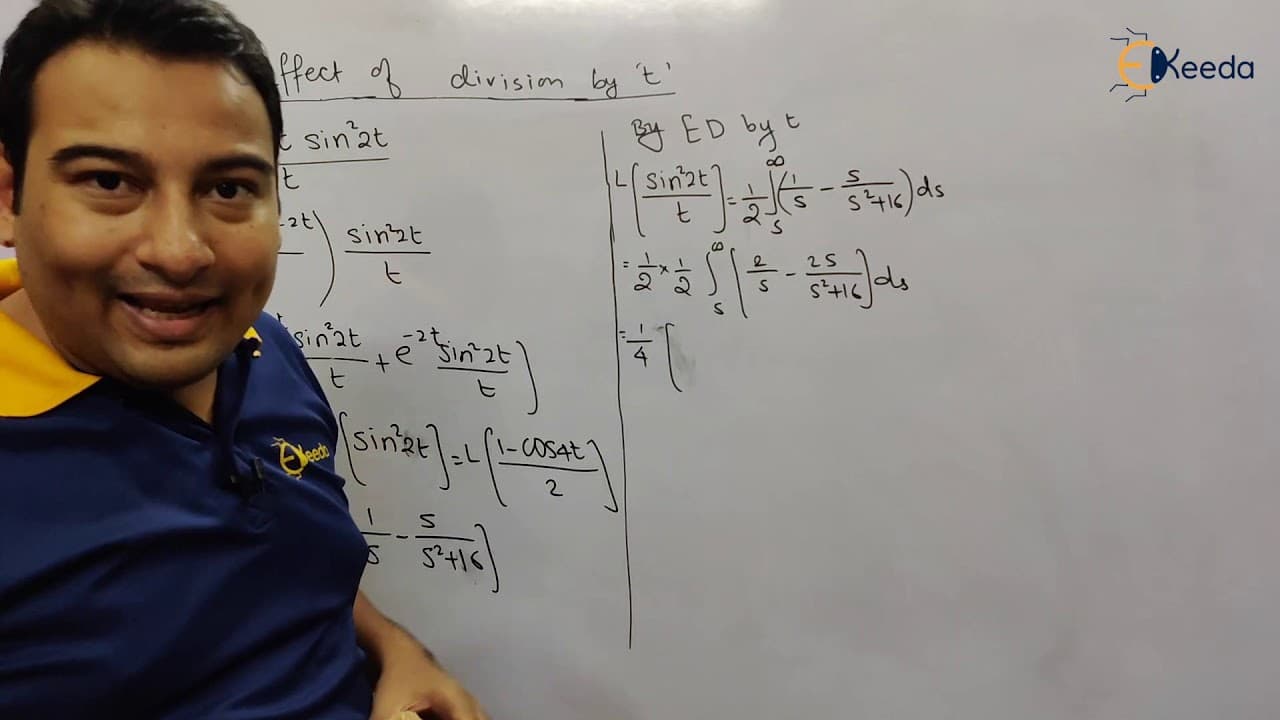
hello friends in this video we'll be discussing effect of division by t problem number three welcome back friends now we are discussing the third problem cos h 2 t sine square 2 t upon t so this is our third problem do you remember the note whenever you get a question from laplace transform the first thing that should come in your mind is note and ... Read More
Key Insights
- ❓ Hyperbolic functions in Laplace transform problems should be converted into exponential functions.
- 🍉 Dividing by t simplifies the problem by isolating specific terms.
- 👨💼 Solving for the Laplace transform of sine functions requires converting them into linear terms.
Install to Summarize YouTube Videos and Get Transcripts
Explore YouTube Video Summarizer or Get YouTube Transcript Extractor
Questions & Answers
Q: What is the first step to take when solving a Laplace transform problem?
The first step is to convert hyperbolic functions into exponential functions. This is done by replacing cosh(2t) with (e^(2t) + e^(-2t))/2.
Q: How can the problem cosh(2t)sin^2(2t)/t be simplified further?
By applying the effect of division by t and focusing on each term individually. In this case, only sin^2(2t) remains, which can be simplified as 1 - cos^2(2t).
Q: How do you find the Laplace transform of sin^2(2t)?
By converting sin^2(2t) into a linear term, it becomes 1 - cos(4t)/2. The Laplace transform of sin^2(2t) is equivalent to the Laplace transform of sin^2(t), which is 1/4s - s/(s^2 + 16).
Q: What is the final solution for the given problem?
The final solution is 1/8 * log[(s-2)^2 + 16]/[(s-2)^2] + log[(s+2)^2 + 16]/[(s+2)^2].
Summary & Key Takeaways
-
The video discusses problem number three, which involves cosh(2t)sin^2(2t)/t.
-
It emphasizes the importance of converting hyperbolic functions into exponential functions when dealing with Laplace transforms.
-
The problem is simplified by converting cosh(2t) into (e^(2t) + e^(-2t))/2 and solving for sin^2(2t).
Read in Other Languages (beta)
Share This Summary 📚
Summarize YouTube Videos and Get Video Transcripts with 1-Click
Try YouTube Summary with ChatGPT & Claude or YouTube Transcript Generator
Explore More Summaries from Ekeeda 📚






Summarize YouTube Videos and Get Video Transcripts with 1-Click
Try YouTube Summary with ChatGPT & Claude or YouTube Transcript Generator