Ideal Gas Law Practice Problems
TL;DR
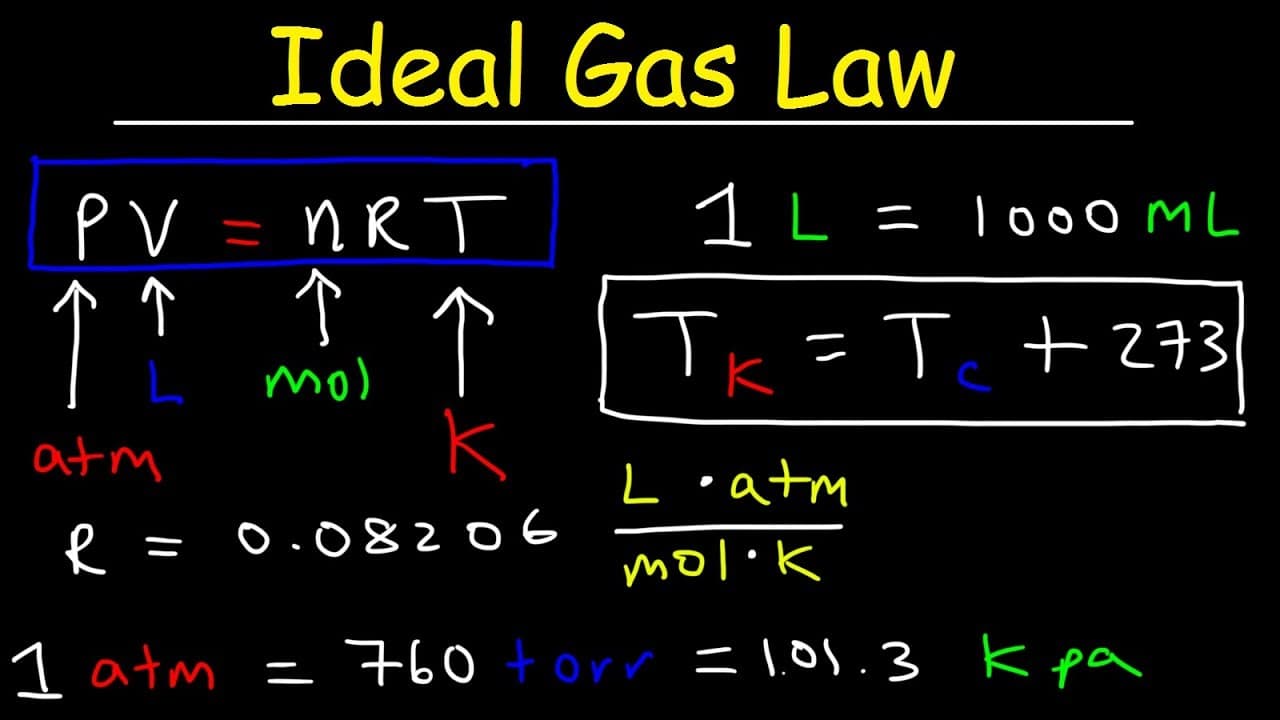
This video explains the ideal gas law and demonstrates how to solve problems using the equation.
Transcript
so here's the first practice problem that we're going to work on a 2.5 liter container holds .45 moles of nitrogen gas at 315 kelvin what is the pressure inside the container let's write down what we know so we know the volume is 2.5 liters n represents the number of moles that's 0.45 moles and the temperature is 315 kelvin our goal is to calculate... Read More
Key Insights
- 🫢 The ideal gas law equation, PV = nRT, describes the behavior of ideal gases.
- 😘 Real gases exhibit more ideal behavior at high temperatures and low pressures.
- 🫢 Correct units (atm for pressure, L for volume, and Kelvin for temperature) are crucial when using the ideal gas law equation.
- 🔇 The equation can be used to calculate pressure, volume, temperature, or number of moles, given the appropriate values for the other variables.
- 🫢 Molar mass is necessary to convert moles to grams in gas-related problems.
- 🫢 Gas laws are essential in understanding and predicting the behavior of gases in various scientific disciplines.
- 🫢 The gas constant (R) is a fundamental constant that relates the properties of gases in the ideal gas law equation.
Install to Summarize YouTube Videos and Get Transcripts
Explore YouTube Video Summarizer or Get YouTube Transcript Extractor
Questions & Answers
Q: What is the ideal gas law equation?
The ideal gas law equation is PV = nRT, where P is pressure, V is volume, n is the number of moles, R is the gas constant, and T is temperature. It helps calculate any one of these variables if the others are known.
Q: How does temperature affect the behavior of real gases?
Real gases behave more like ideal gases at high temperatures because the gas molecules have more kinetic energy and move more freely. At low temperatures, real gases deviate from ideal behavior due to molecular interactions.
Q: What units should be used for pressure and volume in the ideal gas law equation?
Pressure should be in atmospheres (atm), and volume should be in liters (L). It is important to use the correct units to ensure accurate calculations.
Q: How is the ideal gas law equation useful in solving gas-related problems?
The ideal gas law equation allows for the calculation of pressure, volume, temperature, or moles of gas when the other variables are known. It is commonly used in chemistry and physics to analyze and predict gas behavior.
Summary & Key Takeaways
-
The video introduces the ideal gas law equation, PV = nRT, where P is pressure, V is volume, n is the number of moles, R is the gas constant, and T is temperature.
-
It explains how to apply the equation to solve problems involving gas pressure, volume, temperature, and moles.
-
The video emphasizes the importance of using the correct units for each variable in the equation.
Read in Other Languages (beta)
Share This Summary 📚
Summarize YouTube Videos and Get Video Transcripts with 1-Click
Try YouTube Summary with ChatGPT & Claude or YouTube Transcript Generator
Explore More Summaries from The Organic Chemistry Tutor 📚


Summarize YouTube Videos and Get Video Transcripts with 1-Click
Try YouTube Summary with ChatGPT & Claude or YouTube Transcript Generator