What Is the Loanable Funds Market?
TL;DR
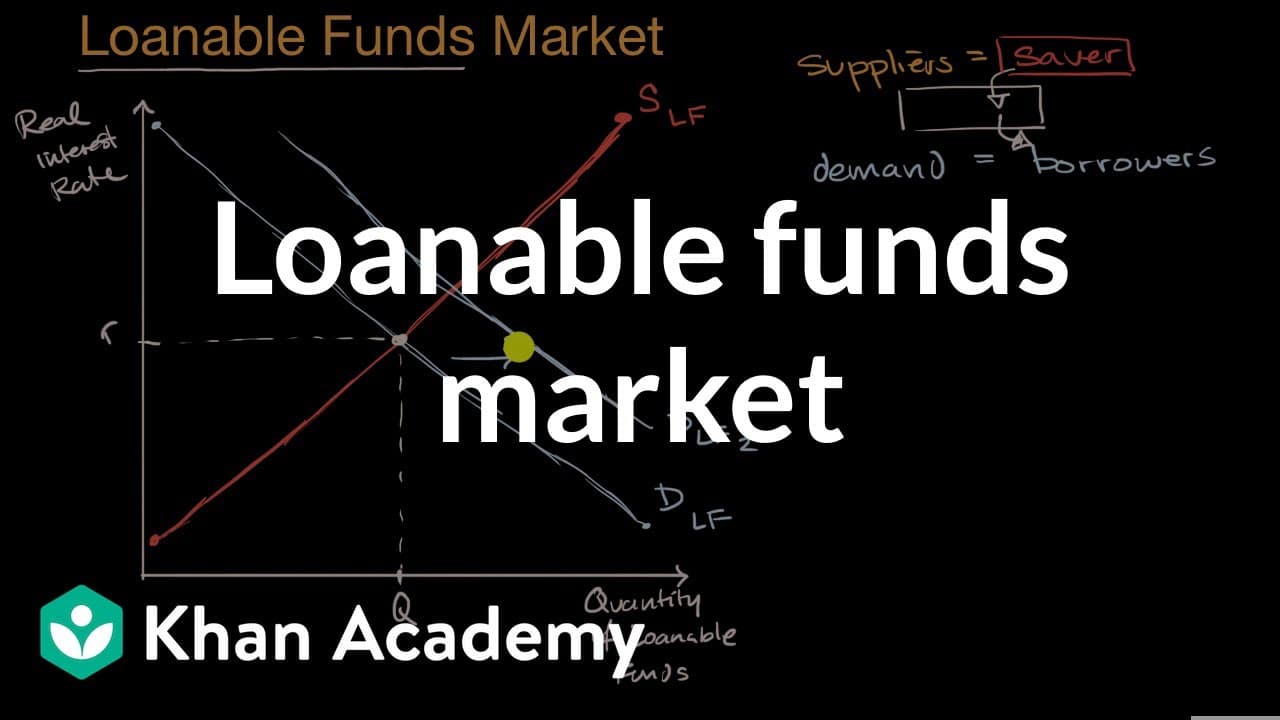
The loanable funds market is where savers supply funds and borrowers seek loans, with the interest rate acting as the price. It operates similarly to other markets, balancing demand and supply, and shifts can occur due to changes in savings rates or business opportunities, affecting the equilibrium interest rate.
Transcript
- [Instructor] We are used to thinking about markets for goods and services, and demand and supply of goods and services, and what we're gonna do in this video is broaden our sense of what a market could be for by thinking about the market for loanable funds. Now, this might seem like a very technical term, loanable funds, but it literally just mea... Read More
Key Insights
- 🏦 The loanable funds market involves the supply of funds from savers and the demand for funds from borrowers, with intermediaries like banks facilitating the process.
- ☠️ The quantity of loanable funds is represented on the horizontal axis, while the real interest rate serves as the price on the vertical axis.
- ☠️ Changes in real interest rates influence the behavior of savers and borrowers, impacting the supply and demand for loanable funds.
- ☠️ Shifts in the demand and supply curves for loanable funds can occur due to factors such as new business opportunities or changes in the savings rate.
- 🥺 A surplus or shortage of loanable funds can lead to adjustments in the real interest rate to reach a new equilibrium.
- ☠️ The loanable funds market operates similarly to other markets, but with the distinction that the price is expressed as an interest rate, specifically the real interest rate.
- ❓ The loanable funds market is an important component of the overall economy, as it influences investment and the allocation of financial resources.
Install to Summarize YouTube Videos and Get Transcripts
Explore YouTube Video Summarizer or Get YouTube Transcript Extractor
Questions & Answers
Q: Who are the suppliers in the loanable funds market?
The suppliers in the loanable funds market are savers, who provide their funds to be lent out to borrowers through financial institutions like banks. Savers receive interest on their savings as a return.
Q: Where does the demand for loanable funds come from?
The demand for loanable funds stems from borrowers who seek to make investments or seize business opportunities. They require funds to finance their activities and are willing to pay interest in return.
Q: How do the supply and demand for loanable funds interact in the market?
While savers and borrowers do not directly interact with each other, their interactions occur through financial institutions. Savers deposit funds in these institutions, which then lend them out to borrowers and charge interest to provide returns to savers.
Q: How do changes in real interest rates affect the supply and demand for loanable funds?
When real interest rates are low, savers are less motivated to supply a significant quantity of loanable funds. Conversely, high real interest rates incentivize savers to supply more funds. On the demand side, a high real interest rate reduces the quantity demanded, while a low real interest rate increases it.
Summary & Key Takeaways
-
The loanable funds market involves the supply and demand of funds for lending, with savers being the suppliers and borrowers being the demanders.
-
Financial institutions, such as banks, typically act as intermediaries between savers and borrowers in this market.
-
The quantity of loanable funds is represented on the horizontal axis, while the real interest rate serves as the price on the vertical axis.
Read in Other Languages (beta)
Share This Summary 📚
Summarize YouTube Videos and Get Video Transcripts with 1-Click
Try YouTube Summary with ChatGPT & Claude or YouTube Transcript Generator
Explore More Summaries from Khan Academy 📚



Summarize YouTube Videos and Get Video Transcripts with 1-Click
Try YouTube Summary with ChatGPT & Claude or YouTube Transcript Generator