Solving Rational Equations and Factoring Trinomials - SAT Math Part 3
TL;DR
Learn how to solve rational equations by eliminating fractions and factoring quadratic expressions.
Transcript
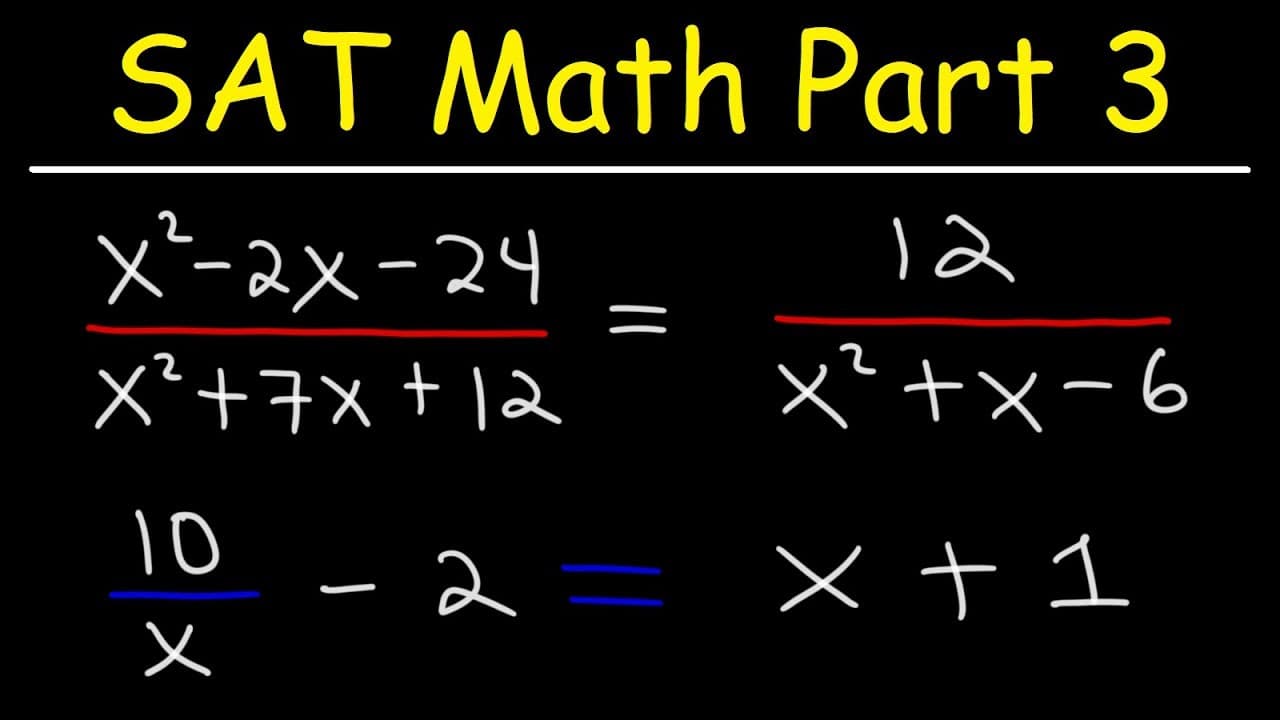
number 14 which of the following could be a value of x so we have a rational equation 10 over x minus 2 is equal to x plus 1. how can we calculate the value of x well what i recommend doing is getting rid of the fraction so let's multiply everything by x so 10 over x times x the x variables will cancel giving us just 10. x times negative 2 is negat... Read More
Key Insights
- 🙃 Multiplying both sides of a rational equation by the denominator eliminates the fractions and allows for further simplification.
- 🍉 Moving terms to one side of the equation and combining like terms leads to a quadratic expression.
- 😑 Factoring the quadratic expression helps find the values of x that satisfy the rational equation.
- ☺️ Certain values of x may make the equation invalid by causing division by zero, so they must be excluded as solutions.
- 🟰 Cross-multiplying can be used when dealing with rational equations involving fractions separated by an equal sign.
- 😑 The GCF (Greatest Common Factor) can be factored out to simplify the quadratic expression and find the solutions.
- ☺️ Solving a rational equation involves finding the values of x that make the equation true.
Install to Summarize YouTube Videos and Get Transcripts
Explore YouTube Video Summarizer or Get YouTube Transcript Extractor
Questions & Answers
Q: How do you solve a rational equation?
To solve a rational equation, eliminate the fraction by multiplying both sides of the equation by the denominator. This results in a quadratic equation, which can then be solved by factoring or using the quadratic formula.
Q: What is the next step after factoring the quadratic expression?
After factoring the quadratic expression, set each factor equal to zero and solve for x. The solutions to the quadratic equation will be the values of x that satisfy the original rational equation.
Q: Why are certain values of x not valid solutions?
Certain values of x may make the denominator of the rational expression zero, which results in an undefined function. These values must be excluded as they would make the equation invalid.
Q: What does it mean to cross-multiply in a rational equation?
Cross-multiplying in a rational equation involves multiplying the numerator of one fraction with the denominator of the other fraction. This helps eliminate the fractions and simplify the equation.
Summary & Key Takeaways
-
Multiply both sides of the equation by x to eliminate the fraction, resulting in a trinomial expression.
-
Move terms to one side of the equation and combine like terms to create a quadratic equation.
-
Factor the quadratic expression to find the values of x that satisfy the equation.
Read in Other Languages (beta)
Share This Summary 📚
Summarize YouTube Videos and Get Video Transcripts with 1-Click
Try YouTube Summary with ChatGPT & Claude or YouTube Transcript Generator
Explore More Summaries from The Organic Chemistry Tutor 📚



Summarize YouTube Videos and Get Video Transcripts with 1-Click
Try YouTube Summary with ChatGPT & Claude or YouTube Transcript Generator