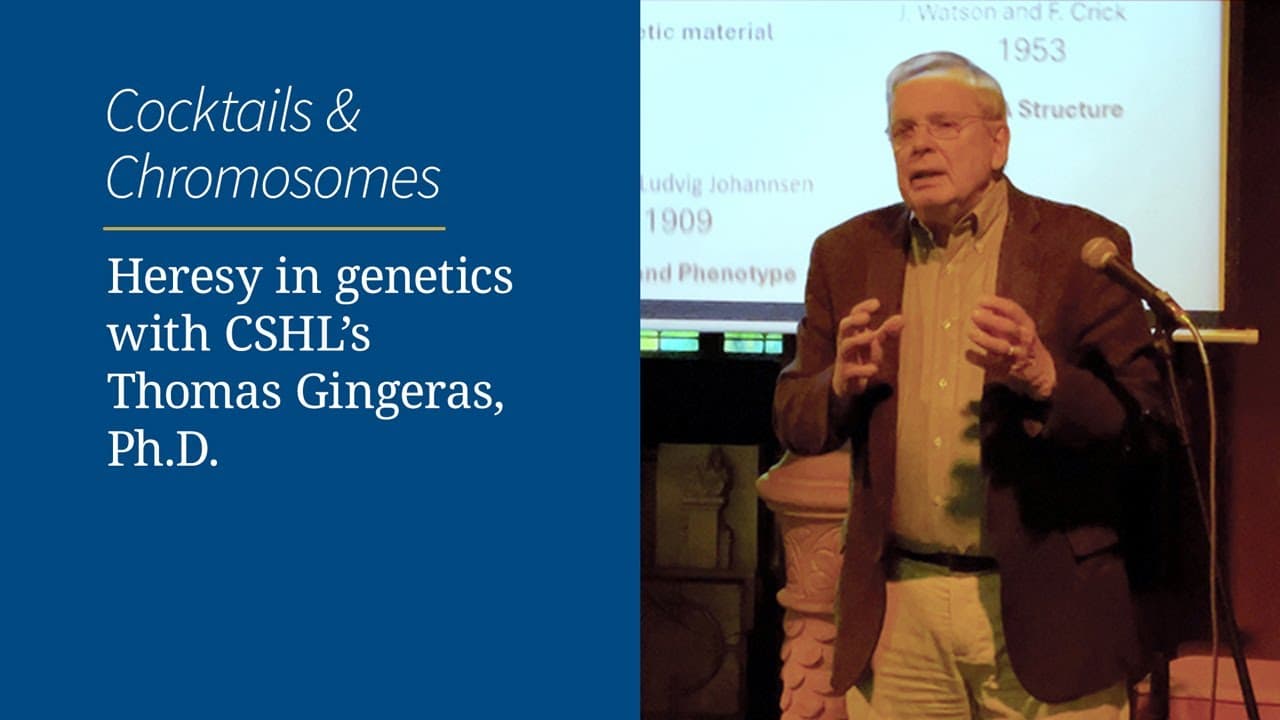
Cocktails & Chromosomes: Heresy in genetics with CSHL's Thomas Gingeras, Ph.D.
TL;DR
The talk challenges traditional gene concepts, highlighting the role of RNA.
Transcript
[music] [applause] Good evening. Good evening, everyone. I want to express my appreciation for you guys coming out tonight. My goal today, tonight is to basically talk a little bit about this slide here. This is a suggestion from my wife, because you can guess who I am in that picture. The idea that we work on the genome as a fundamental unit of in... Read More
Key Insights
- The genome serves as a fundamental unit of information, and understanding its storage and transmission is crucial.
- Historically, the concept of a gene has evolved over 150 years, starting from Miescher's discovery of nuclei material.
- Avery, McCarty, and MacLeod demonstrated that DNA carries transferable genetic information, influencing phenotypes.
- Watson and Crick's DNA structure discovery explained replication and information transfer across generations.
- The traditional view of genes as protein-coding entities is challenged by the discovery of non-coding RNAs.
- Non-coding RNAs, occupying a significant portion of the genome, play crucial regulatory roles in gene expression.
- The complexity of gene regulation involves multiple RNA variants and interactions, influencing cellular traits.
- The controversial idea proposes that RNA, not DNA, might be the primary unit of genetic information in cells.
Install to Summarize YouTube Videos and Get Transcripts
Explore YouTube Video Summarizer or Get YouTube Transcript Extractor
Questions & Answers
Q: What historical milestones contributed to our understanding of genes?
The understanding of genes evolved through several milestones: Miescher's discovery of nuclei material, Avery, McCarty, and MacLeod's demonstration of DNA as genetic material, and Watson and Crick's elucidation of DNA structure. These laid the foundation for understanding genetic information storage, replication, and inheritance.
Q: How did Watson and Crick's discovery impact genetics?
Watson and Crick's discovery of DNA's double helix structure was pivotal. It explained how genetic information is stored and replicated, enabling the transfer of traits across generations. Their work provided a molecular basis for understanding heredity and laid the groundwork for modern genetics.
Q: What role do non-coding RNAs play in genetics?
Non-coding RNAs, which make up a significant portion of the genome, play crucial regulatory roles. They influence gene expression by interacting with protein-coding genes, regulating transcription and translation processes. Their presence challenges the traditional view of genes as solely protein-coding entities.
Q: Why is the discovery of non-coding RNAs significant?
The discovery of non-coding RNAs is significant because it challenges the traditional view that genes are merely protein-coding units. These RNAs regulate gene expression and play critical roles in cellular processes, highlighting the complexity of genetic regulation and expanding our understanding of genomic functions.
Q: What is the proposed controversial idea about genes?
The controversial idea proposed is that RNA, rather than DNA, might be the primary unit of genetic information in cells. This challenges the conventional understanding that DNA is the sole genetic material, emphasizing the importance of RNA in determining cellular functions and phenotypes.
Q: How do non-coding RNAs influence gene expression?
Non-coding RNAs influence gene expression by regulating transcription and translation processes. They interact with protein-coding genes, affecting the levels and timing of gene expression. Their regulatory roles are crucial for cellular functions and highlight the complexity of genetic regulation beyond protein synthesis.
Q: What challenges did the discovery of non-coding RNAs face?
The discovery of non-coding RNAs faced skepticism, as they were initially considered noise in the genome. However, their regulatory roles and abundance in the genome have since been recognized as crucial for gene expression, challenging traditional views and expanding our understanding of genetic complexity.
Q: What implications does the RNA-centric view have for genetics?
The RNA-centric view implies a paradigm shift in genetics, where RNA is considered the primary unit of genetic information. This perspective emphasizes the regulatory roles of RNA in gene expression and cellular functions, challenging the traditional DNA-centric view and expanding our understanding of genomic complexity.
Summary & Key Takeaways
-
The concept of a gene has undergone significant evolution since its inception. Initially, genes were thought to be discrete units responsible for protein production. However, advancements in genetics have revealed the presence of non-coding RNAs, which play crucial regulatory roles in gene expression.
-
Non-coding RNAs, occupying a large portion of the genome, challenge the traditional view of genes as solely protein-coding entities. These RNAs regulate gene expression and influence cellular traits, highlighting the complexity of genetic regulation beyond simple protein synthesis.
-
The talk proposes a controversial idea that RNA, rather than DNA, might be the primary unit of genetic information. This challenges the conventional understanding of genes and emphasizes the importance of RNA in determining cellular functions and phenotypes.
Read in Other Languages (beta)
Share This Summary 📚
Summarize YouTube Videos and Get Video Transcripts with 1-Click
Try YouTube Summary with ChatGPT & Claude or YouTube Transcript Generator
Explore More Summaries from Cold Spring Harbor Laboratory 📚



Summarize YouTube Videos and Get Video Transcripts with 1-Click
Try YouTube Summary with ChatGPT & Claude or YouTube Transcript Generator