Radical expressions with higher roots | Algebra I | Khan Academy
TL;DR
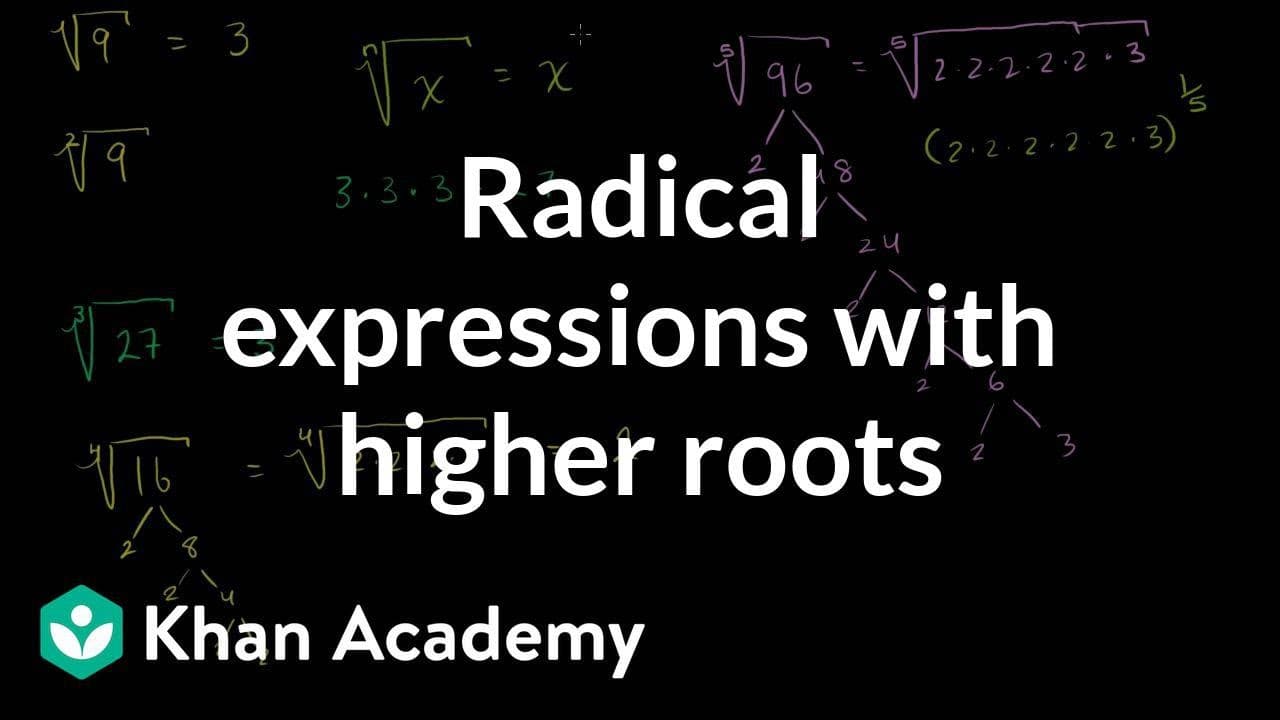
Simplify higher power radicals by factoring the number inside the radical and then rewriting it as a power, or by using exponent properties to simplify the expression.
Transcript
So far, when we were dealing with radicals we've only been using the square root. We've seen that if I write a radical sign like this and put a 9 under it, this means the principal square root of 9, which is positive 3. Or you could view it as the positive square root of 9. Now, what's implicit when we write it like this is that I'm taking the squa... Read More
Key Insights
- 🫚 The radical sign (√) can represent any root, not just the square root.
- ✋ Simplifying higher power radicals involves factoring and reducing exponents.
- 😑 Radical expressions can be written in both power and radical form.
- 😑 Variable expressions can be simplified using the same principles of factoring and reducing exponents.
- ✋ Understanding prime factors is essential for simplifying higher power radicals.
- 😑 Exponent properties, such as adding exponents with the same base, can be used to simplify expressions with variables.
- 🫚 The simplification process may involve fractional exponents or roots, depending on the desired level of simplification.
Install to Summarize YouTube Videos and Get Transcripts
Explore YouTube Video Summarizer or Get YouTube Transcript Extractor
Questions & Answers
Q: What does the radical sign represent, and can it be used for any root?
The radical sign, √, represents a root. It is commonly used for square roots, but it can also be used for any root. For example, the cube root (∛) of a number finds a value that, when cubed, equals the original number.
Q: How can you simplify higher power radicals?
Higher power radicals can be simplified by factoring the number inside the radical and rewriting it as a power of a base. For example, √16 can be simplified as the fourth root (⁴√) of 16, which equals 2.
Q: Can expressions with variables be simplified using higher power radicals?
Yes, expressions with variables can be simplified using higher power radicals. By applying exponent properties, such as adding exponents when the base is the same, you can simplify expressions with variables.
Q: What is the relationship between nth roots and taking a number to the power of 1/n?
Taking the nth root of a number is equivalent to raising that number to the power of 1/n. This relationship allows for simplification by converting between radicals and fractional exponents.
Summary & Key Takeaways
-
Higher power radicals can be simplified by factoring the number inside the radical and rewriting it as a power or by using exponent properties.
-
The radical sign can represent any root, not just the square root. For example, the cube root of 27 is 3.
-
Simplifying higher power radicals involves finding prime factors and reducing exponents.
-
Radical expressions can also be written in fractional or radical form, depending on the desired level of simplification.
Read in Other Languages (beta)
Share This Summary 📚
Summarize YouTube Videos and Get Video Transcripts with 1-Click
Try YouTube Summary with ChatGPT & Claude or YouTube Transcript Generator
Explore More Summaries from Khan Academy 📚



Summarize YouTube Videos and Get Video Transcripts with 1-Click
Try YouTube Summary with ChatGPT & Claude or YouTube Transcript Generator