Inflection points (graphical) | AP Calculus AB | Khan Academy
TL;DR
This video explains how to identify inflection points on a graph by looking at changes in concavity and slope.
Transcript
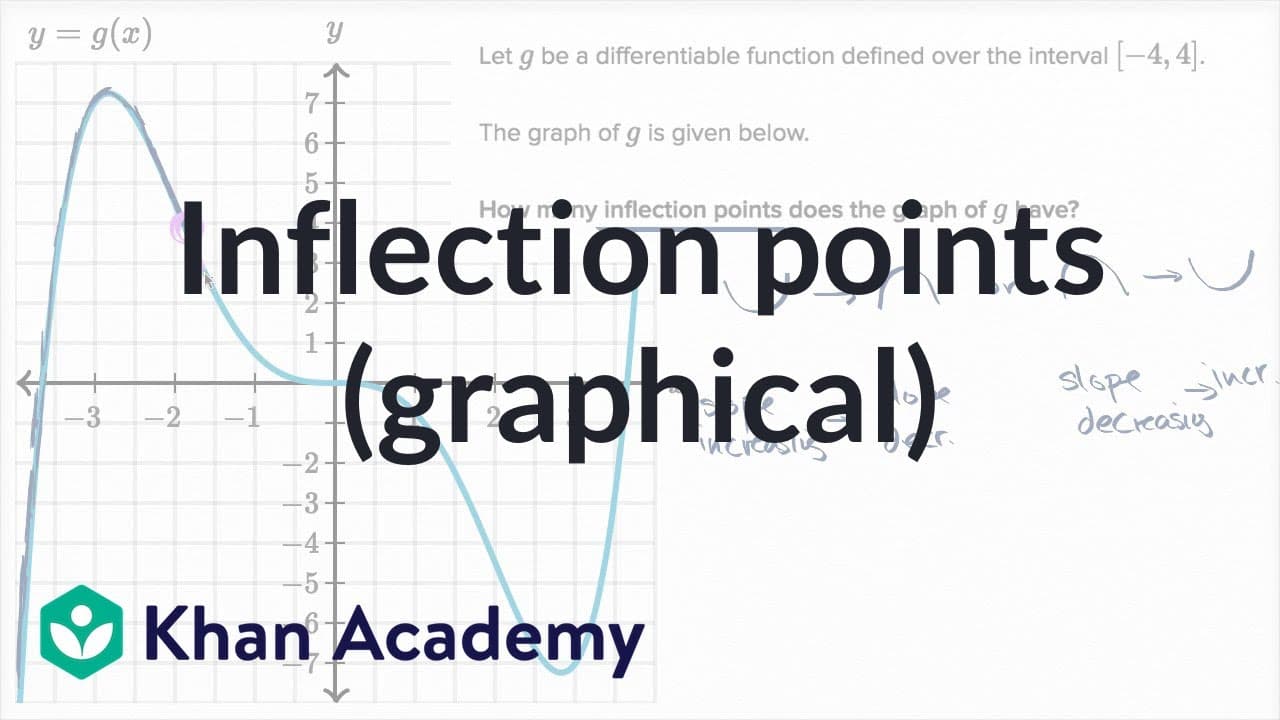
- [Voiceover] We're told let g be a differentiable function defined over the closed interval from negative four to four. The graph of g is given right over here, given below. How many inflection points does the graph of g have? So let's just remind ourselves, what are inflection points? So inflection points are where we change concavity. So we go f... Read More
Key Insights
- 😥 Inflection points occur where the concavity or slope of a graph changes.
- 😥 Inflection points can be identified by observing transitions between concave upwards and concave downwards, or between increasing and decreasing slope.
- 😥 The number of inflection points on a graph can vary.
- 😥 The visibility of inflection points on a graph may depend on the interval shown.
- 😥 Inflection points can provide valuable information about the behavior of a function.
- 😥 Inflection points mark important changes in the curvature of a graph.
- 😥 Understanding inflection points is important in analyzing the behavior and characteristics of functions.
Install to Summarize YouTube Videos and Get Transcripts
Explore YouTube Video Summarizer or Get YouTube Transcript Extractor
Questions & Answers
Q: What are inflection points and how can we identify them on a graph?
Inflection points are locations on a graph where the concavity or slope changes. They can be identified by looking for transitions from concave upwards to concave downwards, or from increasing to decreasing slope, or vice versa.
Q: How can we determine the concavity of a graph at a certain point?
To determine the concavity, we observe the direction in which the graph is curving at the point. If the curve is opening upwards, it is concave upwards, and if it is opening downwards, it is concave downwards.
Q: Can there be multiple inflection points on a graph?
Yes, a graph can have multiple inflection points. These points occur whenever there is a change in the concavity or slope of the graph.
Q: Are inflection points always visible on a graph?
Not necessarily. The visibility of inflection points depends on the interval shown on the graph. There may be more inflection points outside of the visible range.
Summary & Key Takeaways
-
Inflection points occur where a graph transitions from concave upwards to concave downwards or vice versa, or where the slope transitions from increasing to decreasing or vice versa.
-
The graph in the video starts with a steep slope that gradually decreases, reaches zero slope, then becomes negative. At a certain point, the slope starts increasing again.
-
The graph has three inflection points within the visible interval.
Read in Other Languages (beta)
Share This Summary 📚
Summarize YouTube Videos and Get Video Transcripts with 1-Click
Try YouTube Summary with ChatGPT & Claude or YouTube Transcript Generator
Explore More Summaries from Khan Academy 📚



Summarize YouTube Videos and Get Video Transcripts with 1-Click
Try YouTube Summary with ChatGPT & Claude or YouTube Transcript Generator