What if humans went extinct next Friday? | The Gray Area
TL;DR
Exploring humanity's existential crisis and interdependence.
Transcript
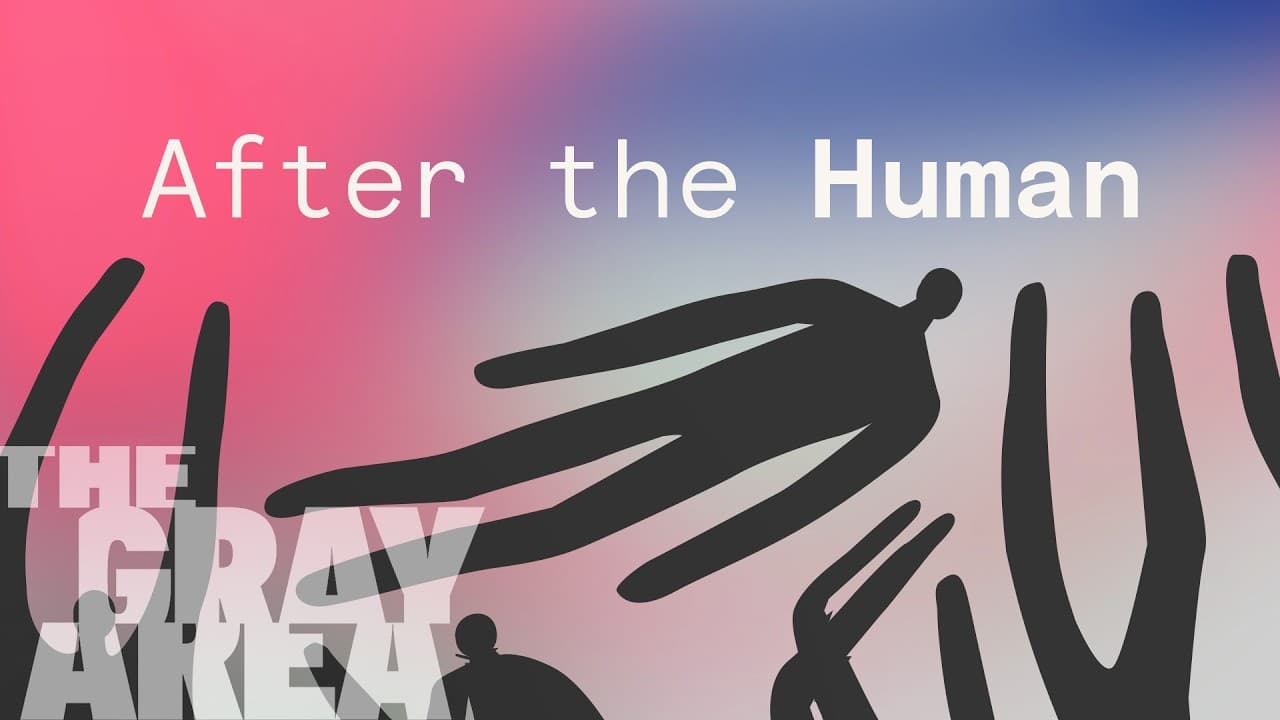
Hey, I'm Sean, host of The Gray Area. For the show this week, I talked to Mark C. Taylor. He's the author of this book right here. It's called After the Human. It's an incredible, ambitious book about the history of modern philosophy and where it went wrong and why we need a new story about ourselves, about our species, and really about our relatio... Read More
Key Insights
- Mark C. Taylor's book 'After the Human' challenges the anthropocentric view of humans as distinct from nature, urging a reconceptualization of human identity as interconnected with the world.
- The discussion highlights the urgent need to address climate change by recognizing the interconnectedness of ecological, technological, and social systems.
- The philosophical roots of modern individualism are traced back to Descartes, whose ideas contributed to the separation of mind and nature, fostering a sense of alienation.
- Taylor argues for a shift from seeing humans as isolated entities to understanding ourselves as part of a dynamic, interdependent web of life.
- The conversation critiques techno-utopianism and the belief in technological salvation, emphasizing the need for a more grounded, relational approach to human existence.
- Taylor stresses the importance of rethinking knowledge, cognition, and intelligence to include alternative forms of consciousness and relationality.
- The dialogue addresses the challenge of translating philosophical insights into practical actions, highlighting the gap between knowledge and behavior in addressing global crises.
- Hope is portrayed as an act of defiance against the prevailing cultural and environmental trajectory, emphasizing the need for collective change to ensure a sustainable future.
Install to Summarize YouTube Videos and Get Transcripts
Explore YouTube Video Summarizer or Get YouTube Transcript Extractor
Questions & Answers
Q: What is the central theme of Mark C. Taylor's book 'After the Human'?
The central theme of 'After the Human' is a philosophical exploration of humanity's existential crisis, challenging the anthropocentric view that separates humans from nature. Taylor advocates for a reconceptualization of human identity, emphasizing our interconnectedness with the world and the need to address ecological, technological, and social crises through a relational perspective.
Q: How does Mark C. Taylor view the impact of Descartes' philosophy on modern individualism?
Mark C. Taylor views Descartes' philosophy as foundational to modern individualism, contributing to the separation of mind and nature. Descartes' idea of 'I think, therefore I am' fostered a sense of alienation by defining human uniqueness in terms of consciousness, leading to an oppositional ontology where humans are seen as distinct from the natural world. This has implications for how we interact with and exploit nature.
Q: What are the dangers of techno-utopianism according to the discussion?
The dangers of techno-utopianism, as discussed, include the belief in technological salvation and the idea that technology can solve all human problems. This perspective is critiqued as an extension of anthropocentric thinking, where humans are seen as separate from nature and capable of transcending mortality. Taylor argues that this mindset overlooks the need for a relational approach to human existence and the ecological crises we face.
Q: How does Taylor propose we address the philosophical problem of modernity?
Taylor proposes addressing the philosophical problem of modernity by shifting from seeing humans as isolated entities to understanding ourselves as part of an interdependent web of life. This involves rethinking knowledge, cognition, and intelligence to include alternative forms of consciousness and relationality. By recognizing our interconnectedness, we can better address global crises and foster a more sustainable future.
Q: What is the significance of hope in the context of the discussion?
Hope is portrayed as an act of defiance against the prevailing cultural and environmental trajectory. Despite the urgent need for change, Taylor emphasizes the importance of maintaining hope as a means to inspire action and address global crises. Hope is seen as essential for motivating collective change and ensuring a sustainable future, even in the face of daunting challenges.
Q: How does the conversation address the gap between knowledge and behavior?
The conversation addresses the gap between knowledge and behavior by highlighting the challenge of translating philosophical insights into practical actions. While the theory of interconnectedness is compelling, the practice of living relationally is more difficult. Taylor critiques the cultural and systemic incentives that reinforce individualism and emphasizes the need for a cultural shift to align behavior with relational understanding.
Q: What role do ideas play in addressing global crises according to Taylor?
According to Taylor, ideas play a crucial role in addressing global crises by providing the framework for understanding and responding to complex challenges. He argues that rethinking our philosophical foundations, particularly our sense of self and our relationship to the world, is essential for developing effective solutions. Ideas matter because they shape our perceptions and actions, influencing how we address ecological, technological, and social issues.
Q: What is the 'network self' concept mentioned in the discussion?
The 'network self' concept refers to the idea of identity and mind as emergent properties of a dynamic, interconnected web of relationships. Instead of viewing the self as a contained, isolated entity, Taylor suggests understanding the mind as extending beyond the individual, shaped by interactions within a vast network. This perspective challenges traditional notions of individuality and emphasizes the importance of relationality in defining human existence.
Summary & Key Takeaways
-
Mark C. Taylor's book 'After the Human' explores humanity's existential crisis, challenging the anthropocentric view and advocating for a reconceptualization of human identity as interconnected with the world.
-
The discussion highlights the philosophical roots of climate change, the dangers of individualism, and the false promise of techno-utopianism, urging a shift from isolated egos to members of an interdependent web.
-
Taylor emphasizes the importance of ideas in addressing global crises, critiquing the gap between knowledge and behavior and advocating for hope as an act of defiance against the current cultural trajectory.
Read in Other Languages (beta)
Share This Summary 📚
Summarize YouTube Videos and Get Video Transcripts with 1-Click
Try YouTube Summary with ChatGPT & Claude or YouTube Transcript Generator
Explore More Summaries from Vox 📚



Summarize YouTube Videos and Get Video Transcripts with 1-Click
Try YouTube Summary with ChatGPT & Claude or YouTube Transcript Generator