How to Calculate Neutral Velocity in Special Relativity
TL;DR
To calculate neutral velocity in special relativity, use the quadratic equation derived from the velocities involved. The relative motion depends on the observer's frame of reference, leading to different interpretations of velocity. Establishing a neutral frame simplifies the understanding of movement between different observers.
Transcript
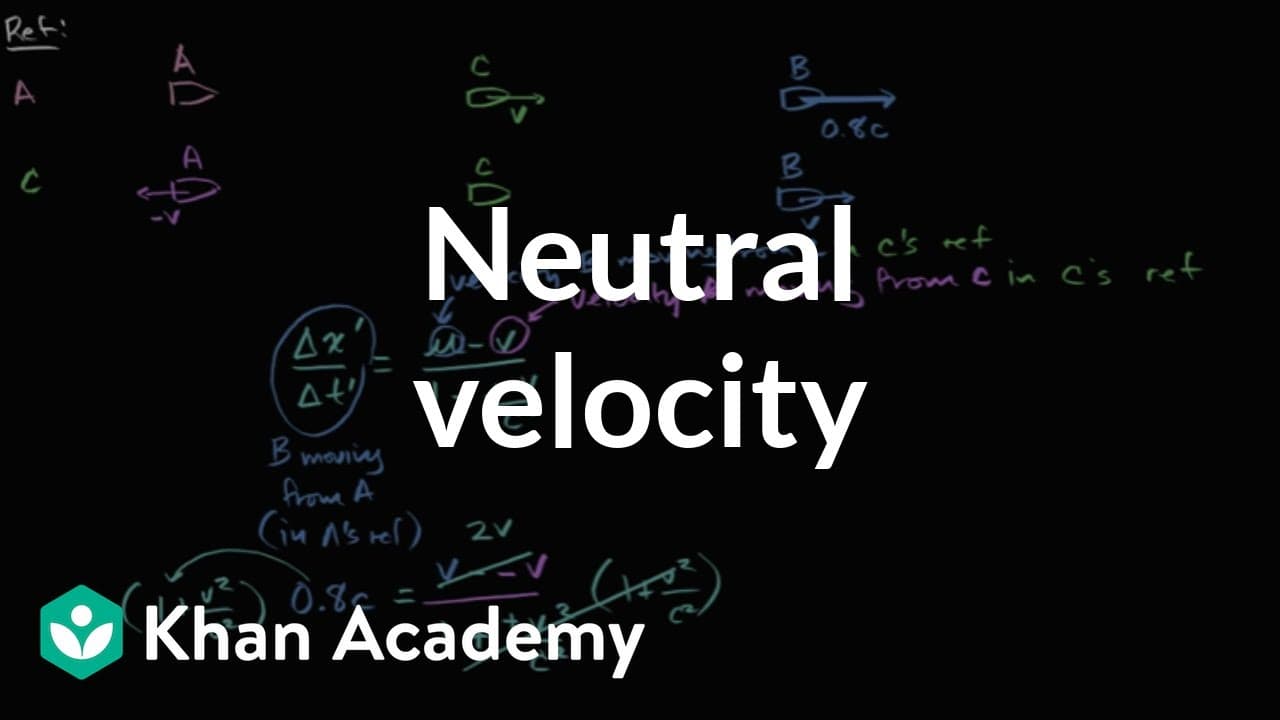
- [Voiceover] Alright, we can now do the math to solve for v. So let me just simplify the right hand side of this equation, v minus negative v. Well, that's just going to be two v. One minus negative of v squared over c squared. Well that's just one plus positive v squared over c squared. And let's see, what can we do next? Well we can multiply, we... Read More
Key Insights
- ❓ The quadratic equation is used to solve for velocity in relativity.
- 🥺 Frames of reference affect the perception of motion and can lead to different measurements of velocity.
- 😐 A neutral frame of reference provides a simplified interpretation of space-time diagrams.
- 🖼️ Motion in relativity is relative to the observer's frame of reference.
- ❓ Different observers may measure different velocities for the same object.
- 🖼️ The perception of motion can change depending on the observer's frame of reference.
- 😑 The manipulation of algebraic expressions is necessary to solve for velocity in relativity.
Install to Summarize YouTube Videos and Get Transcripts
Explore YouTube Video Summarizer or Get YouTube Transcript Extractor
Questions & Answers
Q: How is velocity calculated in relativity?
Velocity in relativity can be calculated using a quadratic equation derived from the manipulation of algebraic expressions. The quadratic formula can then be applied to find the value of velocity (v) in terms of other variables.
Q: What is the significance of frames of reference in relativity?
Frames of reference determine how motion is perceived and can lead to different interpretations of velocity. Different observers in different frames of reference may measure different velocities for the same object.
Q: How does the perception of motion change from different frames of reference?
In relativity, motion is relative, meaning that an object's motion is relative to the observer's frame of reference. The speed and direction of an object may appear different to observers in different frames of reference.
Q: What is the purpose of a neutral frame of reference?
A neutral frame of reference is a frame where two objects are observed to have the same speed but in opposite directions. It simplifies interpretations of space-time diagrams and eliminates the asymmetry presented in other frames of reference.
Summary & Key Takeaways
-
The video explains how to solve for velocity in relativity using a quadratic equation.
-
Frames of reference play a crucial role in how motion is perceived and can lead to different interpretations of velocity.
-
A neutral frame of reference can be used to simplify the interpretation of space-time diagrams.
Read in Other Languages (beta)
Share This Summary 📚
Summarize YouTube Videos and Get Video Transcripts with 1-Click
Try YouTube Summary with ChatGPT & Claude or YouTube Transcript Generator
Explore More Summaries from Khan Academy 📚



Summarize YouTube Videos and Get Video Transcripts with 1-Click
Try YouTube Summary with ChatGPT & Claude or YouTube Transcript Generator