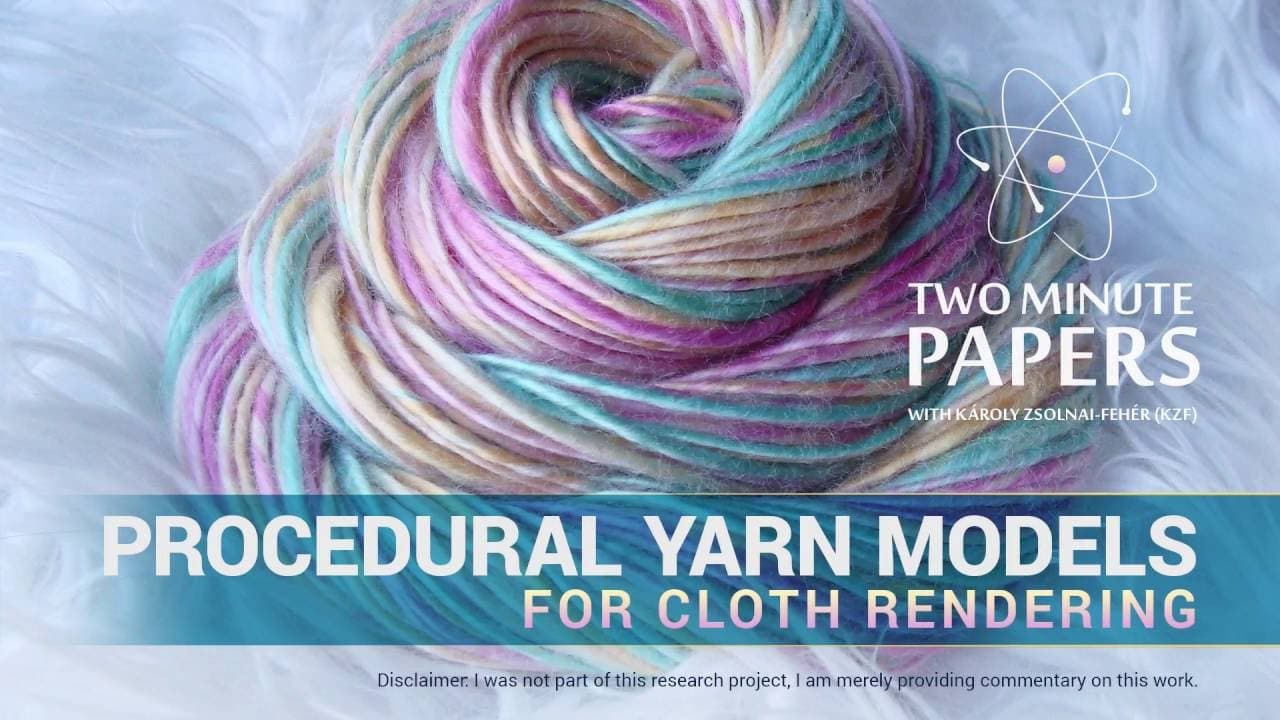
Procedural Yarn Models for Cloth Rendering | Two Minute Papers #76
TL;DR
A procedural algorithm is developed to automatically generate realistic yarn geometry for sewing garments, offering customizable parameters and matching real-world properties.
Transcript
Dear Fellow Scholars, this is Two Minute Papers with Károly Zsolnai-Fehér. Today we're going to talk about a procedural algorithm. But first of all, what does procedural mean? Procedural graphics is an exciting subfield of computer graphics where instead of storing a lot of stuff, information is generated on the fly. For instance, in photorealistic... Read More
Key Insights
- 💁 Procedural graphics generates information on demand, enabling realistic rendering and flexible editing of digital objects.
- 🎮 Certain computer games can generate infinite levels based on logical constraints, providing endless gameplay opportunities.
- 🌍 The paper presents a procedural algorithm for generating yarn geometry, offering customizable parameters and validation against real-world materials.
- 👻 The integration of procedural techniques with physical properties allows for the creation of realistic-looking yarn geometry for sewing garments.
- 🌍 The algorithm's results are compared to photographs and CT scans, ensuring its accuracy in simulating real-world materials.
- 💄 The combination of mathematics and visually appealing results makes the paper engaging and informative.
- 💬 The respectful and scholarly conversations in the comments section highlight the building of a community of Fellow Scholars.
Install to Summarize YouTube Videos and Get Transcripts
Explore YouTube Video Summarizer or Get YouTube Transcript Extractor
Questions & Answers
Q: What is procedural graphics and how does it differ from traditional graphics?
Procedural graphics generates information on the fly, whereas traditional graphics store pre-defined data. This allows for flexibility and customization in rendering digital objects.
Q: What are some applications of procedural graphics?
Procedural graphics can be used in photorealistic rendering to simulate real-life objects, generate natural environments like cloudy skies, and create computer game levels that are generated on the fly.
Q: How does the algorithm in this paper generate procedural yarn geometry?
The algorithm matches physical properties of real yarns, such as twisting and hairiness, with procedural techniques. It allows for customizable parameters to generate realistic-looking yarn geometry for sewing garments.
Q: How are the solutions in this paper validated?
The solutions are validated against photographs and even CT scans to ensure that the procedural yarn geometry closely resembles real-world materials.
Summary & Key Takeaways
-
Procedural graphics generates information on the fly instead of storing it, allowing for realistic rendering and flexible editing.
-
Computer games can generate infinite levels on the fly based on logical constraints.
-
The paper proposes a procedural algorithm for generating yarn geometry, offering customizable parameters and validation against real-world materials.
Read in Other Languages (beta)
Share This Summary 📚
Summarize YouTube Videos and Get Video Transcripts with 1-Click
Try YouTube Summary with ChatGPT & Claude or YouTube Transcript Generator
Explore More Summaries from Two Minute Papers 📚

Summarize YouTube Videos and Get Video Transcripts with 1-Click
Try YouTube Summary with ChatGPT & Claude or YouTube Transcript Generator