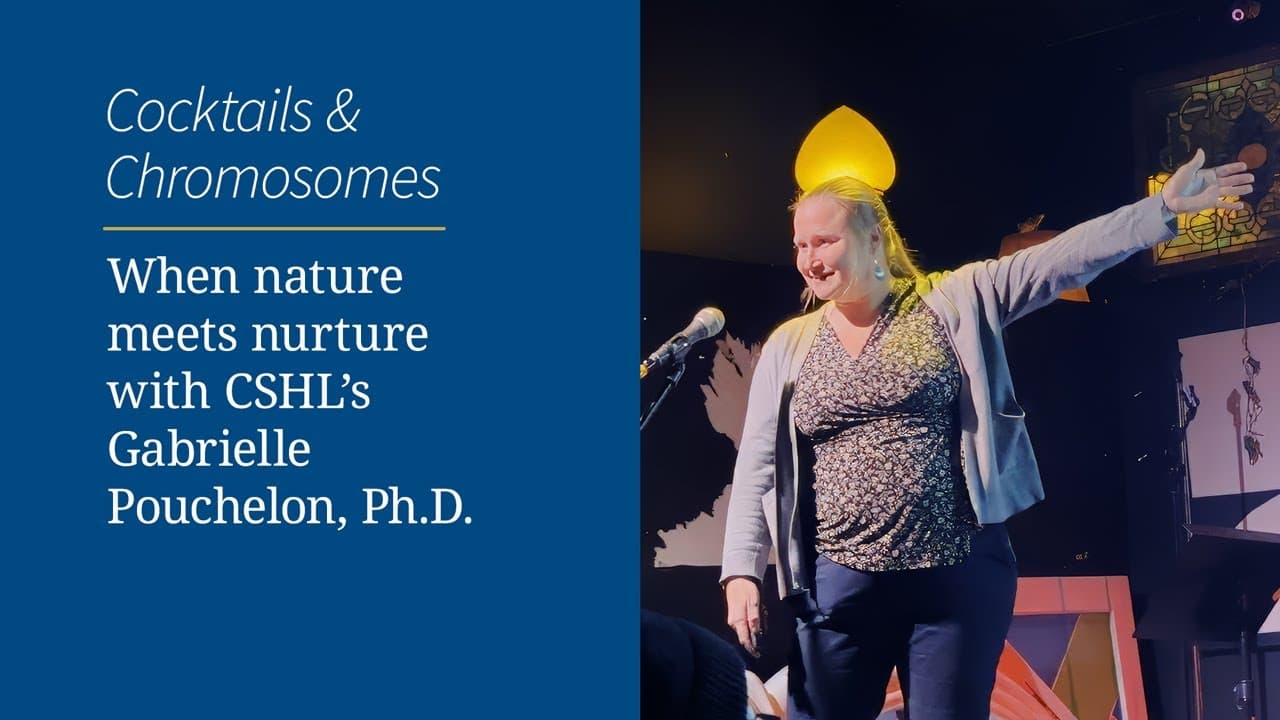
Cocktails & Chromosomes: Where nature meets nurture, with CSHL's Gabrielle Pouchelon, Ph.D.
TL;DR
Explores how nature and nurture influence neurodevelopment.
Transcript
[music] [applause] Well, thank you for the introduction. I was planning, you'll see, next slide to introduce myself. So, great. I can be shorter and talk about more of the science. So as said, I’m Gabrielle Pouchelon, working on brain development. And, here I said, when nature meets nurture, which is basically the focus of what we do when we study ... Read More
Key Insights
- Gabrielle Pouchelon discusses the interplay between genetic predispositions (nature) and environmental influences (nurture) in brain development, emphasizing their roles in shaping neurodevelopmental outcomes.
- Pouchelon's journey from Paris to Cold Spring Harbor highlights her diverse educational and professional background, contributing to her expertise in neuroscience.
- Art and creativity, influenced by her father's paintings, play a significant role in Pouchelon's interest in brain development, illustrating how personal experiences can shape scientific pursuits.
- The complexity of the brain, with billions of neurons forming trillions of connections, makes it challenging to study, necessitating detailed research to understand behavior and neurodevelopmental disorders.
- Neurodevelopmental disorders like autism involve subtle differences in brain function rather than obvious morphological defects, highlighting the complexity of diagnosing and understanding these conditions.
- Critical periods of plasticity in brain development allow for significant learning and adaptation, but also pose vulnerabilities, emphasizing the importance of early experiences in shaping behavior.
- Pouchelon uses mouse models to study the detailed processes of neurodevelopment, focusing on how sensory inputs and genetic factors influence brain circuits and connections.
- The talk concludes with a disclaimer that Pouchelon's work is fundamental neuroscience research, not clinical practice, underscoring the importance of basic science in understanding complex brain functions.
Install to Summarize YouTube Videos and Get Transcripts
Explore YouTube Video Summarizer or Get YouTube Transcript Extractor
Questions & Answers
Q: What is the main focus of Gabrielle Pouchelon's research?
Gabrielle Pouchelon's research focuses on the interplay between genetic predispositions and environmental influences in brain development. She studies how these factors shape neurodevelopmental outcomes, particularly in the context of neurodevelopmental disorders like autism. Her work involves using mouse models to investigate how sensory inputs and genetic factors influence brain circuits and connections.
Q: How does Pouchelon's personal background influence her scientific interests?
Gabrielle Pouchelon's personal background, particularly her creative upbringing influenced by her father's paintings, plays a significant role in shaping her interest in brain development. Growing up in a creative environment sparked her fascination with how art and creativity originate in the brain, leading her to explore the intricate processes of neurodevelopment in her scientific research.
Q: What challenges are associated with studying the brain?
Studying the brain presents significant challenges due to its complexity, with billions of neurons forming trillions of connections. This complexity makes it difficult to map and understand the networks that underlie behavior and neurodevelopmental disorders. Additionally, the brain's protective skull makes it challenging to access, requiring detailed research and advanced tools to study its functions and development.
Q: How are neurodevelopmental disorders like autism characterized?
Neurodevelopmental disorders like autism are characterized by subtle differences in brain function rather than obvious morphological defects. While there is a genetic component, the manifestation of such disorders can vary greatly, making it challenging to categorize and diagnose. Current methods rely heavily on behavioral criteria, as there are no genetic screenings or imaging techniques that can definitively diagnose these conditions.
Q: What are critical periods of plasticity in brain development?
Critical periods of plasticity in brain development are times when the brain is highly flexible and responsive to environmental inputs and experiences. During these periods, significant learning and adaptation occur, shaping behavior and cognitive functions. These periods also pose vulnerabilities, as the brain is more susceptible to external influences, emphasizing the importance of early experiences in development.
Q: How does Pouchelon use mouse models in her research?
Gabrielle Pouchelon uses mouse models to study the detailed processes of neurodevelopment. By examining the mouse's whisker system, she investigates how sensory inputs and genetic factors influence brain circuits and connections. This model allows her to explore the critical periods of plasticity and the formation of neural networks, providing insights into the fundamental processes of brain development.
Q: Why is Pouchelon's work considered fundamental neuroscience?
Gabrielle Pouchelon's work is considered fundamental neuroscience because it focuses on understanding the basic processes of brain development and neurodevelopmental disorders at a detailed level. Her research aims to uncover the underlying mechanisms of how genetic and environmental factors shape the brain, providing foundational knowledge that can inform future clinical applications and treatments.
Q: What is the significance of Pouchelon's findings on neurodevelopment?
Gabrielle Pouchelon's findings on neurodevelopment are significant because they highlight the complex interplay between nature and nurture in shaping brain functions and behavior. By elucidating the processes of neural circuit formation and plasticity, her research provides valuable insights into the development of neurodevelopmental disorders, offering potential pathways for early diagnosis and intervention strategies.
Summary & Key Takeaways
-
Gabrielle Pouchelon explores the intricate balance between genetic factors and environmental influences in brain development, focusing on how these elements shape neurodevelopmental outcomes. Her personal journey and creative background underscore her interest in neuroscience, emphasizing the role of personal experiences in scientific discovery.
-
The talk highlights the complexity of the brain, with its billions of neurons and trillions of connections, making it challenging to study. Pouchelon discusses neurodevelopmental disorders like autism, which involve subtle functional differences, illustrating the need for detailed research to understand these conditions.
-
Pouchelon emphasizes the importance of critical periods of plasticity in brain development, where significant learning and adaptation occur. Using mouse models, she studies how sensory inputs and genetic factors influence brain circuits, providing insights into the fundamental processes of neurodevelopment.
Read in Other Languages (beta)
Share This Summary 📚
Summarize YouTube Videos and Get Video Transcripts with 1-Click
Try YouTube Summary with ChatGPT & Claude or YouTube Transcript Generator
Explore More Summaries from Cold Spring Harbor Laboratory 📚


Summarize YouTube Videos and Get Video Transcripts with 1-Click
Try YouTube Summary with ChatGPT & Claude or YouTube Transcript Generator