Maximum Number of Orders Available with Grating
TL;DR
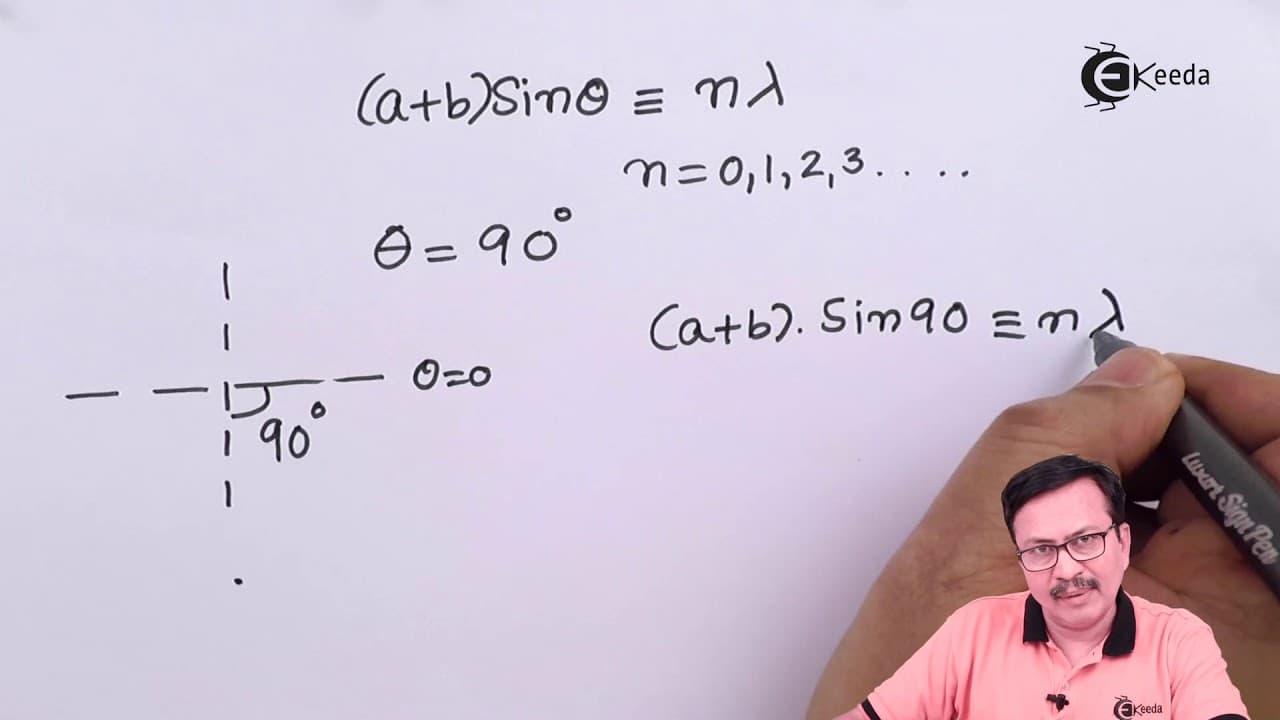
The video explains the conditions and calculations for the maximum order of diffraction in a grating, as well as the concept of the grating element.
Transcript
click the bell icon to get latest videos from equator hello friends in this video we are going to derive the condition for the maximum number of orders that are available in a grading the grading equation is a plus B into sine of theta is equal to n-lambda wherein n is equal to 0 1 2 3 so on and so forth lambda is the wave length that is inserted o... Read More
Key Insights
- 🆎 The maximum order of diffraction in a grating can be calculated using the formula n = (a + B) / λ, where a and B are distances in the grating and λ is the wavelength.
- 🪈 The maximum order is observable when the angle of diffraction is 90 degrees.
- 🍹 The grating element, denoted as D, is equal to the sum of distances a and B.
- 🥳 The maximum order can be calculated using the ratio of the grating element to the wavelength.
Install to Summarize YouTube Videos and Get Transcripts
Explore YouTube Video Summarizer or Get YouTube Transcript Extractor
Questions & Answers
Q: What is the formula for the maximum order of diffraction in a grating?
The formula is n = (a + B) / λ, where a and B are distances in the grating and λ is the wavelength.
Q: When does the maximum order of diffraction occur?
The maximum order occurs when the angle of diffraction (θ) is 90 degrees.
Q: What is the grating element?
The grating element, denoted as D, is equal to the sum of distances a and B in the grating.
Q: How can the maximum order of diffraction be calculated using the grating element?
By using the formula n = D / λ, where D is the grating element and λ is the wavelength.
Summary & Key Takeaways
-
The video discusses the formula for the maximum order of diffraction in a grating, which is given by n = (a + B) / λ, where a and B are distances in the grating and λ is the wavelength.
-
The maximum order of diffraction occurs when the angle of diffraction (θ) is 90 degrees.
-
The grating element, denoted as D, is equal to (a + B), and can be used to calculate the maximum order of diffraction.
Read in Other Languages (beta)
Share This Summary 📚
Summarize YouTube Videos and Get Video Transcripts with 1-Click
Try YouTube Summary with ChatGPT & Claude or YouTube Transcript Generator
Explore More Summaries from Ekeeda 📚



Summarize YouTube Videos and Get Video Transcripts with 1-Click
Try YouTube Summary with ChatGPT & Claude or YouTube Transcript Generator