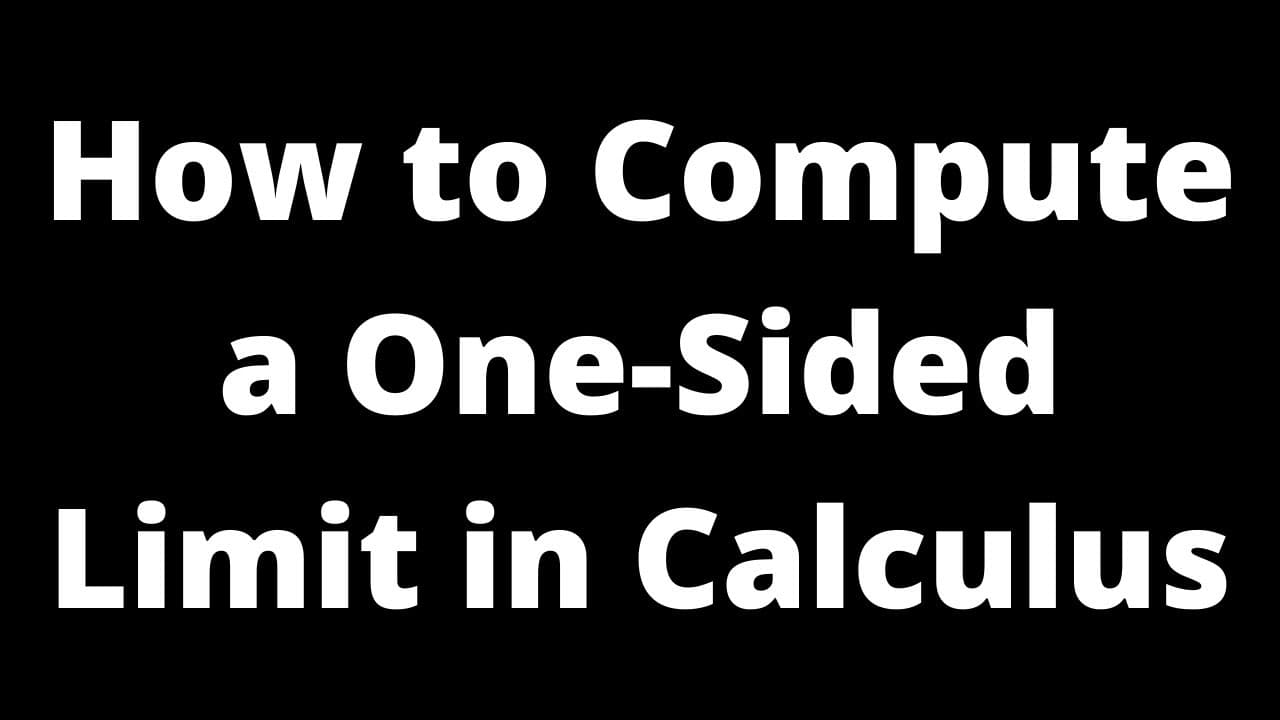
How to Compute a One Sided Limit in Calculus
TL;DR
Explaining how to approach a limit as x approaches 1 from the left resulting in negative infinity.
Transcript
so limit as X approaches 1 from the left of 1 over X minus 1 I don't know what the answer is I haven't thought about it but you could put it in your calculator and graph it and try to get the answer if you plug in 1 it fails right because you get 1 over 0 right you get 1 over 0 so it doesn't work so how do you do it so let's see it's a solution to ... Read More
Key Insights
- ☺️ Understanding limits involves approaching a specific x-value to determine the behavior of a function.
- 😚 Visualizing the fraction's behavior with numbers closer to the limiting value enhances comprehension.
- ♾️ As the denominator approaches zero in a fraction, the magnitude of the fraction tends towards infinity.
- ⛔ Different approach directions influence how a limit is evaluated in calculus.
- ⛔ Limits are crucial in analyzing mathematical functions with precision and accuracy.
- 💁 The concept of limits forms the basis for derivatives and continuity in calculus.
- 😥 Analyzing limits provides insights into the behavior of functions near specific points.
Install to Summarize YouTube Videos and Get Transcripts
Explore YouTube Video Summarizer or Get YouTube Transcript Extractor
Questions & Answers
Q: How do you approach a limit as x approaches 1 from the left in calculus?
To approach a limit as x approaches 1 from the left, you can plug in a number slightly smaller than 1, like 0.99, and analyze the behavior of the fraction as the denominator gets closer to zero.
Q: Why does the fraction tend towards negative infinity in this case?
The fraction tends towards negative infinity because when you have a positive number divided by a very small negative number, the resulting fraction becomes very large in magnitude, indicating negative infinity as the limit.
Q: How does the concept of limits play a crucial role in calculus?
Limits are fundamental in analyzing functions, continuity, and derivatives in calculus. They provide insights into behavior and trends of functions close to certain values, enabling precise mathematical analysis.
Q: Can limits have different behaviors based on the approach direction?
Yes, limits can exhibit different behaviors depending on whether the approach is from the left or right. This distinction is essential in understanding the continuity and characteristics of functions in calculus.
Summary & Key Takeaways
-
Explains how to approach limits as x approaches 1 in calculus.
-
Uses visualization and number examples to understand the concept better.
-
Demonstrates that as the denominator approaches zero, the fraction tends towards negative infinity.
Read in Other Languages (beta)
Share This Summary 📚
Summarize YouTube Videos and Get Video Transcripts with 1-Click
Try YouTube Summary with ChatGPT & Claude or YouTube Transcript Generator
Explore More Summaries from The Math Sorcerer 📚



Summarize YouTube Videos and Get Video Transcripts with 1-Click
Try YouTube Summary with ChatGPT & Claude or YouTube Transcript Generator