Socially efficient and inefficient outcomes
TL;DR
Understanding how market equilibrium, negative and positive externalities, and deadweight loss can impact society's benefits and costs.
Transcript
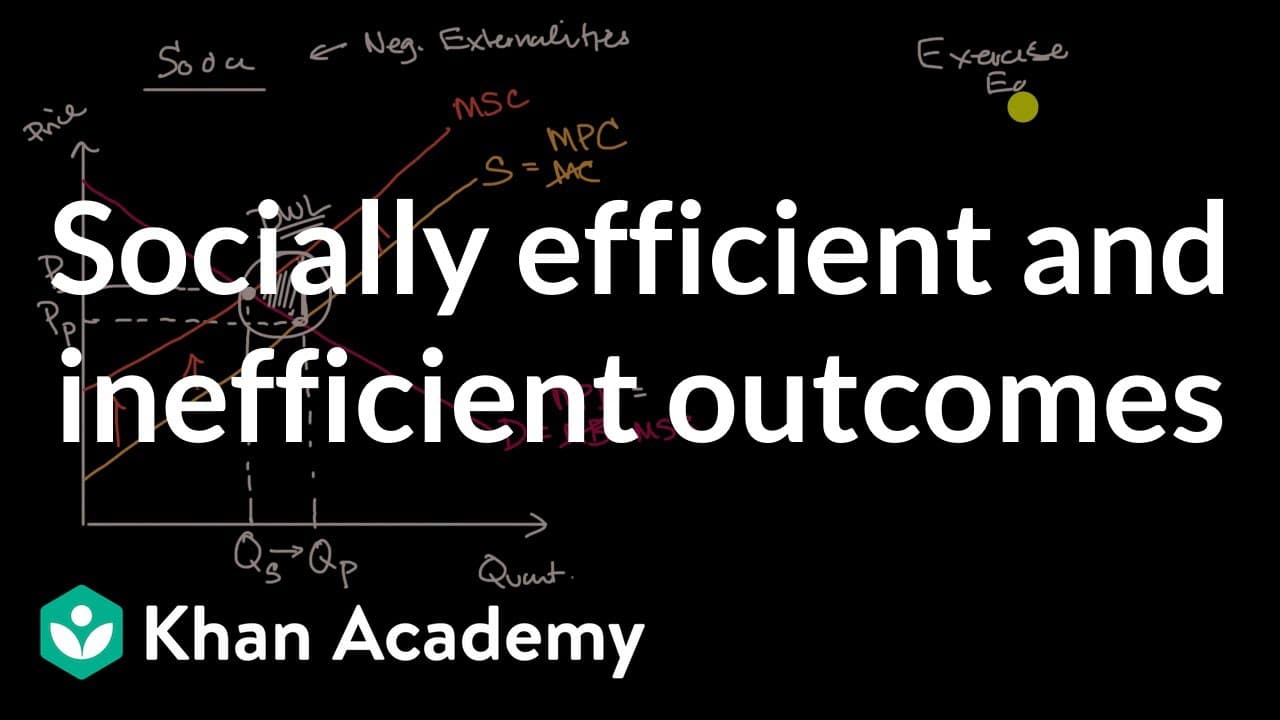
- [Sal] Let's study the market for soda a little bit. And so, we're going to draw our traditional axes, so that is price, and that is quantity. And we have seen our classic supply and demand curves. So, this could be our upward-sloping supply curve at a low price. Not a lotta people wanna produce soda, but as price goes higher, more and more people... Read More
Key Insights
- 🔒 Market equilibrium is determined by the intersection of supply and demand curves, resulting in an optimal price and quantity in a private market.
- 🥺 Negative externalities, such as pollution or health issues, increase the marginal social cost and can lead to overproduction from a societal perspective.
- 🧑⚕️ Positive externalities, like improved health from exercise equipment, increase the marginal social benefit and can result in underproduction in the private market.
- 🌸 Deadweight loss occurs when the private market equilibrium does not align with the optimal societal outcome.
Install to Summarize YouTube Videos and Get Transcripts
Explore YouTube Video Summarizer or Get YouTube Transcript Extractor
Questions & Answers
Q: What are the key factors that determine market equilibrium?
Market equilibrium is determined by the intersection of supply and demand curves, where quantity supplied equals quantity demanded and price balances the buying power of consumers and the willingness of producers to supply goods or services.
Q: How does adding negative externalities affect market equilibrium?
Negative externalities, like pollution or health issues associated with soda consumption, increase the marginal social cost. This leads to a higher optimal price and a lower optimal quantity from a societal perspective, creating deadweight loss when compared to the private market equilibrium.
Q: What are positive externalities and how do they impact market equilibrium?
Positive externalities, such as exercise equipment benefiting people's health and lowering healthcare costs, increase the marginal social benefit. This results in a lower optimal price and a higher optimal quantity, creating deadweight loss if the private market equilibrium doesn't account for these externalities.
Q: How can society rectify deadweight loss caused by externalities?
Society can rectify deadweight loss caused by externalities through government interventions like taxes or subsidies. Taxing activities with negative externalities and subsidizing activities with positive externalities can align private market equilibrium with the optimal societal outcome.
Summary & Key Takeaways
-
The video explains the concept of market equilibrium using supply and demand curves for soda as an example.
-
It introduces the idea of marginal private benefit and cost and the equilibrium price and quantity based on these factors.
-
The video then introduces negative externalities, such as pollution and health issues from soda consumption, and positive externalities, like exercise equipment improving people's health and lowering healthcare costs.
-
It shows how adding externalities to the private benefits and costs leads to marginal social cost and benefit curves.
-
From a societal perspective, optimal prices and quantities are where marginal social cost equals marginal social benefit, but the private market equilibrium often differs, resulting in deadweight loss.
Read in Other Languages (beta)
Share This Summary 📚
Summarize YouTube Videos and Get Video Transcripts with 1-Click
Try YouTube Summary with ChatGPT & Claude or YouTube Transcript Generator
Explore More Summaries from Khan Academy 📚



Summarize YouTube Videos and Get Video Transcripts with 1-Click
Try YouTube Summary with ChatGPT & Claude or YouTube Transcript Generator