What Is the Hagen-Poiseuille Equation for Laminar Flow?
TL;DR
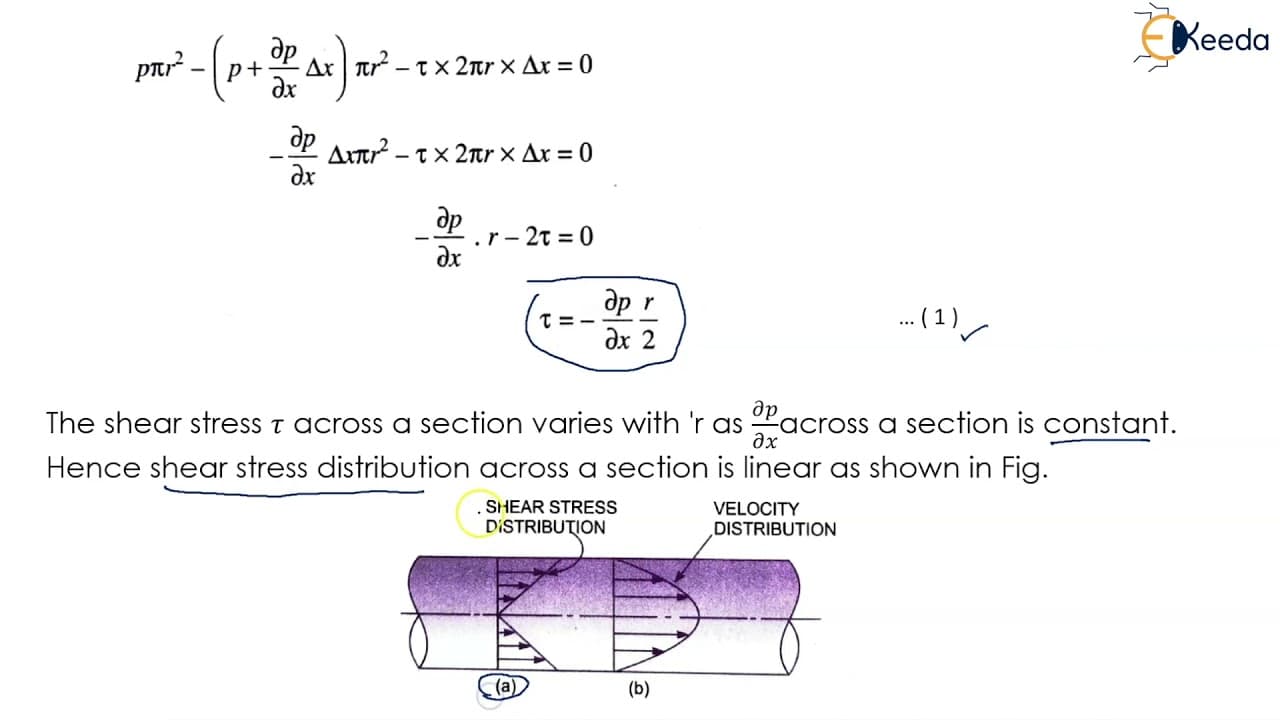
The Hagen-Poiseuille equation describes laminar flow in circular pipes, highlighting that the velocity distribution is parabolic and the ratio of maximum to average velocity is 2. This equation applies when the Reynolds number is less than 2000 and is essential for calculating pressure drop in viscous fluid flow, expressed as hf = (32μUL)/(ρgd²).
Transcript
hello students let's start with a new topic from the chapter fluid dynamics that is equation to viscous laminar flow the derivation of hagen possibly equation for the laminar flow in straight circular pipes is based on the following two assumptions a viscous property of fluid which follows newton's law of viscosity that is tau is equal to mu d u up... Read More
Key Insights
- 💋 The Hagen-Poiseuille equation is derived based on assumptions of Newton's law of viscosity and no slip at solid boundaries.
- 💦 The equation describes the velocity distribution, shear stress distribution, and pressure drop in laminar flow through circular pipes.
- 💐 Laminar flow occurs when the Reynolds number (Re) is less than 2000.
- 💐 The velocity distribution in laminar flow follows a parabolic pattern.
- 🥳 The ratio of maximum velocity to average velocity in laminar flow is 2.
- 💦 The Hagen-Poiseuille formula is commonly used to calculate pressure drop in pipes.
- ✋ The formula can be written as hf = (32𝜇UL)/(𝜌gd^2), where hf is the pressure loss, 𝜇 is the viscosity, U is the average velocity, L is the pipe length, 𝜌 is the fluid density, g is the acceleration due to gravity, and d is the pipe diameter.
Install to Summarize YouTube Videos and Get Transcripts
Explore YouTube Video Summarizer or Get YouTube Transcript Extractor
Questions & Answers
Q: What are the two assumptions on which the derivation of the Hagen-Poiseuille equation is based?
The two assumptions are: 1) The fluid follows Newton's law of viscosity (𝜏 = 𝜇(du/dy)), and 2) There is no relative motion between fluid particles and solid boundaries (no slip).
Q: How is the velocity distribution across a section described in laminar flow?
The velocity distribution in laminar flow is of a parabolic nature, as described by the Hagen-Poiseuille equation (u = (1/4𝜇)(𝛿P/𝛿x)(r^2 - R^2)).
Q: What is the ratio of maximum velocity to average velocity in laminar flow?
The ratio of maximum velocity (UMax) to average velocity (UBar) in laminar flow is 2.
Q: What is the Hagen-Poiseuille formula used for?
The Hagen-Poiseuille formula (also known as the Hagen-Poiseuille equation) is used to calculate the drop of pressure (pressure loss) in a pipe for a given length of flow.
Summary & Key Takeaways
-
The Hagen-Poiseuille equation is derived based on two assumptions: the fluid follows Newton's law of viscosity, and there is no relative motion between fluid particles and solid boundaries.
-
The equation takes into account the velocity distribution, shear stress distribution, and pressure drop for viscous flow through circular pipes.
-
The Hagen-Poiseuille equation is applicable when the Reynolds number (Re) is less than 2000, indicating laminar flow.
Read in Other Languages (beta)
Share This Summary 📚
Summarize YouTube Videos and Get Video Transcripts with 1-Click
Try YouTube Summary with ChatGPT & Claude or YouTube Transcript Generator
Explore More Summaries from Ekeeda 📚




Summarize YouTube Videos and Get Video Transcripts with 1-Click
Try YouTube Summary with ChatGPT & Claude or YouTube Transcript Generator