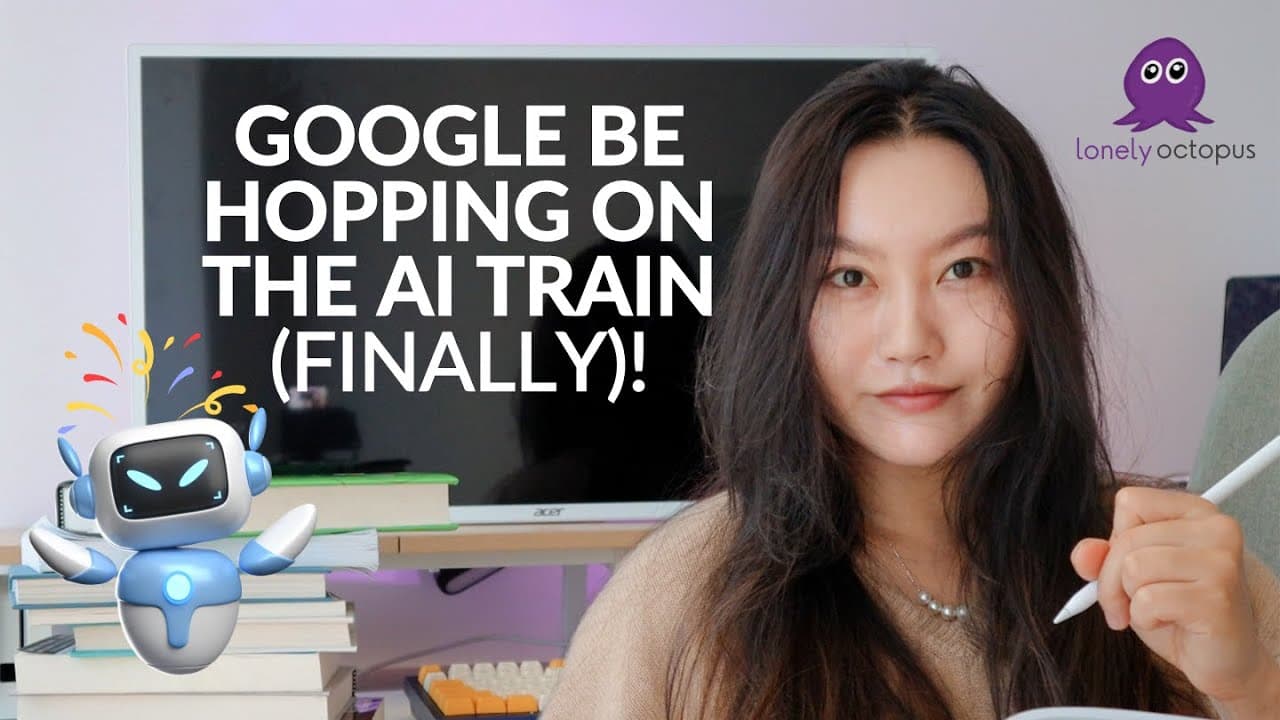
🐙 Lunch & Learn: Google Be Hopping On The AI Agents Train (finally)!
TL;DR
Google introduces AI agents to enhance productivity and creativity.
Transcript
H I don't know if anybody could hear me hello everyone I am sorry I'm late I apologize I ordered food so I'm going to eat stuff in a bit hi and this is Inky for anybody who hasn't met Inky before can say hi to him okay ink he will just hang out on the stool here doing Inky stuff yay how's everyone doing Aloha everyone hello thanks for joining every... Read More
Key Insights
- Google's AI agents aim to improve productivity by integrating with existing Google tools like Calendar and Maps, offering a seamless experience.
- The introduction of AI agents is part of Google's strategy to differentiate from competitors like OpenAI by leveraging its extensive suite of products.
- Google's AI agents are designed to automate tasks, from booking appointments to managing business operations, reducing reliance on human intervention.
- The creative agent can streamline content creation for marketing teams, offering tools to generate images, videos, and campaigns efficiently.
- Despite the potential, Google's AI agents face skepticism regarding their ability to meet expectations, with concerns about accuracy and innovation.
- The implementation of AI agents in customer service could lead to more personalized and efficient interactions, though it raises concerns about consumer privacy.
- Google's focus on enterprise solutions highlights its shift towards B2B services, aiming to integrate AI across various business functions.
- The current AI agent platform requires technical knowledge to implement, which may limit its accessibility to non-technical users.
Install to Summarize YouTube Videos and Get Transcripts
Explore YouTube Video Summarizer or Get YouTube Transcript Extractor
Questions & Answers
Q: What is the primary goal of Google's AI agents?
The primary goal of Google's AI agents is to enhance productivity and streamline operations by integrating with Google's existing suite of products. These agents are designed to automate tasks such as booking appointments, managing business operations, and assisting with content creation, thereby reducing reliance on human intervention.
Q: How do Google's AI agents differentiate from competitors like OpenAI?
Google's AI agents differentiate from competitors like OpenAI by leveraging the extensive suite of Google products, offering a more integrated and seamless user experience. By focusing on enterprise solutions and integrating AI across various business functions, Google aims to provide a comprehensive B2B service that capitalizes on its existing ecosystem.
Q: What are the potential benefits of the creative agent for marketing teams?
The creative agent offers significant benefits for marketing teams by streamlining the content creation process. It provides tools to generate images, videos, and campaigns efficiently, reducing the time and effort required for traditional methods. This can lead to more dynamic and personalized marketing strategies, enhancing engagement with target audiences.
Q: What concerns have been raised about Google's AI agents?
Concerns about Google's AI agents include skepticism regarding their ability to meet expectations, particularly in terms of accuracy and innovation. Additionally, the implementation of AI agents in customer service raises privacy concerns, as personalized interactions could involve handling sensitive consumer data. The platform's complexity also poses challenges for non-technical users.
Q: How does Google's focus on enterprise solutions impact its AI strategy?
Google's focus on enterprise solutions reflects a strategic shift towards B2B services, aiming to integrate AI across various business functions. By targeting businesses, Google seeks to provide comprehensive solutions that enhance productivity and efficiency, positioning itself as a leader in the enterprise AI market. This focus also aligns with its goal to differentiate from consumer-focused competitors.
Q: What technical requirements are needed to implement Google's AI agents?
Implementing Google's AI agents requires technical knowledge, particularly in understanding APIs and schemas. Users need to define schemas for tools and agents, which may involve coding skills. This complexity could limit the platform's accessibility to non-technical users, posing a challenge for widespread adoption outside technical teams.
Q: What role does multimodality play in Google's AI agents?
Multimodality is a key feature of Google's AI agents, allowing them to understand and process information across various formats, such as text, audio, and video. This capability enables agents to perform complex reasoning tasks and integrate data from multiple sources, enhancing their functionality and providing more comprehensive solutions for users.
Q: How might Google's AI agents impact customer service interactions?
Google's AI agents have the potential to transform customer service interactions by providing more personalized and efficient support. By automating routine tasks and leveraging Google's search capabilities, agents can offer timely and relevant assistance. However, this shift also raises concerns about consumer privacy and the need for robust data protection measures.
Summary & Key Takeaways
-
Google's AI agents are designed to enhance productivity by integrating with its suite of products, offering seamless task automation. The agents aim to differentiate Google from competitors by leveraging its extensive product ecosystem. However, the platform's complexity may limit accessibility for non-technical users.
-
The introduction of creative agents aims to revolutionize content creation, enabling marketing teams to generate campaigns efficiently. Despite the potential, Google's AI agents face skepticism regarding their ability to meet expectations, with concerns about accuracy and innovation.
-
Google's focus on enterprise solutions highlights its shift towards B2B services, aiming to integrate AI across various business functions. The implementation of AI agents in customer service could lead to more personalized interactions, though it raises concerns about consumer privacy.
Read in Other Languages (beta)
Share This Summary 📚
Summarize YouTube Videos and Get Video Transcripts with 1-Click
Try YouTube Summary with ChatGPT & Claude or YouTube Transcript Generator
Explore More Summaries from Tina Huang 📚





Summarize YouTube Videos and Get Video Transcripts with 1-Click
Try YouTube Summary with ChatGPT & Claude or YouTube Transcript Generator