What Is the Transformer Model and Its Advantages Over RNNs?
TL;DR
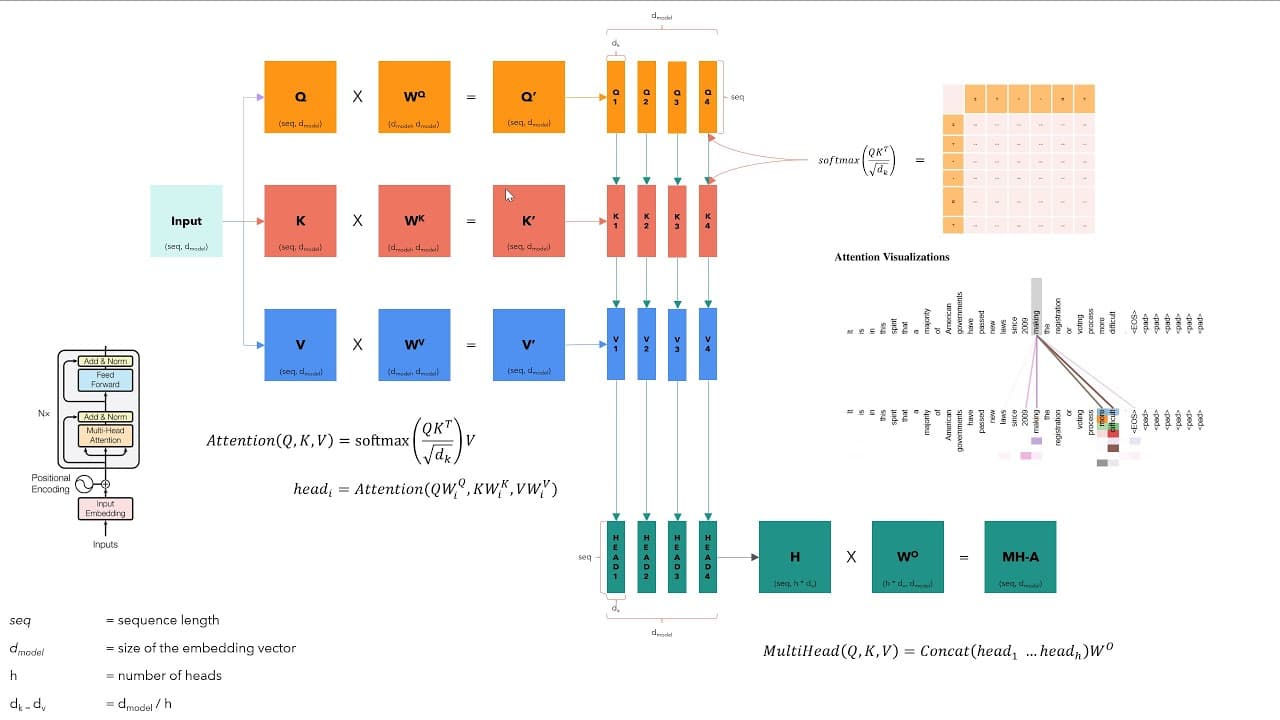
The Transformer model, introduced in 2017, revolutionizes sequence-to-sequence tasks by overcoming the limitations of recurrent neural networks (RNNs). It enables faster computation and parallelization while effectively capturing long-term dependencies through self-attention and multi-head attention mechanisms. This model consists of an encoder and decoder, with layer normalization ensuring stable training.
Transcript
hello guys and welcome to my video about the Transformer welcome to my Channel first of all I will be sharing uh I hope every week videos about Ai and AI models and this video in particular I made about the Transformer which is a very famous model which came out in 2017 paper called attention is all you need I think most of you are already familiar... Read More
Key Insights
- ❓ The Transformer model revolutionized sequence-to-sequence tasks in AI.
- 🐢 It overcomes limitations of RNNs, such as slow computation and inability to parallelize.
- 👻 Self-attention captures relationships between words, allowing for better understanding of long-term dependencies.
- 🤕 Multi-head attention enhances the model's ability to capture different aspects of word interactions.
- ❓ Layer normalization ensures stable training by normalizing values within each embedding.
- 💨 The Transformer model enables fast and efficient training with parallel computation.
- 😁 Inferences can be made using greedy decoding or beam search strategies.
Install to Summarize YouTube Videos and Get Transcripts
Explore YouTube Video Summarizer or Get YouTube Transcript Extractor
Questions & Answers
Q: What are the limitations of recurrent neural networks (RNNs) that led to the development of the Transformer model?
RNNs are slow for long sequences and cannot be parallelized. They also suffer from vanishing or exploding gradients, making it difficult to access information from long ago in the sequence.
Q: How does self-attention work in the Transformer model?
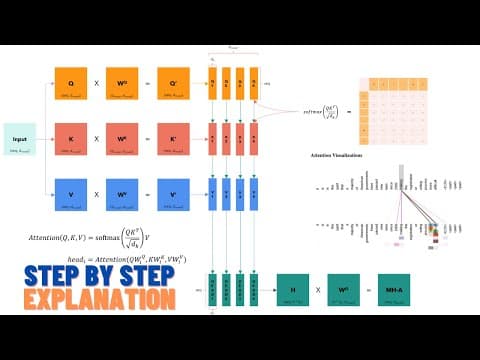
Self-attention allows the model to relate words to each other by calculating a dot product between each word's embedding. This captures relationships and allows for parallel computation.
Q: What is the purpose of the multi-head attention mechanism in the Transformer?
Multi-head attention allows the model to capture different aspects of word interactions by splitting the embeddings into multiple heads. Each head focuses on a different aspect and contributes to the final output.
Q: How does the Transformer handle sequences of different lengths during training and inference?
During training, padding tokens are added to ensure all sequences have the same length. During inference, a special token is used to indicate the start of the sentence, and beam search or greedy decoding strategies are employed to generate the output.
Key Insights:
- The Transformer model revolutionized sequence-to-sequence tasks in AI.
- It overcomes limitations of RNNs, such as slow computation and inability to parallelize.
- Self-attention captures relationships between words, allowing for better understanding of long-term dependencies.
- Multi-head attention enhances the model's ability to capture different aspects of word interactions.
- Layer normalization ensures stable training by normalizing values within each embedding.
- The Transformer model enables fast and efficient training with parallel computation.
- Inferences can be made using greedy decoding or beam search strategies.
- Training involves calculating the loss between the predicted output and the target output.
Summary & Key Takeaways
-
The Transformer model was introduced in 2017 and is a revolutionary approach to sequence-to-sequence tasks.
-
It solves issues with recurrent neural networks, such as slow computation for long sequences and inability to parallelize.
-
The model consists of an encoder and decoder, with multi-head attention and layer normalization as key components.
Read in Other Languages (beta)
Share This Summary 📚
Summarize YouTube Videos and Get Video Transcripts with 1-Click
Try YouTube Summary with ChatGPT & Claude or YouTube Transcript Generator
Explore More Summaries from Umar Jamil 📚
Summarize YouTube Videos and Get Video Transcripts with 1-Click
Try YouTube Summary with ChatGPT & Claude or YouTube Transcript Generator