Coding a Transformer from scratch on PyTorch, with full explanation, training and inference.
TL;DR
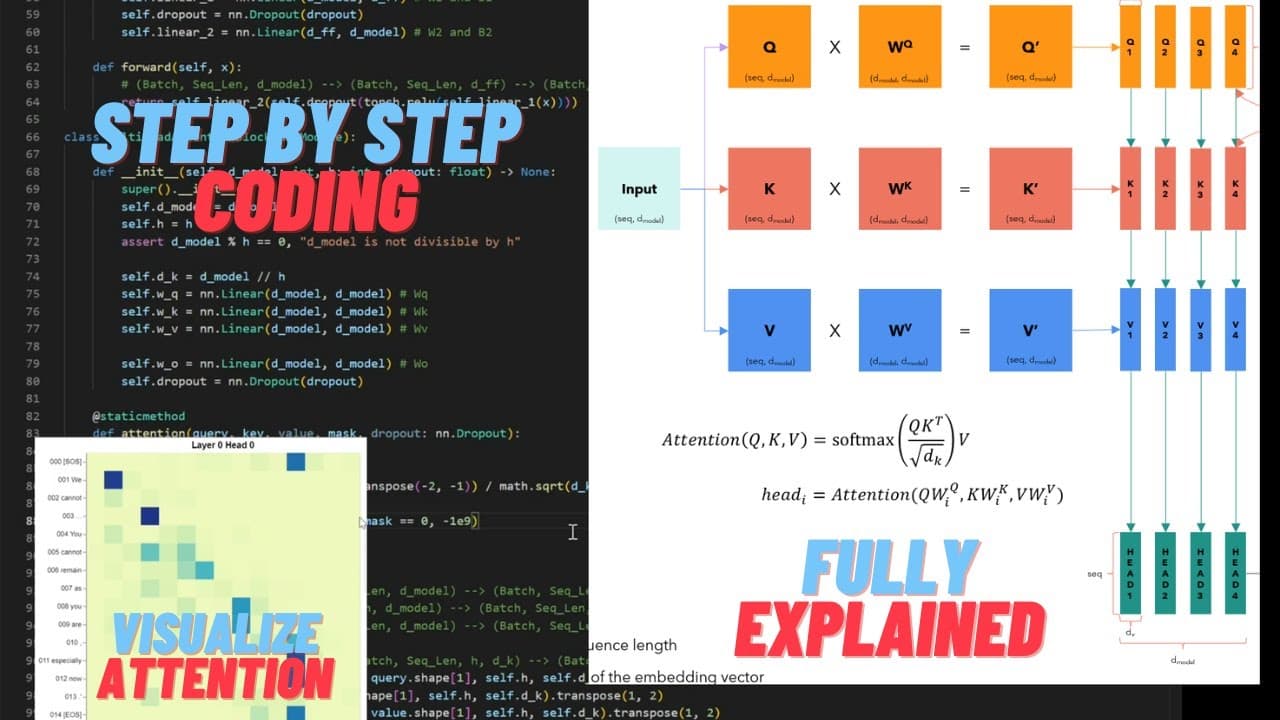
Learn how to build a Transformer model from scratch in PyTorch for language translation tasks, including creating the model, training it, and visualizing attention scores.
Transcript
hello guys welcome to another episode about the Transformer in this episode we will be building the Transformer from scratch using pytorque so coding it from zero we will building the model and we will also build the code for training it for inferencing and for visualizing the attention scores stick with me because it's going to be a long video but... Read More
Key Insights
- 📝 The Transformer model is being built from scratch using PyTorch, starting with the input embeddings and then moving on to positional encoding.
- 🔍 The input embeddings convert the original sentence into a vector of 512 dimensions using a mapping between numbers and vectors.
- 🔤 The positional encoding conveys information about the position of each word in the sentence.
- 🔢 The multi-head attention is a crucial part of the model that calculates the relationship between different words in the sentence.
- 🔄 Residual connections are used to skip connections between different sub-layers of the model, aiding in the flow of information.
- 🌐 The model is designed to handle translation tasks, such as translating English to Italian.
- 💻 The training code is built using PyTorch and includes the creation of the data set, tokenizer, and the use of hugging face libraries.
- 🎯 The completed Transformer model is capable of translating sentences from one language to another with the help of tokenization and attention mechanisms.
Install to Summarize YouTube Videos and Get Transcripts
Explore YouTube Video Summarizer or Get YouTube Transcript Extractor
Questions & Answers
Q: What is the purpose of the input embeddings and how are they created?
The input embeddings convert the original sentence into a vector of 512 dimensions and are created by mapping each word in the vocabulary to a unique number and then converting these numbers into embedding vectors using the embedding layer provided by PyTorch.
Q: How are the positional encodings generated in the Transformer model?
The positional encodings convey the positional information of each word in the sentence and are created using a formula that includes special values based on the position of each word. These position encodings are added to the input embeddings.
Q: What is the role of the multi-head attention in the Transformer model?
The multi-head attention allows the model to capture relationships between different words within the same sentence. It consists of three matrices (query, key, and value) that are multiplied together to calculate attention scores, which are used to weight the importance of each word when generating the output.
Q: How is the training process for the Transformer model explained in the content?
The content provides details on data preprocessing, including tokenization, creating input tensors, and splitting data into training and validation sets. It also covers training the model using standard machine learning techniques and visualizing attention scores to evaluate translation performance.
Q: What is the purpose of the projection layer in the Transformer model?
The projection layer converts the output of the multi-head attention, which is a sequence by D_model matrix, into a sequence by vocabulary_size matrix, effectively predicting the most likely word for each position in the output sentence.
Q: How are the encoder and decoder blocks combined together to create the Transformer model?
The encoder and decoder blocks are combined by connecting the output of the encoder to the input of the decoder. This allows the decoder to use information learned by the encoder to generate the output sentence.
Q: What is the role of the positional encoding in the Transformer model?
The positional encoding provides information about the position of each word in the sentence to the model. It ensures that the model understands the sequential ordering of words in a sentence and helps it learn dependencies between words.
Summary & Key Takeaways
-
The content explains how to build a Transformer model from scratch using PyTorch for language translation.
-
It covers the process of creating the input embeddings, positional encoding, encoder and decoder blocks, and the projection layer.
-
The content also includes details on training the model, including data preprocessing and visualization of attention scores.
Read in Other Languages (beta)
Share This Summary 📚
Summarize YouTube Videos and Get Video Transcripts with 1-Click
Try YouTube Summary with ChatGPT & Claude or YouTube Transcript Generator
Explore More Summaries from Umar Jamil 📚
Summarize YouTube Videos and Get Video Transcripts with 1-Click
Try YouTube Summary with ChatGPT & Claude or YouTube Transcript Generator