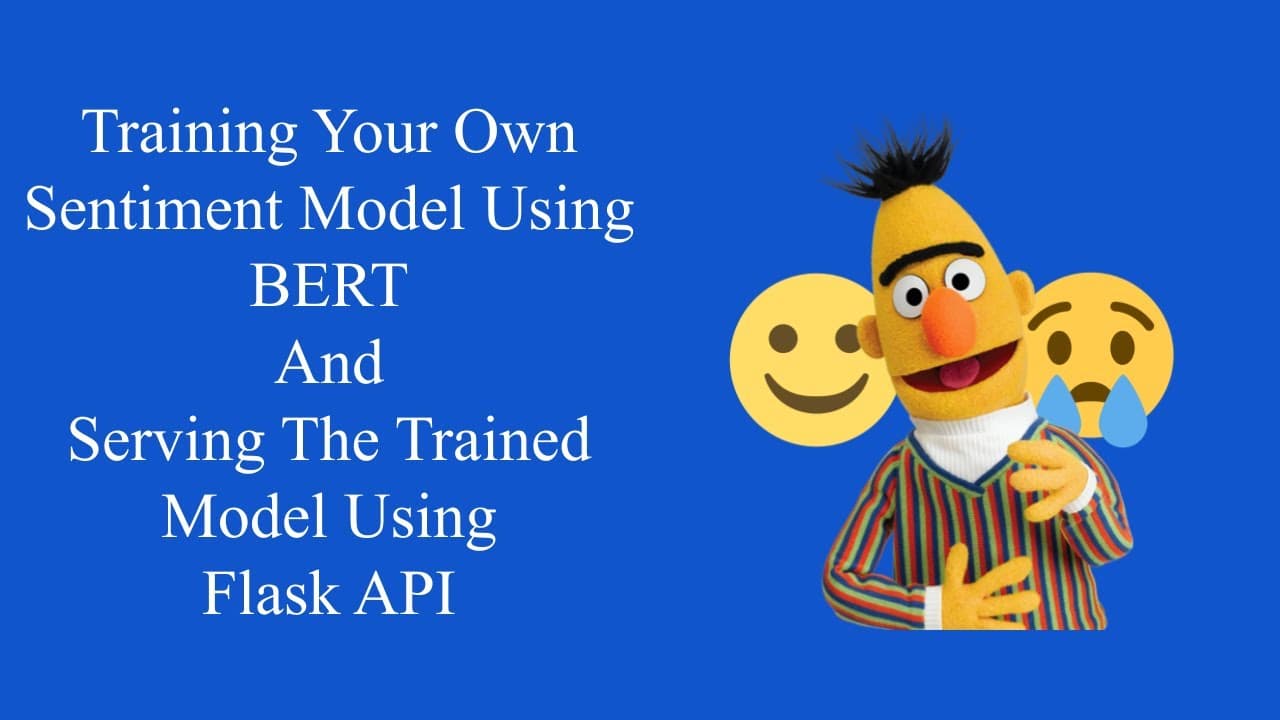
Training Sentiment Model Using BERT and Serving it with Flask API
TL;DR
Learn how to train a sentiment prediction model using Byrd and IMDb dataset with a step-by-step guide.
Transcript
hello and welcome everyone to my new video and again now a special episode and a few days ago I posted a poll on Twitter and I asked if anybody is interested in knowing how to train a sentiment prediction model using Byrd and I've got quite a lot of boots on yes so total of 391 people voted and that's amazing so I decided to make this video and now... Read More
Key Insights
- ❓ Byrd is a powerful language model that can be utilized for training sentiment prediction models.
- ❓ The IMDb dataset provides a suitable training dataset for sentiment prediction tasks.
- 📁 Setting up the necessary files and folders, configuring the model's hyperparameters, and defining the architecture are crucial steps in training the sentiment prediction model.
- 👶 The trained model can be deployed and used to make sentiment predictions on new text inputs.
- 🥠 Fine-tuning the model and experimenting with different hyperparameters can further enhance the model's performance.
- 👋 The sentiment prediction model achieved an accuracy of 93%, indicating good performance on the IMDb dataset.
- 🕸️ The trained model can be integrated into an API for real-time sentiment prediction in web applications.
Install to Summarize YouTube Videos and Get Transcripts
Explore YouTube Video Summarizer or Get YouTube Transcript Extractor
Questions & Answers
Q: What is the IMDb dataset used for in this tutorial?
The IMDb dataset is used as the training data for the sentiment prediction model. It consists of 50,000 movie reviews labeled as positive or negative.
Q: What is Byrd and how is it used in this tutorial?
Byrd is a language model that uses the Transformer architecture. It is used in this tutorial to train the sentiment prediction model by processing textual data and making predictions.
Q: How many positive and negative samples are there in the IMDb dataset?
The IMDb dataset contains an equal number of positive and negative samples, with 25,000 reviews labeled as positive and 25,000 labeled as negative.
Q: What are the key steps involved in training the sentiment prediction model?
The key steps involved in training the sentiment prediction model using Byrd are setting up the required folders and files, creating a configuration file, defining the model architecture, configuring the optimizer, and performing training and evaluation.
Q: Can the sentiment prediction model be easily improved or modified?
Yes, the sentiment prediction model can be improved or modified by adjusting hyperparameters, trying different optimization techniques, exploring different architectures, and optimizing the model's performance based on specific requirements.
Summary & Key Takeaways
-
The video tutorial focuses on training a sentiment prediction model using Byrd and IMDb dataset, which contains 50,000 movie reviews labeled as positive or negative.
-
The presenter explains the process of setting up the necessary folders and files, such as the configuration file, vocabulary file, and model file.
-
A basic sentiment prediction model is created using Byrd and the IMDb dataset, without comparing different models or advanced techniques.
-
The presenter demonstrates how to train the model, configure the optimizer, set the hyperparameters, and perform evaluation to calculate accuracy.
Read in Other Languages (beta)
Share This Summary 📚
Summarize YouTube Videos and Get Video Transcripts with 1-Click
Try YouTube Summary with ChatGPT & Claude or YouTube Transcript Generator
Explore More Summaries from Abhishek Thakur 📚
Summarize YouTube Videos and Get Video Transcripts with 1-Click
Try YouTube Summary with ChatGPT & Claude or YouTube Transcript Generator