How to evaluate a piecewise function (example) | Functions | Algebra I | Khan Academy
TL;DR
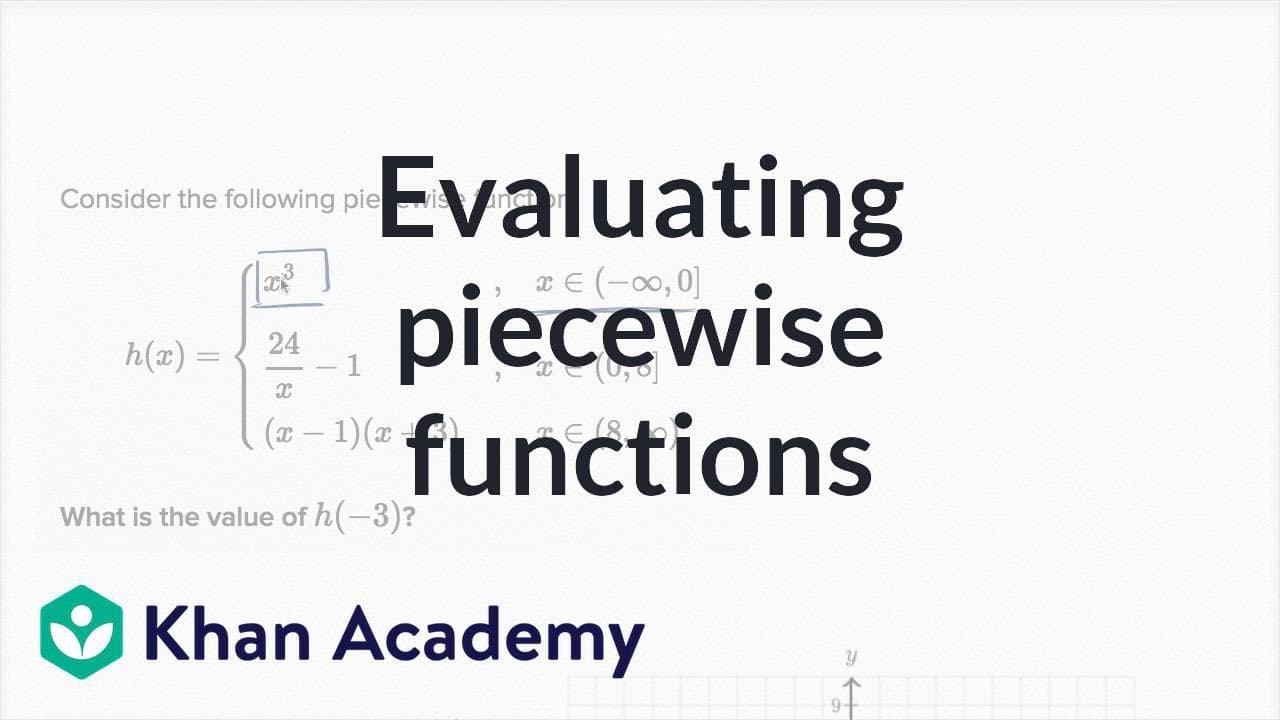
This content explains how to evaluate piecewise functions and match expressions with their corresponding values in step functions.
Transcript
- [Instructor] Consider the following piecewise function and we say f(t) is equal to and they tell us what it's equal to based on what t is, so if t is less than or equal to -10, we use this case. If t is between -10 and -2, we use this case. And if t is greater than or equal to -2, we use this case. And then they ask us what is the value of f(-10)... Read More
Key Insights
- 💼 Piecewise functions involve dividing the given domain into separate cases with different expressions for each case.
- 😥 When evaluating a piecewise function at a specific point, the case that includes the given point is used to substitute the value and compute the result.
- 😥 Step functions are discontinuous and only change their value at specific points.
- ⭕ In step function graphs, open circles indicate that the function is not defined at that particular point, while filled-in circles represent the actual value.
- 😥 Evaluating step functions involves finding the corresponding value based on the given point's location on the graph.
- 😑 Matching expressions with their values in step functions requires careful examination of the points and circles on the graph.
- 💦 Step functions can have constant values in intervals or involve jumps and drops between different values.
Install to Summarize YouTube Videos and Get Transcripts
Explore YouTube Video Summarizer or Get YouTube Transcript Extractor
Questions & Answers
Q: How do you determine which case to use when evaluating a piecewise function at a specific point?
To determine the case to use in a piecewise function, you need to compare the given point with the conditions stated in each case. Choose the case that includes the given point within its range.
Q: What is the value of f(-10) in the given piecewise function?
To find the value of f(-10), we use the first case because -10 is less than or equal to -10. Substituting -10 into the expression, we get 150 as the result.
Q: How is a step function graph analyzed to match expressions with their values?
By examining the points and circles on the step function graph, you can determine the corresponding values for different expressions. Open circles indicate that the function is not defined at a particular point, while filled-in circles represent the actual value at that point.
Q: What is the value of g(9) in the step function graph?
For g(9), the function is undefined because there is no filled-in circle at x = 9 on the graph. The undefined value indicates that g is not defined at x = 9.
Summary & Key Takeaways
-
The content discusses how to determine the value of a piecewise function at a specific point by using the appropriate case based on the given conditions.
-
It also explains how to match expressions with their corresponding values in a step function graph by analyzing the points and circles on the graph.
-
Examples are provided to demonstrate the process of evaluating piecewise functions and identifying values in step functions.
Read in Other Languages (beta)
Share This Summary 📚
Summarize YouTube Videos and Get Video Transcripts with 1-Click
Try YouTube Summary with ChatGPT & Claude or YouTube Transcript Generator
Explore More Summaries from Khan Academy 📚



Summarize YouTube Videos and Get Video Transcripts with 1-Click
Try YouTube Summary with ChatGPT & Claude or YouTube Transcript Generator