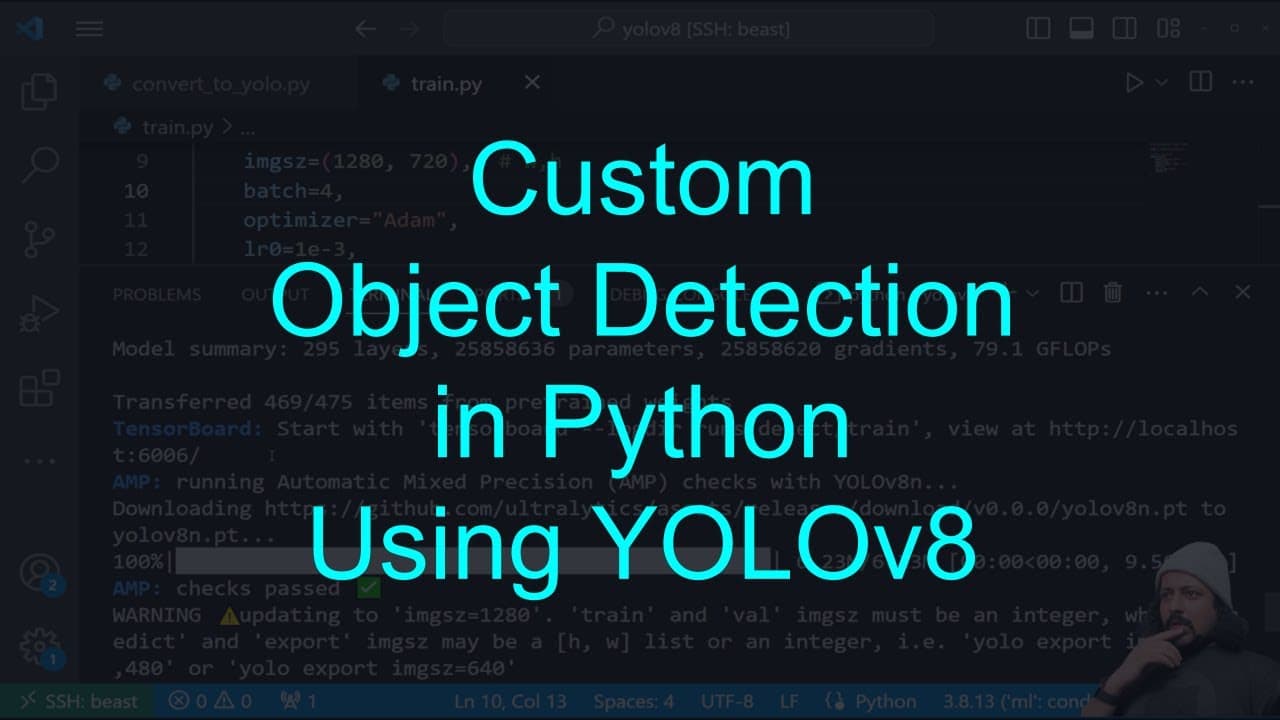
Custom object detection in Python using YOLOv8
TL;DR
Learn how to train YOLO V8 object detection models on a custom dataset using Python.
Transcript
hello everyone and welcome to my YouTube channel in today's video we are going to take a look at how to train YOLO p8 on a custom data set using python now I have seen a lot of YouTube videos on YOLO V8 and almost all of them are using the command line interface and they are creating data using some kind of labeling tool but in today's video I'm go... Read More
Key Insights
- 🥰 YOLO V8 offers state-of-the-art object detection with real-time performance.
- 💁 Converting data to the YOLO format is necessary for training YOLO V8 models.
- 💁 The Plastic In River dataset is an example of a dataset that needs to be converted to the YOLO format for training.
- 😄 YOLO V8 training and inference can be performed using Python, providing flexibility and ease of use.
- 💁 Different bounding box formats exist, but they can be converted to the YOLO format with simple mathematical calculations.
- ☠️ The YOLO V8 model can be fine-tuned using different parameters, such as image size and learning rate.
- 👶 After training, the model can be used for object detection on new images.
Install to Summarize YouTube Videos and Get Transcripts
Explore YouTube Video Summarizer or Get YouTube Transcript Extractor
Questions & Answers
Q: What is YOLO V8 and how does it compare to other object detection models?
YOLO V8 is an object detection model considered to be state-of-the-art. It offers real-time object detection with high accuracy and is widely used in computer vision tasks. Its performance can outperform other models such as YOLO V5.
Q: What is the required format for data in YOLO V8?
YOLO V8 expects the data to be in a normalized format, including the bounding box's center coordinates, normalized width and height. This format allows for easy training of the YOLO V8 model.
Q: How can you convert different bounding box formats to the YOLO format?
Converting different bounding box formats to the YOLO format involves simple mathematical calculations. You can calculate the X and Y center coordinates, as well as the normalized width and height using the given bounding box coordinates.
Q: What dataset is used as an example in the video, and what are the target objects to be detected?
The Plastic In River dataset is used, which contains images of rivers or water bodies. The goal is to detect four different types of objects: plastic bags, plastic bottles, other plastic waste, and non-plastic waste.
Summary & Key Takeaways
-
YOLO V8 is a popular object detection model claimed to be state-of-the-art, and Python can be used for training and inference.
-
Converting data to the YOLO format is necessary for training YOLO V8, and there are different formats for bounding boxes, including coordinate-based formats and YOLO's normalized width and height format.
-
The Plastic In River dataset is used as an example, and the video explains how to convert this dataset into the YOLO format for training.
Read in Other Languages (beta)
Share This Summary 📚
Summarize YouTube Videos and Get Video Transcripts with 1-Click
Try YouTube Summary with ChatGPT & Claude or YouTube Transcript Generator
Explore More Summaries from Abhishek Thakur 📚



Summarize YouTube Videos and Get Video Transcripts with 1-Click
Try YouTube Summary with ChatGPT & Claude or YouTube Transcript Generator