Advantages and Disadvantages of F E M
TL;DR
Finite elemental analysis (FEA) is a powerful tool for understanding complex geometries, evaluating material properties, and solving time-dependent problems. However, it requires expertise, can be time-consuming, and may not provide accurate solutions in all cases.
Transcript
hello friends by now hopefully you have understood the basics of finite elemental analysis now let's understand the advantages and disadvantages of this method first let's take a look at the advantages of this system we have seen the importance of this method with respect to complex geometries by breaking the domain into fragments and individually ... Read More
Key Insights
- 💄 FEA is highly compatible with different boundary conditions and materials, making it suitable for complex geometries.
- 🍵 It can handle time-dependent problems and evaluate transient issues such as noise and vibration.
- 👻 FEA reduces costs by allowing testing without physically testing the model and optimizing efficiency in redesigning.
- 💼 It requires expertise and may not provide accurate solutions in all cases.
- 💁 Linear FEA may have limitations in providing information on buckling for lightweight components.
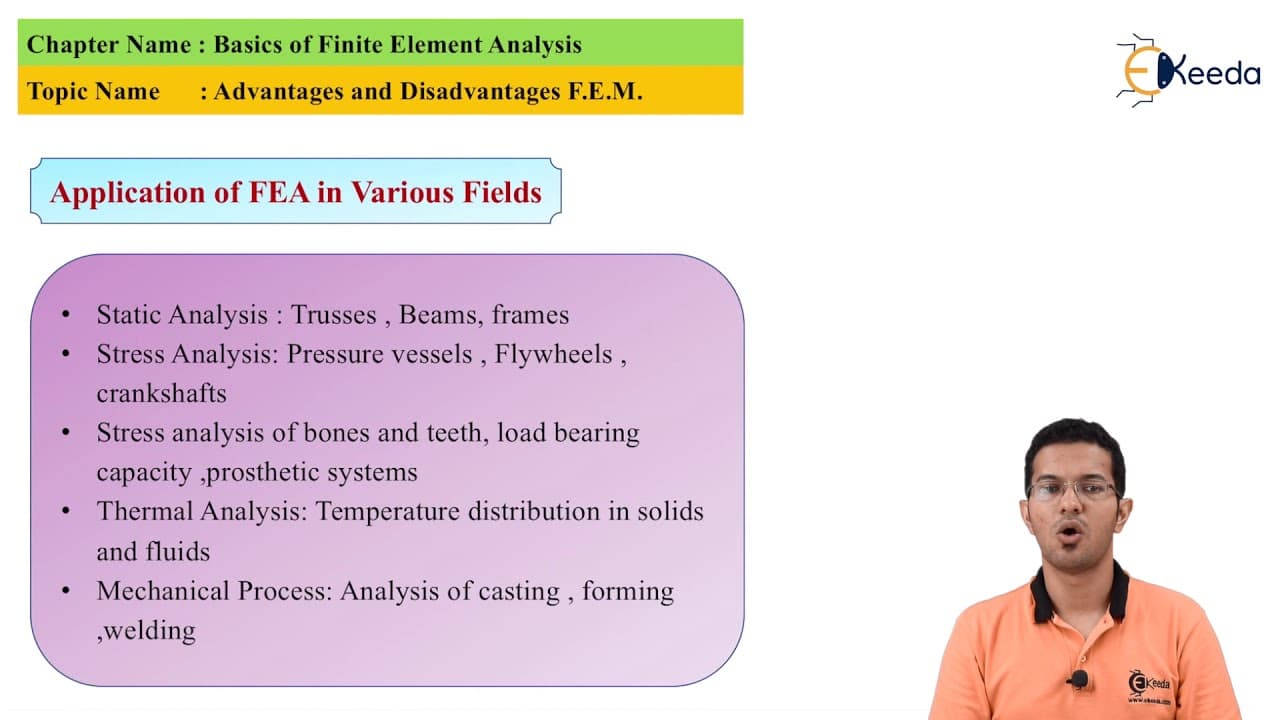
- ☠️ FEA is widely used in static stress analysis, mechanical analysis, stress analysis of teeth and bones, nuclear analysis, and vibration analysis.
- ✊ FEA is particularly important in the analysis and prediction of structures in nuclear power plants.
Install to Summarize YouTube Videos and Get Transcripts
Explore YouTube Video Summarizer or Get YouTube Transcript Extractor
Questions & Answers
Q: How does FEA make complex geometries easier to analyze?
FEA breaks complex geometries into smaller elements, allowing for the individual solution of each element. This makes it easier to understand and analyze the behavior of the overall system.
Q: What advantages does FEA offer in time-dependent problems?
FEA uses time derivatives to solve spatial problems, making it suitable for time-dependent problems. It can evaluate transient problems, such as noise and vibration, and design out potential issues.
Q: How does FEA reduce costs and optimize efficiency in the design process?
FEA allows testing of models by applying boundary conditions without physically testing the actual model. This reduces the cost of testing and allows for efficient redesigning.
Q: What are the disadvantages of FEA?
FEA may not give accurate solutions in the discretization of a problem, and the results may vary between software. It requires expertise in derivatives, integration, and matrix solving. Linear FEA may not provide enough information on buckling for correct design decisions.
Summary & Key Takeaways
-
Finite elemental analysis (FEA) breaks complex geometries into fragments, allowing for individual solution of each element and reassembling the model. This makes it highly compatible with different boundary conditions and helps understand the behavior of real materials.
-
FEA is useful for time-dependent problems, as it uses time derivatives to solve spatial problems. It also allows testing of models without physically testing them, reducing costs and optimizing efficiency.
-
FEA aids in evaluating transient problems, such as noise and vibration, by designing out potential issues. It can handle different types of loading, including forces, pressure, and temperature.
Read in Other Languages (beta)
Share This Summary 📚
Summarize YouTube Videos and Get Video Transcripts with 1-Click
Try YouTube Summary with ChatGPT & Claude or YouTube Transcript Generator
Explore More Summaries from Ekeeda 📚






Summarize YouTube Videos and Get Video Transcripts with 1-Click
Try YouTube Summary with ChatGPT & Claude or YouTube Transcript Generator