Lift and Drag - Boundary Layer Flow - Fluid Mechanics 1
TL;DR
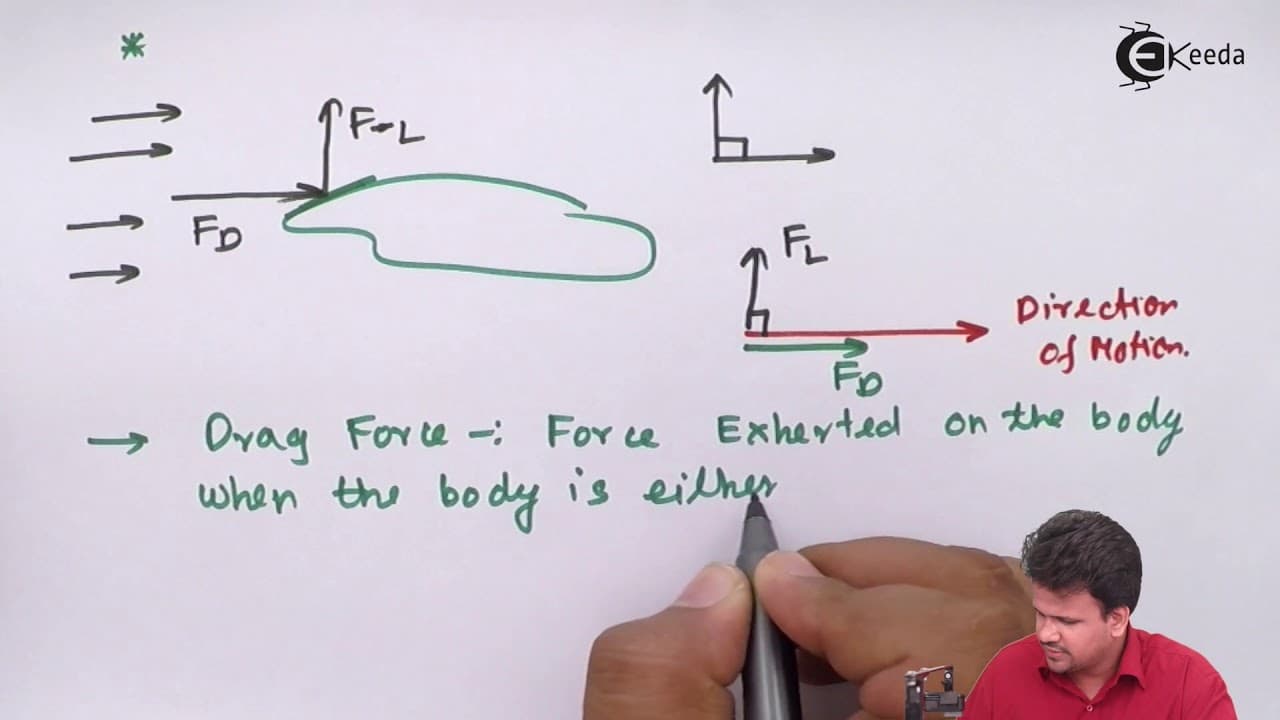
Lift force and drag force are the two types of forces acting on a body submerged in a fluid, with lift force being perpendicular to the direction of fluid flow and drag force being parallel to it.
Transcript
hello students in the previous section we have seen what is boundary layer theory as well as we have discussed what are methods of separation of boundary layer now why it is necessary that we should keep the boundary layer separation as minimum as possible because there is some amount of lift force or drag force involved in that so let us study wha... Read More
Key Insights
- 🦾 Lift force and drag force are two important forces in fluid mechanics, influencing the motion of objects submerged in fluids.
- 🧑🏭 The magnitude and direction of lift and drag forces depend on factors such as the angle of the body, area, velocity, and fluid properties.
- ✈️ Real-life examples of drag force include parachutes and spoilers in vehicles, while the lift force is responsible for the flight of objects like kites and airplanes.
- 🏋️ Understanding the concepts of lift and drag forces can help in designing efficient and aerodynamic structures.
- 🥳 The ratio of coefficient of lift to coefficient of drag can provide insights into the performance of a body in a fluid flow.
- 🏋️ Streamlined shapes and airfoil designs are commonly used to reduce drag and increase lift.
- 👻 Control over the angle of the body can be used to manipulate lift and drag forces, allowing for precise maneuvering in fluid environments.
Install to Summarize YouTube Videos and Get Transcripts
Explore YouTube Video Summarizer or Get YouTube Transcript Extractor
Questions & Answers
Q: What is the difference between lift force and drag force?
Lift force is perpendicular to the direction of fluid flow and allows an object to move upward or stay afloat. Drag force is parallel to the direction of fluid flow and opposes the motion of the object, causing it to slow down.
Q: How are lift and drag forces related to the shape of a body?
The shape of a body affects the distribution of pressures and shear forces acting on it, which in turn determine the magnitudes of lift and drag forces. A streamlined shape reduces drag, while certain designs can enhance lift.
Q: What are some real-life examples of drag force?
Drag force can be observed when skydivers use parachutes to control their fall or when spoilers on vehicles increase drag for better stability. It is also responsible for air resistance experienced by moving objects.
Q: How do lift and drag forces vary with the angle of the body?
The angle of the body with respect to the direction of fluid flow affects the distribution of pressure and shear forces. Varying the angle can change the magnitudes of lift and drag forces, altering the behavior of the object in the fluid.
Summary & Key Takeaways
-
Lift force and drag force are two types of forces acting on a body submerged in a fluid.
-
Drag force is parallel to the direction of fluid flow, while lift force is perpendicular to it.
-
The magnitude of drag and lift forces depend on factors such as the angle of the body, area, velocity, and coefficients of drag and lift.
Read in Other Languages (beta)
Share This Summary 📚
Summarize YouTube Videos and Get Video Transcripts with 1-Click
Try YouTube Summary with ChatGPT & Claude or YouTube Transcript Generator
Explore More Summaries from Ekeeda 📚






Summarize YouTube Videos and Get Video Transcripts with 1-Click
Try YouTube Summary with ChatGPT & Claude or YouTube Transcript Generator