When a particle is speeding up
TL;DR
Analysis of the velocity and acceleration of a particle moving in one dimension to determine when it is speeding up.
Transcript
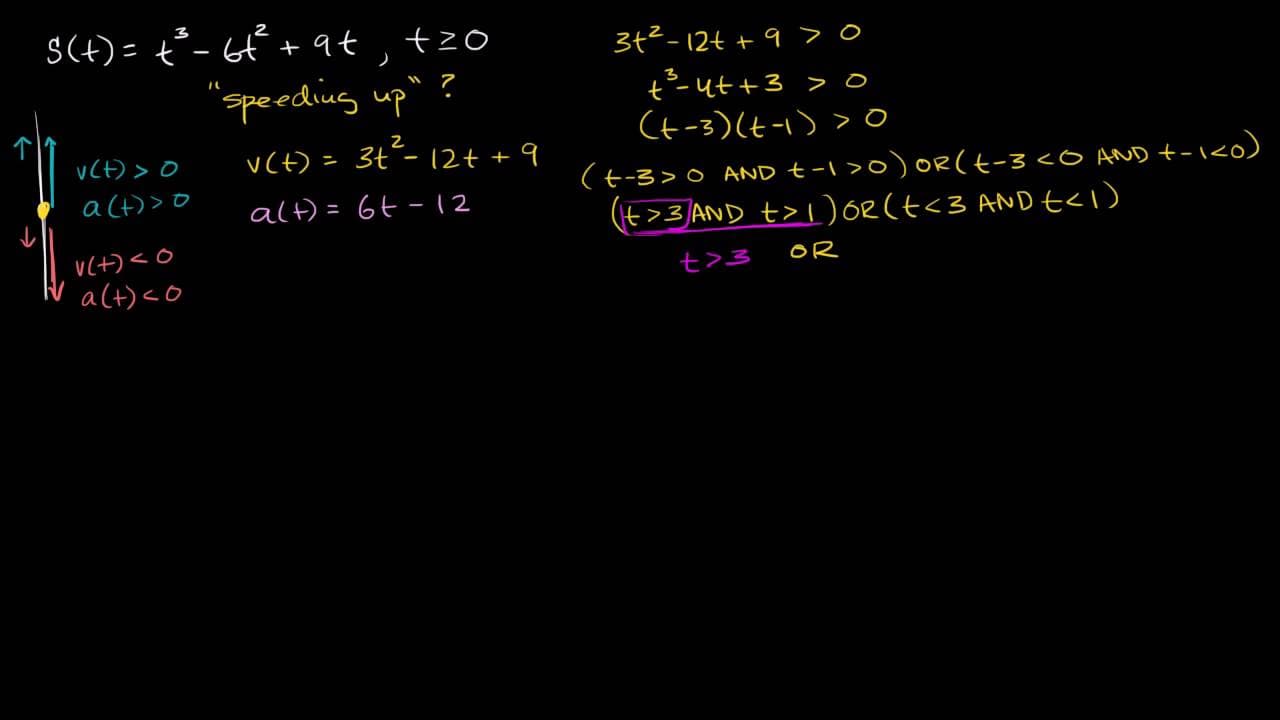
let's say that some particle is moving up or down so it's moving in one direct dimension the vertical dimension and we know its position as a function of time its position is given as a function of time as t to the third power minus 6 t squared plus nine t and we're going to assume that our time is greater than or equal to zero so you could imagine... Read More
Key Insights
- 🤘 Speeding up occurs when the velocity and acceleration have the same sign.
- 🐎 When a particle is moving upwards, it is speeding up if its velocity and acceleration are positive.
- 🐎 When a particle is moving downwards, it is speeding up if its velocity and acceleration are negative.
- 🤘 The intervals when a particle is speeding up include when its velocity and acceleration have the same sign.
- 🤘 If the velocity and acceleration have opposite signs, the particle is decelerating, not speeding up.
- ❎ The analysis involves determining the intervals when the velocity and acceleration are positive or negative.
- 🐎 The intervals when the particle is speeding up in the upward direction are when time is greater than three.
- 🐎 The intervals when the particle is speeding up in the downward direction are when time is between one and two.
Install to Summarize YouTube Videos and Get Transcripts
Explore YouTube Video Summarizer or Get YouTube Transcript Extractor
Questions & Answers
Q: How can we determine if a particle is speeding up when moving upwards?
When a particle is moving upwards, it is speeding up if its velocity is positive and its acceleration is greater than zero. This means that the particle is increasing its upward velocity.
Q: What happens when a particle is moving downwards and speeding up?
When a particle is moving downwards and speeding up, its velocity is negative and its acceleration is also negative. Therefore, the particle is increasing its downward velocity.
Q: Can a particle be speeding up while its velocity is negative?
Yes, a particle can be speeding up while its velocity is negative. This occurs when the particle is moving downwards and its acceleration is negative, causing it to increase its downward velocity.
Q: How do we determine the intervals when a particle is speeding up?
To determine the intervals when a particle is speeding up, we analyze the signs of velocity and acceleration. When the velocity is positive and the acceleration is positive, or when the velocity is negative and the acceleration is negative, the particle is speeding up.
Summary & Key Takeaways
-
The content discusses the concept of a particle moving in one dimension and focuses on analyzing its velocity and acceleration.
-
When the particle is moving upwards, it is speeding up if both its velocity and acceleration are positive.
-
When the particle is moving downwards, it is speeding up if both its velocity and acceleration are negative.
Read in Other Languages (beta)
Share This Summary 📚
Summarize YouTube Videos and Get Video Transcripts with 1-Click
Try YouTube Summary with ChatGPT & Claude or YouTube Transcript Generator
Explore More Summaries from Khan Academy 📚



Summarize YouTube Videos and Get Video Transcripts with 1-Click
Try YouTube Summary with ChatGPT & Claude or YouTube Transcript Generator