Fundamentals of Pointers
TL;DR
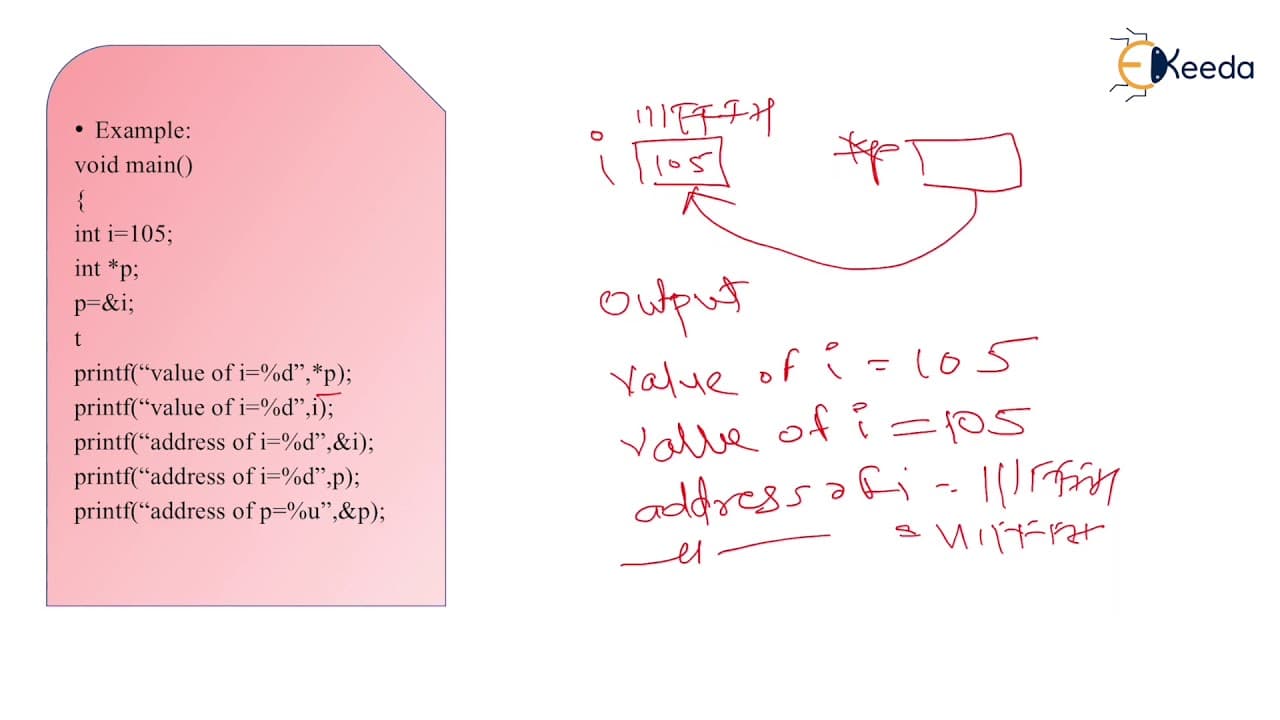
This video explains the basics of pointers in C programming, including declaring, initializing, and accessing the values and addresses of variables using pointers.
Transcript
hello friends in this video we are going to see about the fundamentals of pointers pointer is like a normal variable that store memory address or that contains address of another variable their addresses are the location number always contain the whole numbers so pointer contains always the whole number it is called a pointer because it points to a... Read More
Key Insights
- ♿ Pointers are used to indirectly access the value or address of a variable in C programming.
- 🅰️ Pointer variables are declared using the syntax "data type *pointer name".
- ❓ Pointers can be initialized with the address of another variable using the assignment operator (=).
- 🗺️ The indirection operator (*ptr) is used to access the value stored at a specific memory address.
- 👻 Pointers provide a way to maintain security by allowing indirect access to reference variables.
- ❓ Pointer operations can be used to display values and addresses of variables.
- 🅰️ Pointers can be used to reference variables of different data types.
Install to Summarize YouTube Videos and Get Transcripts
Explore YouTube Video Summarizer or Get YouTube Transcript Extractor
Questions & Answers
Q: What is a pointer in C programming?
In C programming, a pointer is a variable that stores the memory address of another variable. It is used to indirectly access the value or address of that variable.
Q: How do you declare a pointer variable?
To declare a pointer variable, you use the syntax "data type *pointer name". For example, "int *ptr" declares a pointer variable named ptr of type int.
Q: How do you initialize a pointer with the address of another variable?
You can initialize a pointer with the address of another variable using the assignment operator (=). For example, "ptr = &variable" initializes ptr with the address of variable.
Q: What is the indirection operator in C programming?
The indirection operator, represented by the asterisk (*), is used to access the value stored at a particular memory address. For example, "*ptr" accesses the value stored at the address stored in ptr.
Summary & Key Takeaways
-
Pointers in C programming store memory addresses and are used to access values or addresses of other variables.
-
Pointers are declared using the syntax "data type *pointer name" and initialized with the address of another variable.
-
Two operators, the address operator and the indirection operator, are used in pointer operations.
Read in Other Languages (beta)
Share This Summary 📚
Summarize YouTube Videos and Get Video Transcripts with 1-Click
Try YouTube Summary with ChatGPT & Claude or YouTube Transcript Generator
Explore More Summaries from Ekeeda 📚

Summarize YouTube Videos and Get Video Transcripts with 1-Click
Try YouTube Summary with ChatGPT & Claude or YouTube Transcript Generator