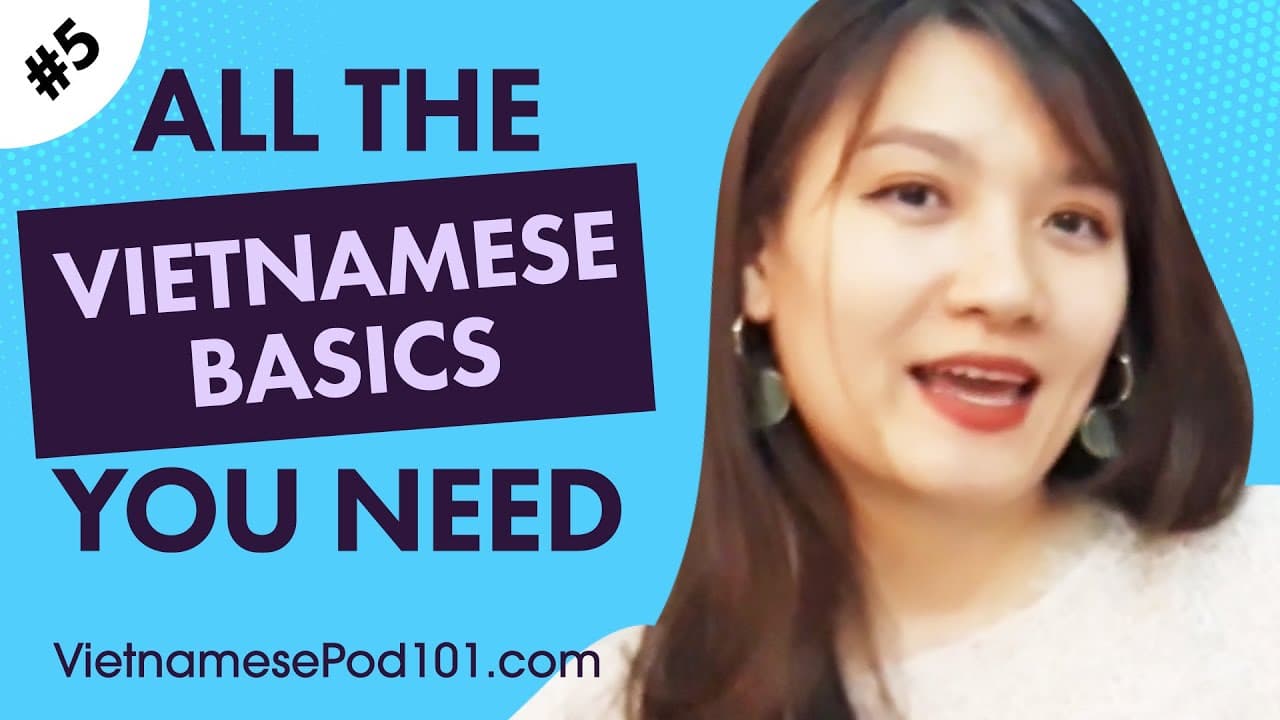
ALL the Basics You Need to Master Vietnamese #5
TL;DR
Learn essential Vietnamese phrases and pronunciation in this comprehensive guide.
Transcript
want to speak real vietnamese from your first lesson sign up for your free lifetime account at vietnamesepod101.com hello everyone welcome back to vietnamese sport 101 my name is okay so uh i don't know but a lot of people asked me to do a video about um how to flirt someone in vietnamese i wouldn't say flirt because it sounds so a little bit over ... Read More
Key Insights
- Vietnamese is a tonal language with six different tones that can change the meaning of a word.
- Common phrases for greetings and introductions are essential for basic communication.
- Understanding the cultural context, such as when to use formal or informal language, is crucial.
- Vietnamese grammar is relatively straightforward, with no verb conjugations for tense.
- The Vietnamese alphabet uses Latin characters, making it easier for English speakers to learn.
- Vietnamese cuisine is diverse, with regional variations and popular dishes like pho and banh mi.
- Shopping in Vietnam often involves bargaining, and knowing basic phrases can be helpful.
- Vietnamese names often consist of three parts: family name, middle name, and given name.
Install to Summarize YouTube Videos and Get Transcripts
Explore YouTube Video Summarizer or Get YouTube Transcript Extractor
Questions & Answers
Q: How do you say 'hello' in Vietnamese?
In Vietnamese, 'hello' is commonly said as 'xin chào.' It's a versatile greeting suitable for both formal and informal situations.
Q: What is the importance of tones in Vietnamese?
Tones in Vietnamese are crucial as they can completely change the meaning of a word. There are six tones, each with a distinct pitch and contour, making pronunciation a key aspect of learning the language.
Q: How is the Vietnamese language structured?
Vietnamese has a subject-verb-object structure similar to English, but it does not have verb conjugations. Tense is indicated by context or specific words like 'đã' for past and 'sẽ' for future.
Q: What are some common Vietnamese dishes?
Common Vietnamese dishes include pho, a noodle soup with beef or chicken, and banh mi, a type of sandwich with various fillings. These dishes are popular both in Vietnam and internationally.
Q: How do you ask for the price in Vietnamese?
To ask for the price in Vietnamese, you can say 'Cái này bao nhiêu?' which means 'How much is this?' It's a useful phrase when shopping in markets.
Q: What is the structure of Vietnamese names?
Vietnamese names typically consist of three parts: the family name, middle name, and given name. The family name comes first, followed by the middle and given names.
Q: How does one express gratitude in Vietnamese?
To express gratitude in Vietnamese, you can say 'Cảm ơn,' which means 'thank you.' It's a basic yet important phrase for polite interactions.
Q: What should travelers be aware of when visiting Vietnam?
Travelers should be aware of cultural norms, such as dressing modestly when visiting temples, and be cautious with personal belongings in crowded areas to avoid theft.
Summary & Key Takeaways
-
Vietnamese is a tonal language where the tone can change the meaning of a word. Mastering pronunciation is key.
-
Basic phrases for greetings, introductions, and polite conversation are essential for effective communication.
-
Understanding cultural nuances and when to use formal or informal language enhances conversations.
Read in Other Languages (beta)
Share This Summary 📚
Summarize YouTube Videos and Get Video Transcripts with 1-Click
Try YouTube Summary with ChatGPT & Claude or YouTube Transcript Generator
Explore More Summaries from Learn Vietnamese with VietnamesePod101.com 📚




Summarize YouTube Videos and Get Video Transcripts with 1-Click
Try YouTube Summary with ChatGPT & Claude or YouTube Transcript Generator