What Is Circle Inversion and How Does It Work?
TL;DR
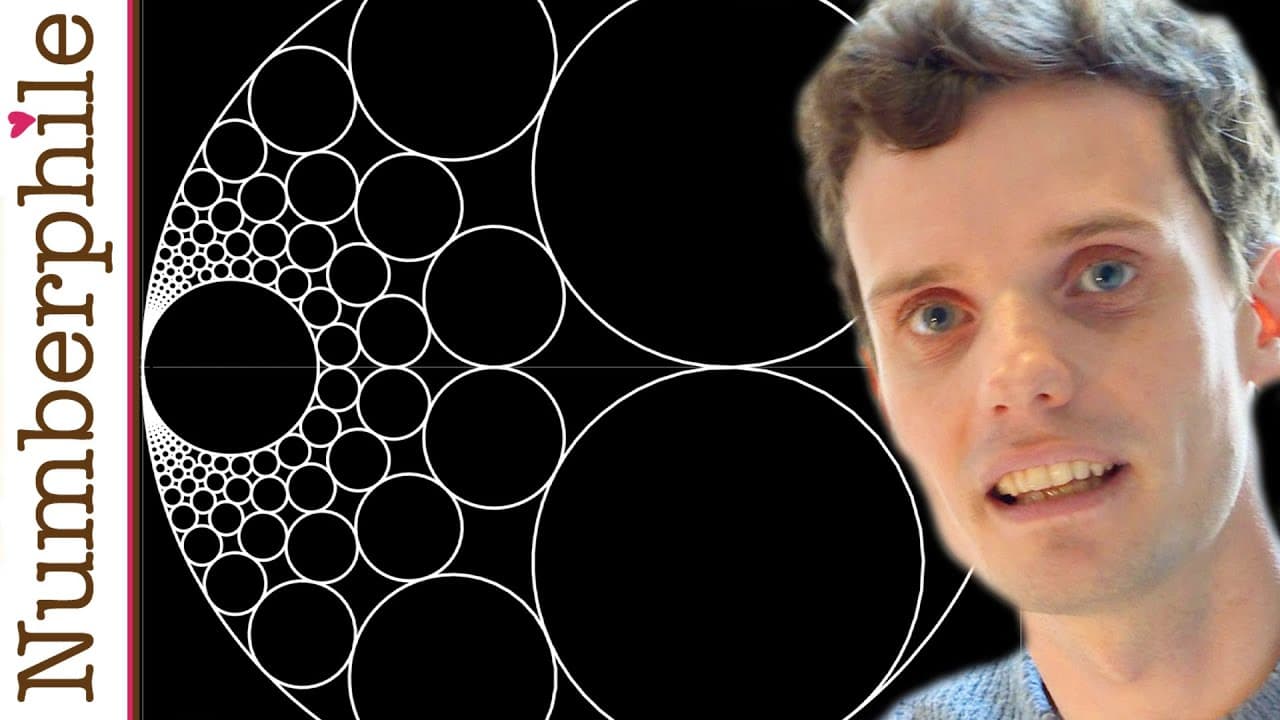
Circle inversion is a geometric transformation where points inside a circle are mapped to points outside, maintaining a specific distance ratio. This process allows for the creation of intricate patterns of infinitely many circles that touch each other. Understanding circle inversion provides deeper insights into conic sections and the relationships between geometric shapes.
Transcript
It goes crazy drawing all these circles. Hey I'm Matt Henderson; I'm a research scientist working on speech and language processing, but in my spare time I like making mathematical animations. This is slicing a cylinder, and this is a way to introduce the sine curve. I've set up in Mathematica something with a few sliders. If I lift this one here, ... Read More
Key Insights
- ❓ Animated illustrations make complex mathematical concepts more accessible and engaging.
- ⭕ Geometric concepts like circle inversion and parabola can be visually represented through animations.
- ❓ Relationship between 2D and 3D perspectives can be effectively explained through interactive demonstrations.
- 💨 Mathematical animations offer a creative way to demonstrate abstract concepts and theories.
- 😒 Math education can benefit from the use of interactive visuals and animations for better comprehension.
- 💅 Demonstrations like circle inversion showcase the beauty and complexity of geometric constructions.
- 🤕 Interactive learning tools like subscription crates from KiwiCo can enhance STEM education for all ages.
Install to Summarize YouTube Videos and Get Transcripts
Explore YouTube Video Summarizer or Get YouTube Transcript Extractor
Questions & Answers
Q: How does slicing a cylinder reveal the sine curve?
Slicing a cylinder and unrolling it reveals a repeating sine wave, a natural occurrence with surprising implications in mathematics.
Q: What is the significance of the circle inversion demonstration?
Circle inversion creates intricate patterns of infinitely many touching circles, showcasing a geometric construction concept with mesmerizing visuals.
Q: How does the demonstration connect 2D geometric concepts to a 3D perspective?
By slicing a cone at the right angle in 3D, concentric circles meeting lines form a parabola, highlighting the relationship between different dimensions.
Q: How does the researcher use interactive animations to teach complex mathematical concepts?
The researcher uses Mathematica and a grid structure to simplify complex mathematical concepts like circle inversion, making them visually engaging and easier to understand.
Summary & Key Takeaways
-
Research scientist creates mathematical animations in spare time.
-
Demonstrates slicing cylinder to reveal sine curve and circle inversion for intricate patterns.
-
Explains geometric concepts like parabola and circle inversion using animations.
Read in Other Languages (beta)
Share This Summary 📚
Summarize YouTube Videos and Get Video Transcripts with 1-Click
Try YouTube Summary with ChatGPT & Claude or YouTube Transcript Generator
Explore More Summaries from Numberphile 📚




Summarize YouTube Videos and Get Video Transcripts with 1-Click
Try YouTube Summary with ChatGPT & Claude or YouTube Transcript Generator