What Is Hypothesis Testing in Statistics?
TL;DR
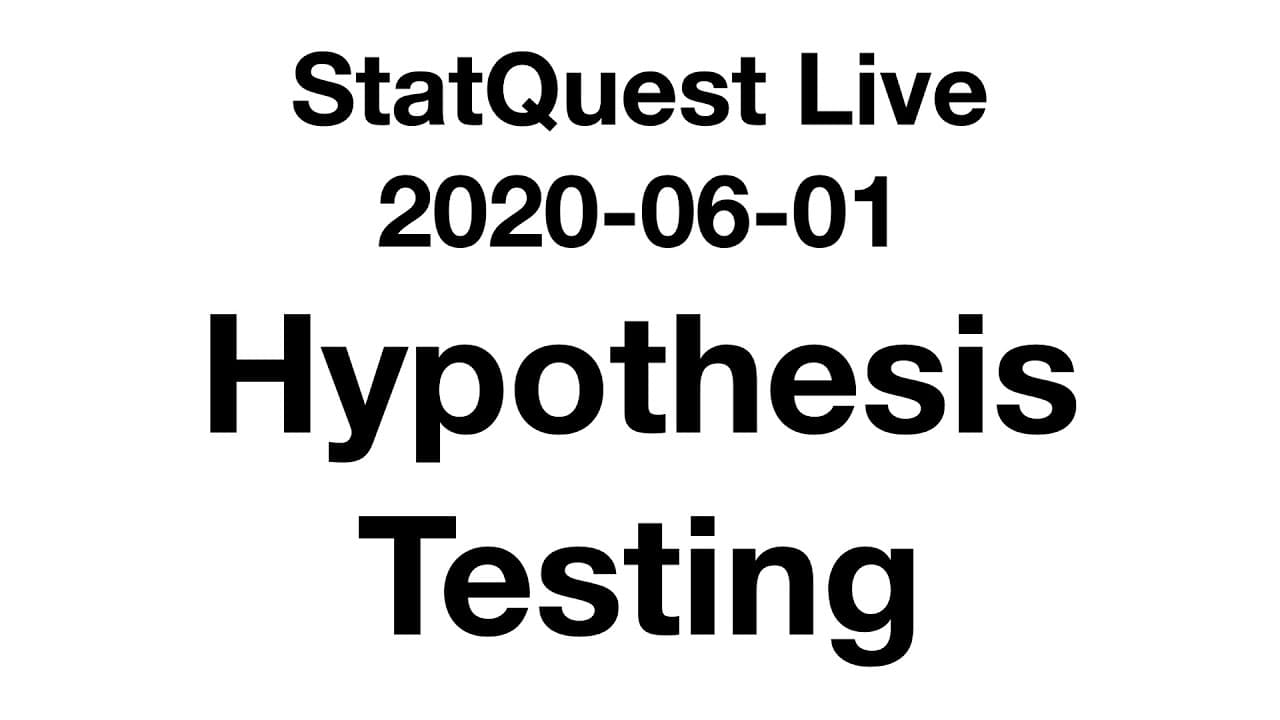
Hypothesis testing is a statistical method used to determine the validity of a hypothesis based on experimental data. It involves forming a hypothesis, conducting experiments, and then deciding whether to reject or fail to reject the null hypothesis, which states that there is no significant difference between groups. Random factors and repeated experiments are crucial in confirming the reliability of the findings.
Transcript
hypothesis testing can be really confusing hypothesis testing we're going to break it down into small pieces and hopefully it'll make sense by the end of this live stream stat quest bam hello i'm josh starmer and welcome to the statquest live stream uh i've we've got people uh watching uh in uruguay in peru uh looks like bangkok india new york city... Read More
Key Insights
- 💁 Hypothesis testing involves forming, testing, and potentially rejecting hypotheses based on experimental data.
- 🥺 Random factors can influence outcomes in experiments, leading to varying results that challenge initial assumptions.
- ❓ Rejection or acceptance of the null hypothesis hinges on statistical analysis to determine the significance of observed differences.
- ❓ Replication of experiments is essential to confirm findings and verify the validity of hypotheses.
- ❓ Bayesian statistics offer an alternative approach to hypothesis testing compared to frequentist methods.
- 🤪 Consideration of sample sizes, effect sizes, and standardized measures like z-scores aids in hypothesis testing and result interpretation.
- 🆘 Null hypothesis assumptions help in establishing baseline comparisons for statistical analyses.
Install to Summarize YouTube Videos and Get Transcripts
Explore YouTube Video Summarizer or Get YouTube Transcript Extractor
Questions & Answers
Q: Why is hypothesis testing necessary in statistics?
Hypothesis testing helps in making informed decisions by analyzing data and drawing meaningful conclusions from experiments.
Q: How does the null hypothesis play a role in hypothesis testing?
The null hypothesis assumes no difference between groups, serving as a basis for comparison to assess the significance of results.
Q: What is the process of rejecting a hypothesis?
Rejecting a hypothesis occurs when the data collected provides strong evidence against the proposed hypothesis, leading to its dismissal.
Q: Why is replication important in hypothesis testing?
Replicating experiments helps in validating results and ensuring the reliability of data analysis, reducing the chances of errors or misinterpretations.
Summary & Key Takeaways
-
Hypothesis testing can be confusing in statistics, but breaking it down into smaller parts can make it clearer.
-
Experiments with drug recovery times illustrate the need for hypothesis testing in determining differences.
-
Rejecting or failing to reject the null hypothesis is crucial in drawing conclusions from data.
Read in Other Languages (beta)
Share This Summary 📚
Summarize YouTube Videos and Get Video Transcripts with 1-Click
Try YouTube Summary with ChatGPT & Claude or YouTube Transcript Generator
Explore More Summaries from StatQuest with Josh Starmer 📚
Summarize YouTube Videos and Get Video Transcripts with 1-Click
Try YouTube Summary with ChatGPT & Claude or YouTube Transcript Generator