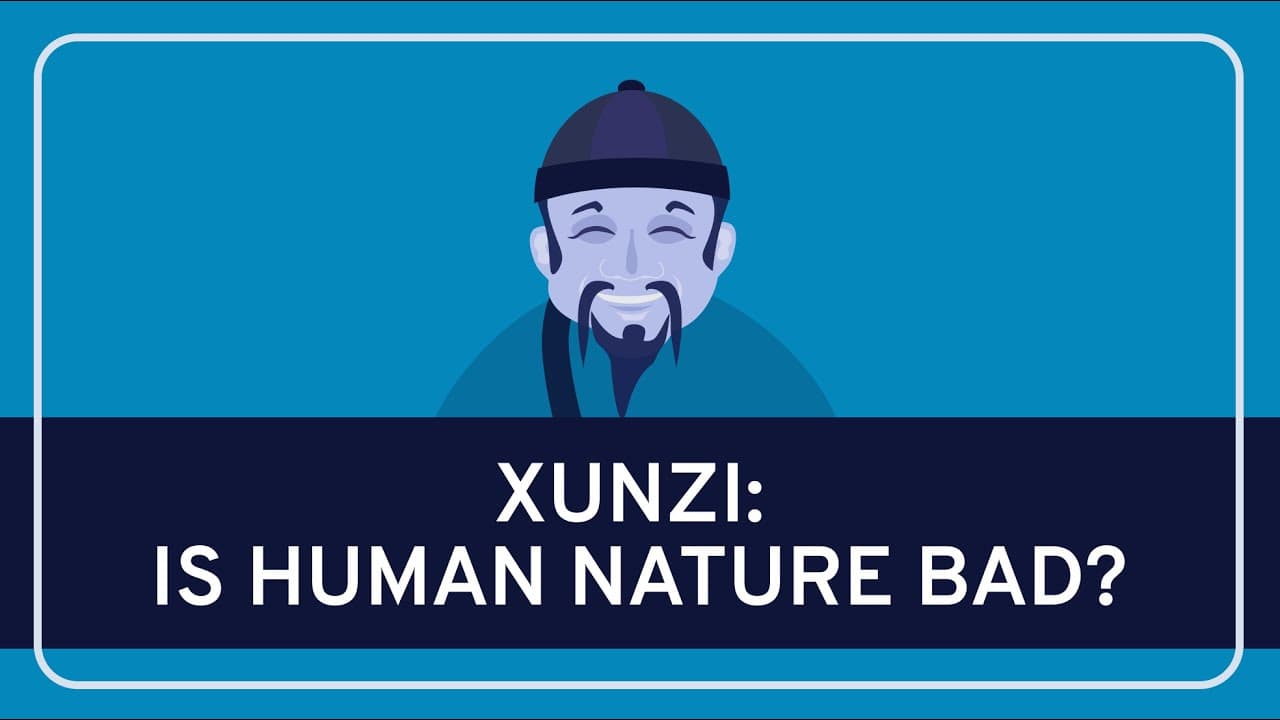
PHILOSOPHY - Ancient: Xunzi on Human Nature [HD]
TL;DR
Xunzi argues human nature is inherently bad, requiring rituals for moral development.
Transcript
(intro music) Hello! I'm David Wong, a professor of philosophy at Duke University, and I'm going to talk about Xunzi, an early Chinese philosopher who lived during the fourth and third century BCE. He was a follower of Confucius and is best known for his view that human nature is bad. He explicitly criticized another Confucian named Mengzi, or, as ... Read More
Key Insights
- Xunzi, an early Chinese philosopher, contended that human nature is inherently bad, opposing Mengzi's view of inherent goodness.
- Mengzi likened human moral potential to sprouts needing nurturing to grow into goodness, contrasting with Xunzi's view.
- Xunzi believed that human beings have natural tendencies toward profit, hatred, and sensual pleasure, leading to conflict.
- He argued that intelligence allows humans to transform these tendencies through rituals and moral education.
- Rituals, according to Xunzi, were created by sages to curb selfish desires and promote social harmony.
- The village drinking ceremony exemplifies how rituals teach respect and community dependence through structured social interactions.
- Xunzi used the metaphor of craftsmen, suggesting humans must actively shape themselves into moral beings.
- Despite his view of bad human nature, Xunzi acknowledged innate impulses that, when nurtured by rituals, promote social cohesion.
Install to Summarize YouTube Videos and Get Transcripts
Explore YouTube Video Summarizer or Get YouTube Transcript Extractor
Questions & Answers
Q: What is Xunzi's main argument about human nature?
Xunzi's main argument is that human nature is inherently bad, characterized by tendencies towards greed, hatred, and sensual pleasure. He believed that without intervention, these natural inclinations would lead to conflict and chaos. Therefore, he emphasized the importance of rituals and moral education to transform these tendencies into harmonious and socially beneficial behaviors.
Q: How does Xunzi's view contrast with Mengzi's perspective on human nature?
Xunzi's view contrasts with Mengzi's in that Mengzi believed human nature is inherently good, with moral potential akin to sprouts that need nurturing to grow. In contrast, Xunzi argued that human nature is inherently bad, requiring the guidance of rituals and moral education to transform negative tendencies into positive behaviors and social harmony.
Q: What role do rituals play in Xunzi's philosophy?
In Xunzi's philosophy, rituals play a crucial role in transforming human nature. He believed that rituals, developed by ancient sages, help curb selfish desires and promote social harmony by teaching respect and community dependence. Rituals are seen as instruments for crafting individuals into moral beings, counteracting their natural negative inclinations.
Q: Can you explain the metaphor Xunzi uses for human moral development?
Xunzi uses the metaphor of craftsmen to describe human moral development. He likens humans to potters who must actively shape the raw material of their nature into something beautiful and harmonious. This process involves using the tools provided by rituals and moral education to transform innate negative tendencies into positive, socially constructive behaviors.
Q: What is the significance of the village drinking ceremony in Xunzi's philosophy?
The village drinking ceremony is significant in Xunzi's philosophy as it exemplifies how rituals teach social values and cohesion. In this ceremony, participants drink from a single cup in order of seniority, fostering respect for elders and a sense of community dependence. This ritual illustrates how structured social interactions can transform individual tendencies towards social harmony.
Q: How does Xunzi address the problem of transforming bad human nature?
Xunzi addresses the problem of transforming bad human nature by emphasizing the role of rituals and moral education. He believed that while humans are born with negative tendencies, they also possess intelligence that allows them to recognize and correct these tendencies. Rituals, by providing structured social practices, help strengthen positive impulses and promote social harmony.
Q: What examples does Xunzi use to illustrate natural impulses that can be nurtured by rituals?
Xunzi uses the example of birds and elephants to illustrate natural impulses that can be nurtured by rituals. He notes that creatures naturally grieve for lost members of their kind, suggesting an innate capacity for empathy and social bonds. Rituals, such as mourning practices, can strengthen these impulses, fostering social cohesion and moral development.
Q: How does Xunzi's philosophy view the role of sages in human moral development?
In Xunzi's philosophy, sages play a pivotal role in human moral development. He believed that in ancient times, sages recognized the destructive potential of unrestrained human nature and created rituals to guide individuals towards social harmony. These rituals serve as tools for transforming negative inclinations into positive behaviors, underscoring the sages' foresight and wisdom in shaping moral society.
Summary & Key Takeaways
-
Xunzi, a follower of Confucius, argued against Mengzi's belief in the inherent goodness of human nature, proposing instead that humans are born with negative tendencies like greed and hatred.
-
Xunzi believed that the sages of ancient times developed rituals to curb these tendencies, allowing humans to transform their nature into something harmonious and beautiful.
-
Through rituals such as the village drinking ceremony and mourning practices, Xunzi argued that humans can strengthen positive impulses and foster social harmony.
Read in Other Languages (beta)
Share This Summary 📚
Summarize YouTube Videos and Get Video Transcripts with 1-Click
Try YouTube Summary with ChatGPT & Claude or YouTube Transcript Generator
Explore More Summaries from Wireless Philosophy 📚

![PHILOSOPHY - Rational Choice Theory: What are Public Goods? [HD] thumbnail](/_next/image?url=https%3A%2F%2Fi.ytimg.com%2Fvi%2FoTIu12zqf04%2Fhqdefault.jpg&w=750&q=75)
Summarize YouTube Videos and Get Video Transcripts with 1-Click
Try YouTube Summary with ChatGPT & Claude or YouTube Transcript Generator