What Key Concepts in Respiratory Physiology for MRCP?
TL;DR
Master essential respiratory physiology concepts for your MRCP Part-1 exam, covering airway anatomy, lung volumes, and pulmonary mechanics. Understand the clinical implications of ventilation-perfusion relationships, gas exchange, and flow volume loops in conditions such as asthma and COPD to enhance your exam preparation.
Transcript
hello everyone um my name is naveed dr david i'm a chess physician uh currently working as a consultant national health service uh i've prepared this slide set just to prepare you for the physiology aspect of your mrcp part 1 exam and i hope that you will find this helpful so just to give you an overview of uh things that we will be... Read More
Key Insights
- The respiratory system's basic anatomy includes the trachea, bronchi, bronchioles, and alveoli, where gas exchange occurs.
- Lung volumes such as tidal volume, inspiratory capacity, and residual volume are critical for understanding respiratory mechanics.
- Pulmonary mechanics involve resistance and compliance, with conditions like asthma and COPD affecting airway resistance.
- Ventilation and perfusion ratios differ across the lung, with higher ratios at the apex due to gravitational effects.
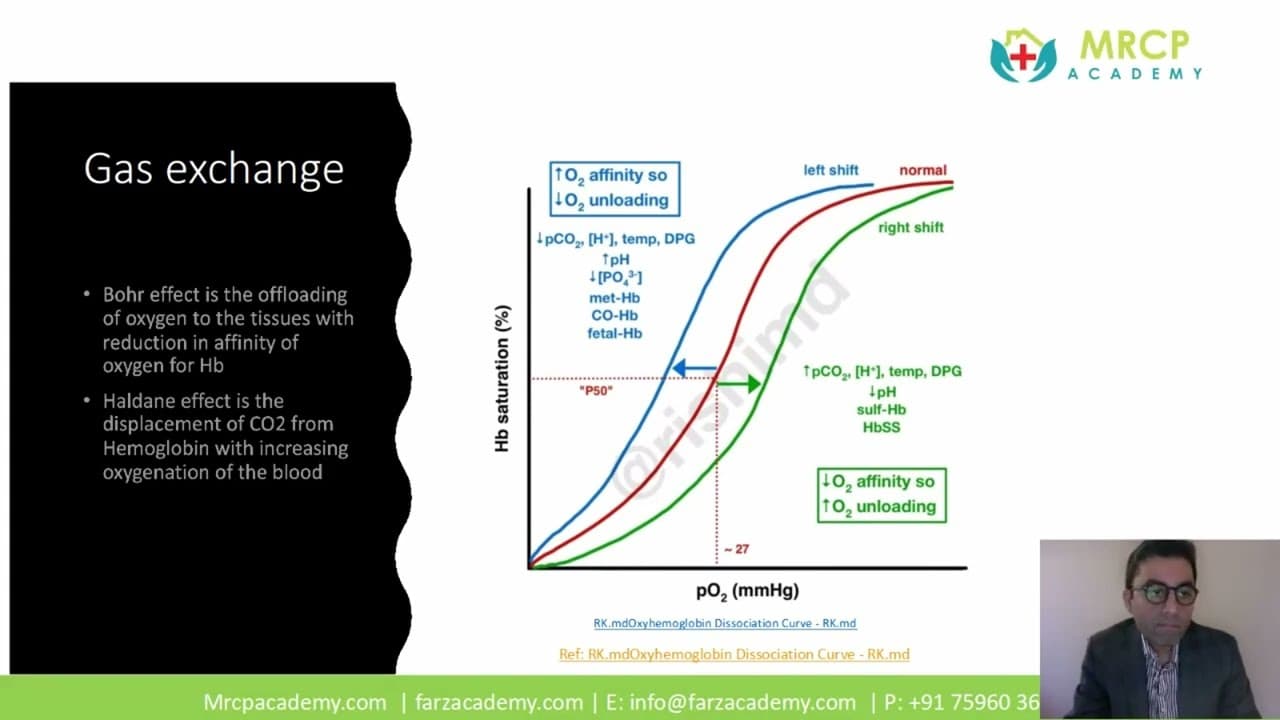
- The hemoglobin-oxygen dissociation curve is crucial for understanding oxygen transport and factors causing curve shifts.
- Carbon dioxide transport is primarily in bicarbonate form, with the Haldane effect influencing CO2 displacement.
- Respiratory control centers include central and peripheral chemoreceptors, responding to changes in pH, CO2, and O2 levels.
- Flow volume loops vary with respiratory conditions, showing characteristic patterns in COPD, asthma, and obstructions.
Install to Summarize YouTube Videos and Get Transcripts
Explore YouTube Video Summarizer or Get YouTube Transcript Extractor
Questions & Answers
Q: What is the basic anatomy of the airways discussed?
The basic anatomy of the airways includes the trachea, which starts from the vocal cords, dividing into right and left main bronchi. These further subdivide into secondary and tertiary bronchi, leading to bronchioles and terminal bronchioles. The terminal bronchioles are part of the acinus, the lung's functional unit, containing alveoli and surrounded by pulmonary capillaries.
Q: How are lung volumes categorized?
Lung volumes are categorized into tidal volume, inspiratory reserve volume, expiratory reserve volume, residual volume, inspiratory capacity, functional residual capacity, vital capacity, and total lung capacity. These volumes help assess different aspects of lung function and are affected by various respiratory conditions like emphysema and obesity.
Q: What are the key components of pulmonary mechanics?
Pulmonary mechanics involve resistance and compliance. Resistance is related to airway diameter, increasing in conditions like asthma and COPD. Compliance refers to lung stretchability, affected by factors like pulmonary edema and fibrosis. Understanding these components is crucial for diagnosing and managing respiratory diseases.
Q: Why is the ventilation-perfusion ratio important?
The ventilation-perfusion ratio is important because it indicates the efficiency of gas exchange in the lungs. It varies from the apex to the base due to gravitational effects, with a higher ratio at the apex. This concept is vital for understanding respiratory physiology and diagnosing conditions affecting gas exchange.
Q: What factors cause shifts in the hemoglobin-oxygen dissociation curve?
Factors causing shifts in the hemoglobin-oxygen dissociation curve include changes in pCO2, pH, temperature, and the presence of different hemoglobins. A left shift indicates increased oxygen affinity, while a right shift suggests enhanced oxygen delivery to tissues. These shifts are significant for understanding oxygen transport and clinical conditions affecting it.
Q: How is carbon dioxide transported in the blood?
Carbon dioxide is primarily transported in the blood as bicarbonate, with some dissolved in plasma and bound to hemoglobin. The Haldane effect describes CO2 displacement from hemoglobin with increased oxygenation. Understanding CO2 transport is essential for managing conditions like COPD, where CO2 retention is a concern.
Q: What role do respiratory control centers play?
Respiratory control centers, including central and peripheral chemoreceptors, regulate breathing by responding to changes in pH, CO2, and O2 levels. Central chemoreceptors in the medulla respond to pH and CO2, while peripheral chemoreceptors in the aortic and carotid bodies respond to hypoxemia. These centers ensure proper respiratory function and adaptation to physiological changes.
Q: What do flow volume loops indicate in respiratory conditions?
Flow volume loops provide insights into respiratory conditions by illustrating airflow patterns during inspiration and expiration. In COPD, loops show early airway collapse, while asthma presents with a smoother decline. Obstructions cause characteristic dampening of loops. Understanding these patterns aids in diagnosing and differentiating respiratory pathologies.
Summary & Key Takeaways
-
Dr. Nawaid Ahmad provides a detailed overview of respiratory physiology, focusing on aspects crucial for the MRCP Part-1 exam. Key topics include airway anatomy, lung volumes, and pulmonary mechanics, essential for understanding respiratory function and disease.
-
The presentation covers ventilation-perfusion relationships, hemoglobin-oxygen dissociation, and carbon dioxide transport, emphasizing their physiological and clinical significance. Dr. Ahmad explains how these concepts relate to common respiratory conditions like asthma and COPD.
-
Flow volume loops are analyzed to illustrate different respiratory pathologies, highlighting their diagnostic value. The session concludes with a summary of key points and their relevance to the MRCP exam, offering a comprehensive study resource.
Read in Other Languages (beta)
Share This Summary 📚
Summarize YouTube Videos and Get Video Transcripts with 1-Click
Try YouTube Summary with ChatGPT & Claude or YouTube Transcript Generator
Explore More Summaries from Farz Auxiliar Academy 📚
Summarize YouTube Videos and Get Video Transcripts with 1-Click
Try YouTube Summary with ChatGPT & Claude or YouTube Transcript Generator