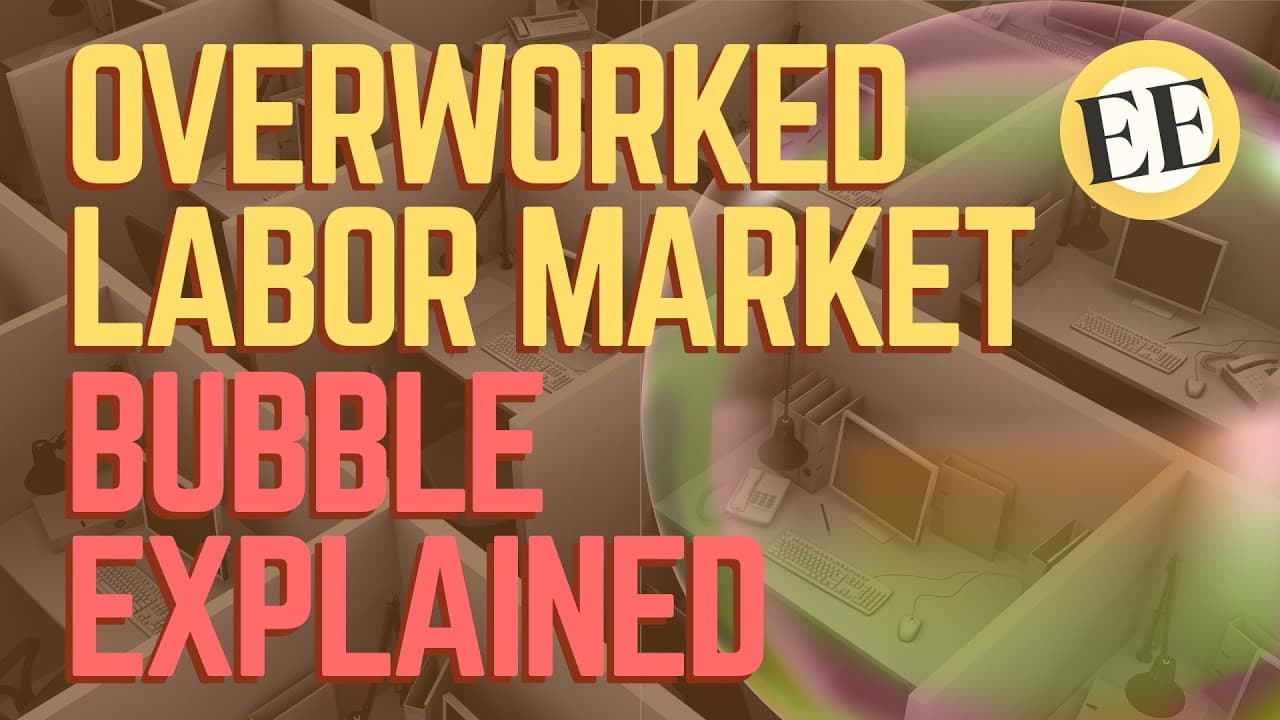
Why is Working Harder Making Us Poorer?
TL;DR
Overworking doesn't necessarily lead to economic prosperity.
Transcript
There is a measure in economics called labor productivity. This is is a really important statistic because it tells us a lot about how any particular economy functions, and perhaps most importantly what it values. Remember above all else Economics is a study of how people interact with things of value. So what labor productivity measures is th... Read More
Key Insights
- Labor productivity measures output per hour of work, revealing how economies value work and efficiency.
- Despite technological advancements, modern workers face new challenges, like hustle culture and constant availability.
- The historical shift from rural to urban jobs brought stability but decreased marginal utility in work hours.
- Technological advancements reduced working hours in the early 20th century, but expectations have since increased.
- The post-WWII era saw a rise in dual-income households, reducing reported leisure time for families.
- Countries with fewer annual working hours, like Germany, often have higher per capita wealth, suggesting efficiency over time spent.
- Free time is crucial for productivity, entrepreneurship, and maintaining a healthy work-life balance.
- The current economic system struggles to balance consumer demands with worker well-being, requiring systemic changes.
Install to Summarize YouTube Videos and Get Transcripts
Explore YouTube Video Summarizer or Get YouTube Transcript Extractor
Questions & Answers
Q: What does labor productivity measure?
Labor productivity measures the amount of output generated for every hour of work done in a particular nation. It is calculated by dividing the national GDP by the total hours worked in a given year. This statistic is crucial as it reveals how efficiently an economy utilizes its labor force and what it values in terms of work and productivity.
Q: How has the nature of work changed since the early 1900s?
Since the early 1900s, work has shifted from rural, farm-based jobs to urban, industrial jobs. This transition brought stability and predictable income, unlike the uncertain returns of farming. However, it also led to a decrease in the marginal utility of work hours, as industrial jobs were more time-dependent. Technological advancements initially reduced working hours but later increased expectations and demands on workers.
Q: Why are countries with fewer working hours often wealthier?
Countries with fewer working hours, such as Germany, tend to be wealthier per capita due to their focus on efficiency over time spent. These nations prioritize output and results rather than clocking in hours. This approach allows workers to be more productive, well-rested, and capable of pursuing entrepreneurial ventures, contributing to the overall wealth and economic health of the country.
Q: What impact did World War II have on work culture?
World War II significantly impacted work culture by introducing women to the workforce in large numbers while men were fighting. It also increased pressure on workers to produce more, as the war effort required substantial industrial output. This period saw a shift towards more demanding work schedules, which persisted even after the war, influencing the modern work culture of longer hours and increased productivity expectations.
Q: How does hustle culture affect modern workers?
Hustle culture affects modern workers by promoting constant availability and glorifying long hours under the guise of professionalism. This culture leads to increased monitoring and scrutiny of performance, contributing to a stressful work environment. It often results in workers being overworked, with little regard for their mental and physical well-being, as the focus remains on productivity and economic gains.
Q: What role does technology play in modern work environments?
Technology plays a dual role in modern work environments. On one hand, it enhances productivity by automating tasks and facilitating communication. On the other hand, it increases expectations for constant availability and immediate responsiveness. This has led to blurred boundaries between work and personal life, as workers are expected to be reachable outside of traditional work hours, contributing to the overworking trend.
Q: Why is free time important for economic health?
Free time is important for economic health because it allows individuals to rest, recharge, and pursue personal interests, leading to increased productivity and creativity. It also provides opportunities for entrepreneurship and innovation, as individuals have the time and energy to explore new ideas. A balanced work-life schedule contributes to a healthier, more satisfied workforce, which ultimately benefits the economy.
Q: What are potential solutions to the overworking problem?
Potential solutions to the overworking problem include promoting work-life balance through flexible work arrangements, emphasizing efficiency over hours worked, and redefining success metrics to focus on output rather than time spent. Encouraging businesses to adopt policies that prioritize employee well-being, such as limited after-hours communication, can also help. On a societal level, challenging consumer expectations for constant availability may lead to systemic improvements.
Summary & Key Takeaways
-
The video explores the concept of labor productivity and how it reflects an economy's values. It highlights that modern workers are highly efficient but face new challenges like hustle culture and constant availability.
-
The shift from rural to urban jobs in the early 1900s brought stability but reduced the marginal utility of work hours. Technological advancements initially reduced working hours, but expectations have since increased.
-
Countries with fewer annual working hours, like Germany, often have higher per capita wealth, suggesting that efficiency and free time are crucial for productivity, entrepreneurship, and maintaining a healthy work-life balance.
Read in Other Languages (beta)
Share This Summary 📚
Summarize YouTube Videos and Get Video Transcripts with 1-Click
Try YouTube Summary with ChatGPT & Claude or YouTube Transcript Generator
Explore More Summaries from Economics Explained 📚




Summarize YouTube Videos and Get Video Transcripts with 1-Click
Try YouTube Summary with ChatGPT & Claude or YouTube Transcript Generator