System Design on AWS Course
TL;DR
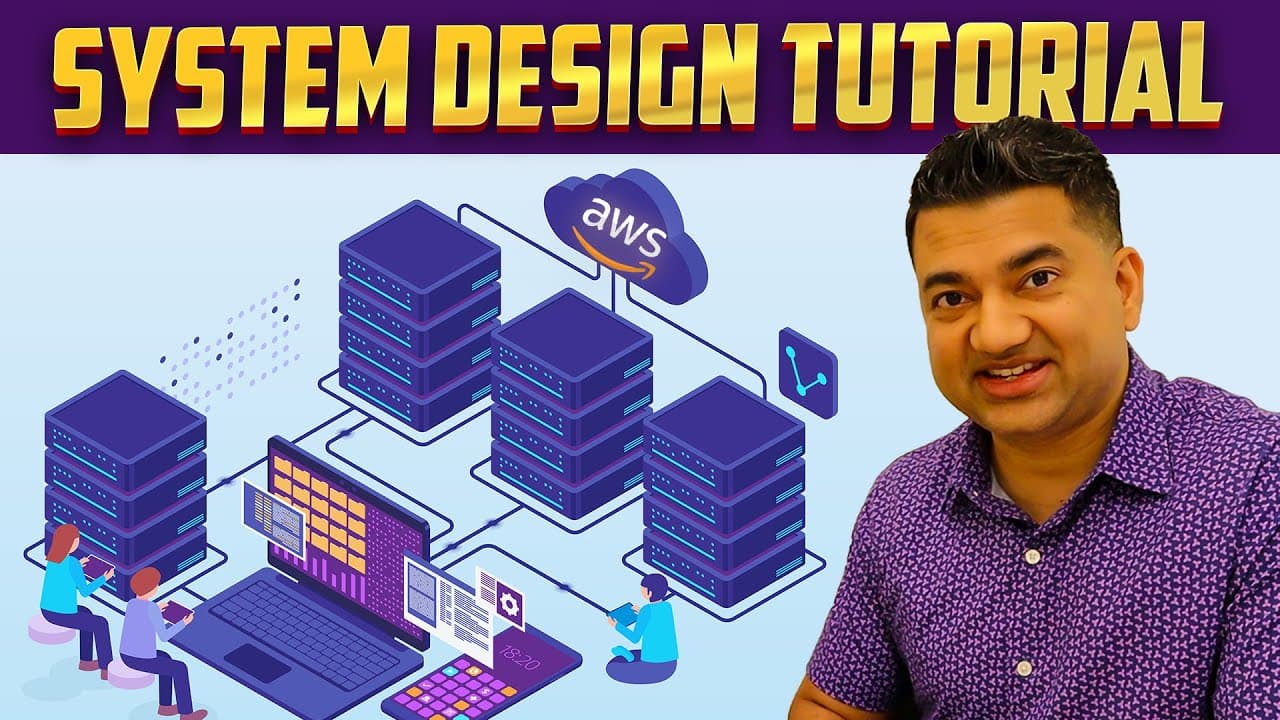
This content provides a comprehensive overview of system design concepts, including monolith versus microservices, load balancers, API gateways, scaling in virtual machines, serverless, and containers, as well as real-world scaling interview tips and a three-tier architecture design.
Transcript
welcome guys and girls to the system design course if you are someone who is preparing for an upcoming system design interview or you want to know how different system design concepts are put together to create modern applications this course is for you this course will teach you the basics and set you up to learn more intermediate and advanced con... Read More
Key Insights
- ⚖️ Monolith applications are simple and resource-efficient at a small scale but become challenging to scale and maintain as projects grow.
- 🔠 APIs can be used with monolith or microservices architectures and can be fronted by load balancers or API gateways.
- ⚖️ Scaling in virtual machines requires scaling the entire monolith, while microservices can be scaled independently.
- 😒 Microservices allow for independent scaling, different programming languages, and faster deployment, but may use the same database for multiple services.
- 🐕🦺 Amazon EC2, AWS Lambda, and container services like Amazon EKS and ECS can be used to implement microservices on AWS.
- 🎨 Application Load Balancer and Network Load Balancer offer different routing options within a system design.
- 🐕🦺 API Gateway provides request validation, response mapping, and integration with different AWS services for serverless architectures.
- 🚥 Horizontal scaling is more suitable for massively scalable and distributed systems, while vertical scaling has limitations and can be costly.
- ✋ AWS native databases like Amazon Aurora and Amazon DynamoDB offer high availability, fault protection, and replication.
- 🔒 Proper network security measures should be implemented, including using private subnets and integrating web application firewalls.
- ✋ Caching can be utilized at different layers of the architecture to improve performance and handle high traffic.
Install to Summarize YouTube Videos and Get Transcripts
Explore YouTube Video Summarizer or Get YouTube Transcript Extractor
Questions & Answers
Q: What is the difference between monolith and microservices?
Monolith is a single-tiered software application where the user interface and data access code are combined into a single program. Microservices, on the other hand, are a type of architecture where an application is composed of loosely coupled services that can be developed and deployed independently.
Q: How does scaling in virtual machines differ from scaling in serverless architectures?
Scaling in virtual machines involves adding more resources, such as CPU and RAM, to existing servers in order to handle increased traffic. In serverless architectures, scaling is automatic and dynamic, with additional instances of functions being spun up as needed to handle incoming requests.
Q: What are some advantages of using microservices?
Microservices offer independent scaling, modularity, and faster deployment. They allow different teams to work on different services, can be written in different programming languages, and can be deployed independently of each other.
Q: How can load balancers and API gateways be used in a system design?
Load balancers distribute incoming application traffic across multiple targets, such as EC2 instances or containers, to ensure scalability and high availability. API gateways act as a connection between the user interface and the backend services, handling traffic management, authentication, and other features.
Key Insights:
- Monolith applications are simple and resource-efficient at a small scale but become challenging to scale and maintain as projects grow.
- APIs can be used with monolith or microservices architectures and can be fronted by load balancers or API gateways.
- Scaling in virtual machines requires scaling the entire monolith, while microservices can be scaled independently.
- Microservices allow for independent scaling, different programming languages, and faster deployment, but may use the same database for multiple services.
- Amazon EC2, AWS Lambda, and container services like Amazon EKS and ECS can be used to implement microservices on AWS.
- Application Load Balancer and Network Load Balancer offer different routing options within a system design.
- API Gateway provides request validation, response mapping, and integration with different AWS services for serverless architectures.
- Horizontal scaling is more suitable for massively scalable and distributed systems, while vertical scaling has limitations and can be costly.
- AWS native databases like Amazon Aurora and Amazon DynamoDB offer high availability, fault protection, and replication.
- Proper network security measures should be implemented, including using private subnets and integrating web application firewalls.
- Caching can be utilized at different layers of the architecture to improve performance and handle high traffic.
- Database optimization techniques, such as read replicas and query tuning, can be implemented to handle high traffic and improve performance.
Summary & Key Takeaways
-
The content is a system design course that covers various topics such as monolith versus microservices, load balancers, API gateways, scaling in virtual machines, serverless, and containers.
-
The course provides an introduction to system design concepts and sets the foundation for learning more intermediate and advanced concepts.
-
It emphasizes the differences between monolith and microservices, the scaling challenges of monolith applications, and the benefits of using microservices.
-
The content also explores different scaling techniques for virtual machines, serverless architectures, and containers, as well as real-world scaling interview tips.
-
Finally, the course includes a practical exercise to design a three-tier architecture.
Read in Other Languages (beta)
Share This Summary 📚
Summarize YouTube Videos and Get Video Transcripts with 1-Click
Try YouTube Summary with ChatGPT & Claude or YouTube Transcript Generator
Explore More Summaries from Cloud With Raj 📚
Summarize YouTube Videos and Get Video Transcripts with 1-Click
Try YouTube Summary with ChatGPT & Claude or YouTube Transcript Generator