Reservoir Sedimentation and It's Control Measures - Water Resource Engineering 1
TL;DR
Reservoir sedimentation occurs when sediment in rivers settles at the bottom of a reservoir, reducing its water storing capacity. Various control measures can be implemented to minimize sediment deposition.
Transcript
hello everyone in this video we are going to discuss the concept of reservoir sedimentation and then how do we control it so let's start now what is the concept of the reservoir sedimentation so every natural stream which is usually known as the river it carries certain amount of the sediment load now this is because of the this is because of the b... Read More
Key Insights
- 💦 Reservoir sedimentation occurs when sediment carried by rivers settles at the bottom of the reservoir, reducing its water storage capacity.
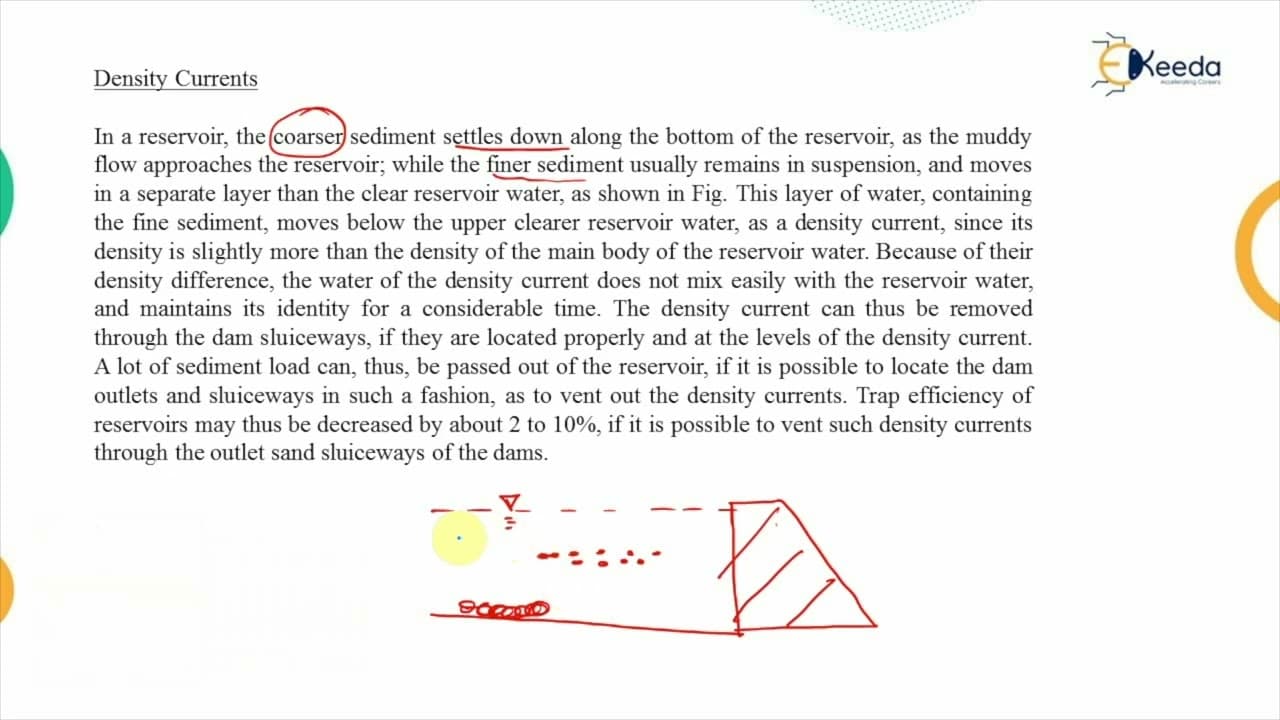
- 🛌 Sediments in a reservoir can be classified as settled sediments (attached to the bed) and suspended sediments (kept in suspension by flow currents).
- 🥺 The deposition of sediments in a reservoir leads to a decrease in water storage capacity, making it necessary to implement control measures.
- 😲 Control measures for reservoir sedimentation include selecting dam sites with less erodible catchments, constructing dams in stages, and building check dams to control sediment inflow.
- 😲 Vegetation screens and under sluices in dams can also aid in sediment control.
- 🏣 Post-construction measures for sediment control include removing post-flood water, mechanically stirring sediment, and implementing erosion control and soil conservation measures.
Install to Summarize YouTube Videos and Get Transcripts
Explore YouTube Video Summarizer or Get YouTube Transcript Extractor
Questions & Answers
Q: What causes sediment to settle at the bottom of a reservoir?
Sediment settles at the bottom of a reservoir due to gravitational force and the reduction in velocity and turbulence near the dam.
Q: What happens to fine sediment particles in a reservoir?
Fine sediment particles may remain in suspension for longer periods, escaping from the dam along with the discharged water.
Q: What is the importance of reservoir sedimentation?
Reservoir sedimentation reduces water storage capacity, and if left uncontrolled, can render a reservoir useless over time.
Q: How is the trap efficiency of a reservoir measured?
The trap efficiency is the ratio of sediments deposited in the reservoir to the total sediment flow. Most reservoirs trap 95-100% of the sediment.
Summary & Key Takeaways
-
Reservoir sedimentation occurs when sediment carried by rivers settles at the bottom of a reservoir, reducing its capacity for storing water.
-
Sediments can be classified as settled sediments (attached to the bed) and suspended sediments (kept in suspension by currents in the flow).
-
Sediment deposition in a reservoir can lead to a decrease in water storage capacity, rendering the reservoir useless over time.
Read in Other Languages (beta)
Share This Summary 📚
Summarize YouTube Videos and Get Video Transcripts with 1-Click
Try YouTube Summary with ChatGPT & Claude or YouTube Transcript Generator
Explore More Summaries from Ekeeda 📚





Summarize YouTube Videos and Get Video Transcripts with 1-Click
Try YouTube Summary with ChatGPT & Claude or YouTube Transcript Generator