Inverse relationship between capital price and returns | Macroeconomics | Khan Academy
TL;DR
Private capital accumulation and returns can be influenced by various factors such as increased income generation, more capital chasing fewer projects, and changes in risk tolerance.
Transcript
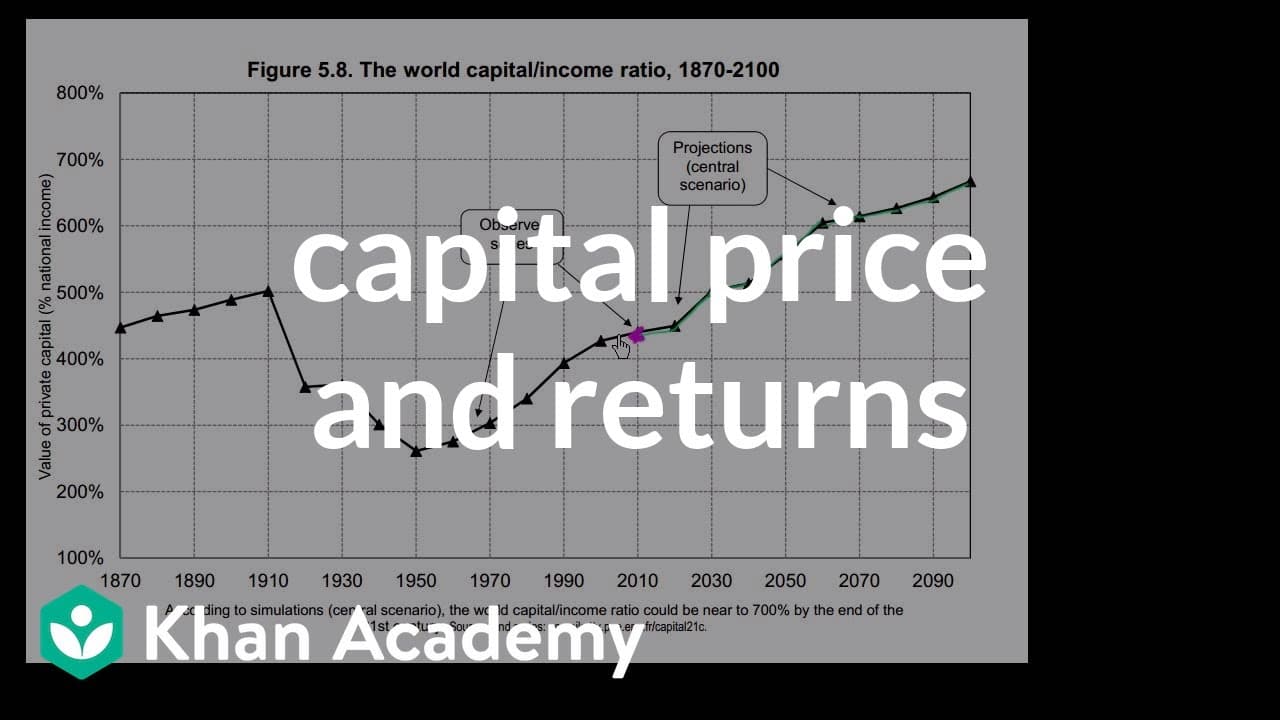
- [Instructor] So much of Piketty's book is about this idea of more and more returns to capital, that the return to capital is going to grow faster than the growth of the economy. We see charts like this, where we have the value of private capital as a percentage of income. And we see this dynamic, and we see this dynamic played out in multiple cha... Read More
Key Insights
- 🔠 The rise and fall of private capital as a percentage of income illustrate the changing dynamics of capital accumulation and returns.
- 🧑🏭 The value of an asset can increase due to factors such as increased income generation or more capital chasing fewer projects.
- ✳️ Risk aversion and risk tolerance can play a significant role in determining the expected returns on capital and asset values.
- 🫱 The historical context, including major wars and periods of unrest, can influence risk preferences and impact private capital accumulation.
- 🔠 The composition of capital has evolved over time, with land representing a smaller percentage compared to created capital, technology, and intellectual property.
- 🧑🏭 It is important to consider multiple factors and make judgments based on the specific context when interpreting trends in private capital and returns.
- ↩️ Increasing private capital accumulation does not automatically imply higher returns; it could indicate lower expected returns due to more capital chasing fewer projects.
Install to Summarize YouTube Videos and Get Transcripts
Explore YouTube Video Summarizer or Get YouTube Transcript Extractor
Questions & Answers
Q: What is the relationship between the value of private capital and income generation?
The value of private capital can increase if an asset starts generating more income, indicating that capital is becoming more valuable and capable of capturing higher returns.
Q: How can more capital and fewer projects impact the value of assets?
When there is more capital available but fewer projects to invest in, the value of assets can increase as individuals bid up prices, resulting in a lower expected return on capital.
Q: How does risk aversion and risk tolerance affect the expected returns on capital?
In a risk-averse environment, investors demand higher returns on their capital. However, in a more risk-tolerant world, investors are willing to accept lower returns, leading to higher asset values.
Q: Does the trend of increasing private capital accumulation indicate a return to a Gilded Age?
The trend of increasing private capital accumulation is not necessarily indicative of a return to a Gilded Age. It could be a sign of more capital chasing fewer projects or a reflection of changing risk preferences among investors.
Summary & Key Takeaways
-
Private capital as a percentage of income has fluctuated over time, with peaks and dips in different eras, suggesting the changing dynamics of capital accumulation and returns.
-
The value of an asset can increase if it starts generating more income or if there is more capital chasing fewer projects, leading to a higher valuation.
-
Risk aversion and risk tolerance can also impact the expected returns on capital, with a more risk-tolerant environment leading to lower expected returns and higher asset values.
Read in Other Languages (beta)
Share This Summary 📚
Summarize YouTube Videos and Get Video Transcripts with 1-Click
Try YouTube Summary with ChatGPT & Claude or YouTube Transcript Generator
Explore More Summaries from Khan Academy 📚



Summarize YouTube Videos and Get Video Transcripts with 1-Click
Try YouTube Summary with ChatGPT & Claude or YouTube Transcript Generator