How to Calculate the Stress Concentration Factor for Design
TL;DR
To calculate the stress concentration factor for a gray cast iron plate under fluctuating loads, first determine the nominal stress based on the smallest diameter and thickness. Using charts for stress concentration factors and applying the maximum allowable stress with a factor of safety, the required thickness is calculated to be 9 millimeters to prevent failure.
Transcript
click the bell icon to get latest videos from equator hello friends welcome back to the subject of machine design one where in the model number 4 where in the last session we have seen what is the stress concentration factor and what are the factors which are getting affected due to it and what are the factors we can implement so as to reduce it in... Read More
Key Insights
- 😥 Stress concentration factor is crucial in analyzing the potential failure points in a structure and determining the required design changes.
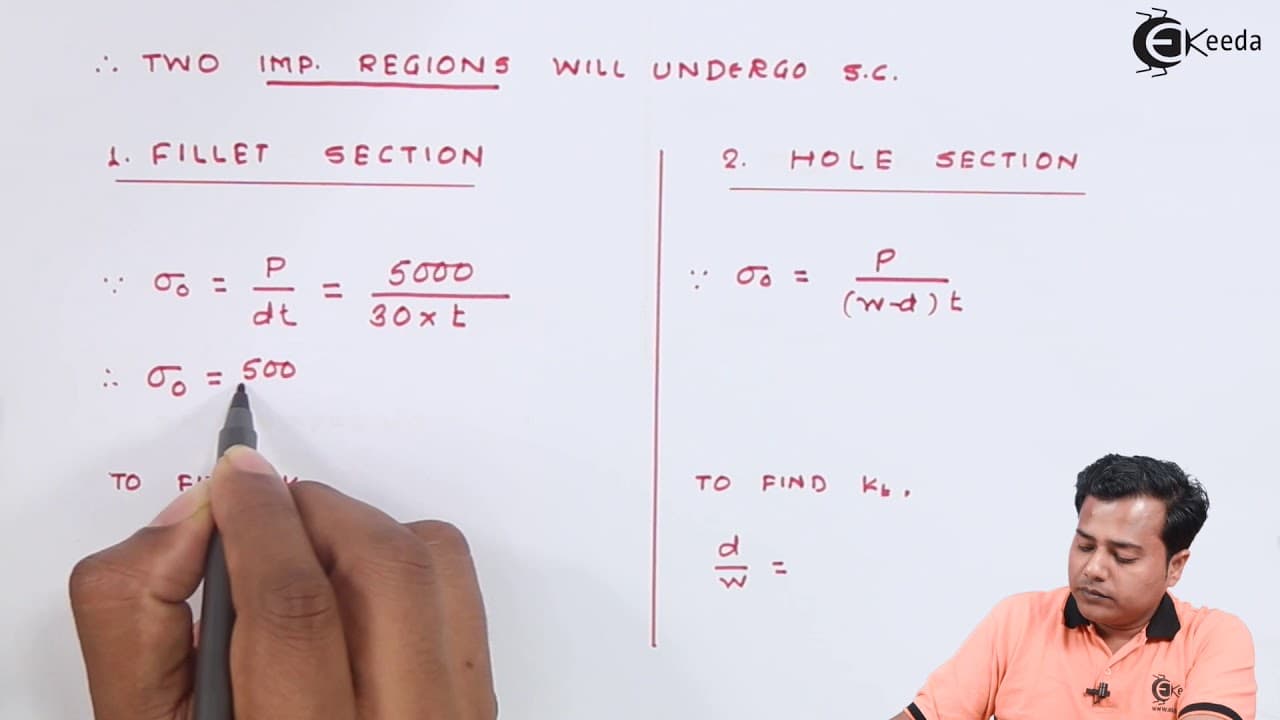
- 🕳️ Different sections of a plate, such as fillet and hole sections, can experience different stress concentration effects.
- 🥳 The stress concentration factor can be obtained using ratio-based charts or tables available in design data books.
Install to Summarize YouTube Videos and Get Transcripts
Explore YouTube Video Summarizer or Get YouTube Transcript Extractor
Questions & Answers
Q: What is the main objective of the video?
The video aims to solve a numerical problem related to stress concentration and plate thickness determination in machine design.
Q: How is the stress concentration factor calculated for the fillet and hole sections?
The stress concentration factor is obtained by using ratios of certain dimensions, such as the ratio of diameter to width (D/W) for the fillet section and hole section.
Q: How is the maximum stress calculated?
The maximum stress is calculated by multiplying the stress concentration factor with the nominal stress induced in the respective sections.
Q: How is the required thickness of the plate determined?
The required thickness is calculated by dividing the ultimate stress value by the factor of safety and setting it equal to the maximum stress value. Solving this equation gives the desired thickness.
Summary & Key Takeaways
-
The video explains the problem statement of determining the thickness of a gray cast iron plate to prevent failure under fluctuating loads.
-
The stress concentration and nominal stress values are calculated for different sections of the plate, namely the fillet and hole sections.
-
By considering the maximum stress and factor of safety, the required thickness of the plate is determined to be 9 millimeters.
Read in Other Languages (beta)
Share This Summary 📚
Summarize YouTube Videos and Get Video Transcripts with 1-Click
Try YouTube Summary with ChatGPT & Claude or YouTube Transcript Generator
Explore More Summaries from Ekeeda 📚

Summarize YouTube Videos and Get Video Transcripts with 1-Click
Try YouTube Summary with ChatGPT & Claude or YouTube Transcript Generator