How to Perform the Push Operation in a Stack
TL;DR
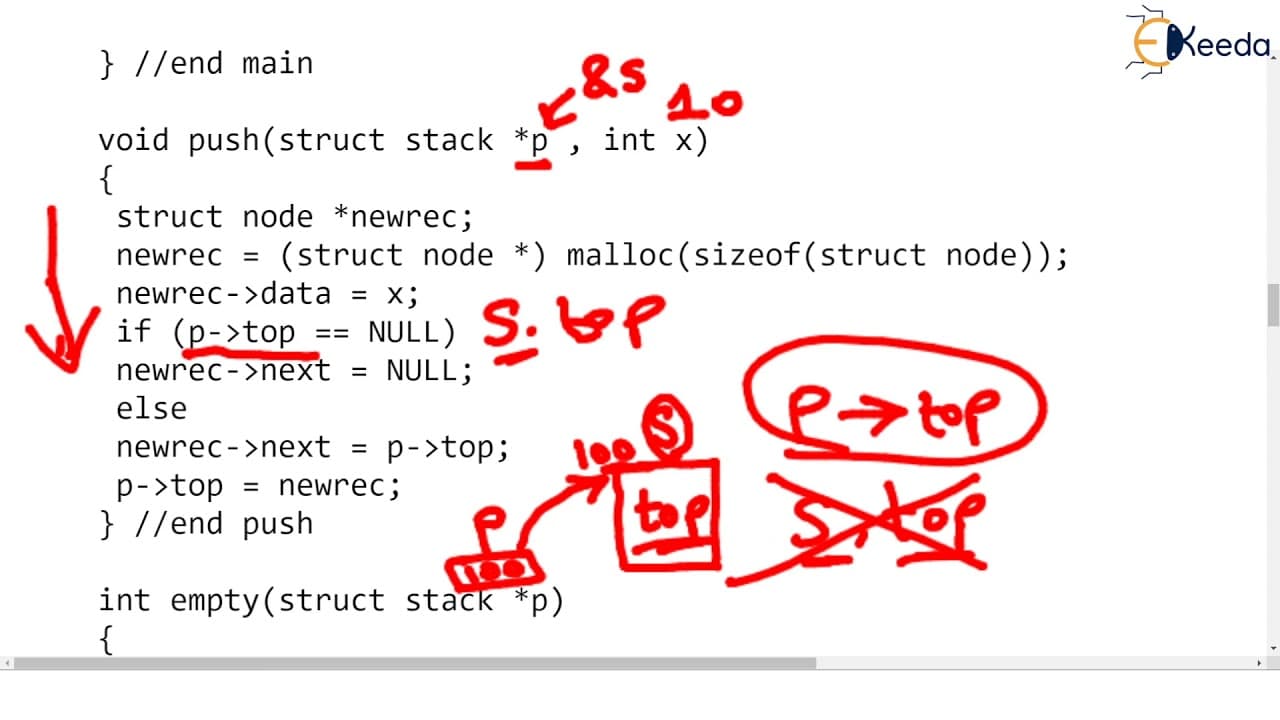
To perform the push operation in a stack, call the push function with the address of the stack and the value to push as parameters. The function allocates memory for a new node, sets its data, links its next pointer to the current top node, and updates the top pointer to the new node, allowing multiple values to be added to the stack.
Transcript
hello dear students let us see how to push a new node in the stack so we are looking at a function called push function it is very important first of all to know that how is this push function called or invoked from main function so let's go to main and just check the call to push now here is main which is menu driven main the main has been written... Read More
Key Insights
- 🫷 The push function is called by passing the address of the stack and the value to push as parameters.
- 🫷 The push function creates a new node, allocates memory for it, and updates its data value.
- 😫 The next pointer of the new node is set to the current top of the stack.
- 😥 The top pointer of the stack is updated to point to the new node.
- ❤️🩹 The variables created within the push function are deleted after the function ends.
- 👻 Passing the address of the stack allows the push function to directly modify the stack.
- 🫷 The push function can be called multiple times to add multiple values to the stack.
Install to Summarize YouTube Videos and Get Transcripts
Explore YouTube Video Summarizer or Get YouTube Transcript Extractor
Questions & Answers
Q: How is the push function called from the main function?
The push function is called by passing the address of the stack and the value to push as parameters. This ensures that the push function operates on the correct stack.
Q: Why do we pass the address of the stack to the push function?
By passing the address of the stack, we can modify the stack directly within the push function. This allows us to update the top pointer and add new nodes to the stack.
Q: How does the push function create and initialize a new node?
The push function allocates memory for a new node using the malloc function and sets the data value of the new node. It then updates the next pointer of the new node.
Q: What happens to the variables created within the push function after it ends?
The variables created within the push function, such as the new node pointer and the parameter pointer, are deleted or deallocated when the function ends. This frees up memory and prevents memory leaks.
Summary & Key Takeaways
-
The content explains the process of invoking the push function from the main function in a menu-driven program.
-
It details the parameters passed to the push function, including the address of the stack and the value to push.
-
The push function creates a new node, allocates memory for it, sets its data value, and updates the next pointer accordingly.
-
The top pointer of the stack is then updated to point to the newly created node.
Read in Other Languages (beta)
Share This Summary 📚
Summarize YouTube Videos and Get Video Transcripts with 1-Click
Try YouTube Summary with ChatGPT & Claude or YouTube Transcript Generator
Explore More Summaries from Ekeeda 📚




Summarize YouTube Videos and Get Video Transcripts with 1-Click
Try YouTube Summary with ChatGPT & Claude or YouTube Transcript Generator