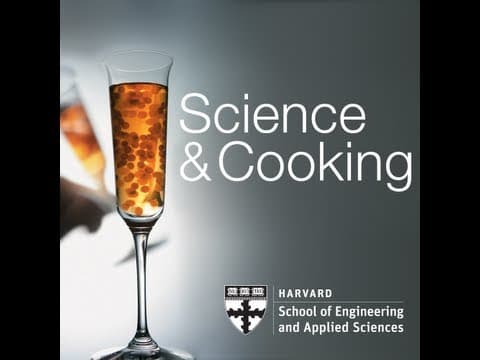
Gelation | Lecture 8 (2010)

Transcript
DAVID WEITZ: So welcome to the next in our series of public lectures in our science and cooking class. We're back in our cozy little room, so we have to sit on the side and everything. As always, I'd like to begin by thanking the various people who really helped a lot in putting this whole course together. Our sponsors, in particular, we're going t... Read More
Install to Summarize YouTube Videos and Get Transcripts
Explore YouTube Video Summarizer or Get YouTube Transcript Extractor
Summary
In this video, the speaker discusses the science behind gelation and showcases two recipes using gelatin. The speaker also delves into the history of gelatin and how it has been used throughout the years. They emphasize the importance of understanding the different types of gelation and how it can be used to transform liquids into solids. The speaker also touches on the concept of using gelatin in modern cooking and the significance of experimenting with different textures and flavors.
Questions & Answers
Q: How has gelatin been used historically?
Gelatin has been used historically as a glue and a blood replacement. It has also been used in cooking to create gel-like substances that could be easily consumed and sustained individuals during times of famine.
Q: How does gelation work and what is its role in cooking?
Gelation is a process of turning a liquid into a solid by forming a network of cross-links. In cooking, gelation is used to create gels that control the texture of a dish. Gelation allows for the transformation of normally liquid substances into solid ones, opening up a world of possibilities for creating new dishes and textures.
Q: What is spherification and how does it involve gelation?
Spherification is a process in which a gel is formed using alginate and calcium ions. Alginate is a charged polymer that helps create the gel-like texture, while calcium ions act as the gelling agent. The diffusion of calcium ions into the gel helps determine the thickness of the gel shell.
Q: How does the diffusion of ions affect gelation?
The diffusion of ions, specifically calcium ions, into the gel determines the growth and thickness of the gel shell. The diffusion equation helps calculate and predict this growth over time. By understanding the diffusion process, one can control the thickness of the gel and create unique textures in dishes.
Q: How has gelation changed the way we approach cooking?
Gelation has opened up new possibilities in cooking by allowing for the creation of gels that change the texture and presentation of dishes. Chefs can now experiment with different textures, flavors, and presentations by using gelatin and other gelling agents. This has led to innovative cooking techniques and the creation of dishes that push the boundaries of traditional cooking.
Q: How can gelatin be used to create mousses without using heavy cream?
Gelatin can be used as a substitute for heavy cream in creating mousses. By using gelatin and a liquid nitrogen technique, chefs can make mousses that are 100% pure and do not require the addition of heavy cream or fats. Gelatin helps retain the air in the mousse, resulting in a light and airy texture.
Q: What is the significance of using gelatin in modern cooking?
The use of gelatin in modern cooking allows for the creation of unique textures and presentations in dishes. Gelatin provides a versatile and innovative tool for chefs to experiment with and push the boundaries of traditional cooking. It allows for the creation of dishes that are visually stunning and have unexpected textures and flavors.
Q: How does the speaker address the debate between using local and seasonal ingredients versus using innovative cooking techniques?
The speaker emphasizes that both approaches to cooking have their merits and do not have to be in conflict with each other. While it is important to support local farmers and use seasonal ingredients, there is also value in using innovative cooking techniques and exploring new textures and flavors. The speaker encourages a middle ground approach that appreciates the importance of both local ingredients and culinary experimentation.
Q: How does the speaker challenge the traditional use of gelatin in cooking?
The speaker challenges the traditional use of gelatin by showcasing recipes that use gelatin in unconventional ways. They highlight the potential to create mousses without heavy cream and experiment with gelatin to achieve pure flavors and unique textures. The speaker encourages chefs to think beyond traditional methods and push the boundaries of what can be achieved with gelatin in cooking.
Q: How does the speaker convey the significance of food in our lives?
The speaker emphasizes that food is more than just sustenance. It is a unifying force that brings people together and provides a sense of identity. By experimenting with different textures and flavors, chefs can create memorable experiences and showcase the power of food as a form of self-expression and exploration.
Takeaways
The use of gelatin in cooking has a long history and allows for the creation of unique textures and presentations in dishes. Gelation is a process by which a liquid becomes a solid, and its understanding has revolutionized the culinary world. Through techniques like spherification and the use of gellants like gelatin, chefs can create innovative dishes that push the boundaries of traditional cooking. The incorporation of gelatin in mousses allows for the creation of 100% pure flavors without the need for heavy cream. While there is a debate between using local and seasonal ingredients versus using innovative techniques, both have their merits and can coexist in the culinary world. Food is a unifying force that brings people together and provides a sense of identity and exploration.
Read in Other Languages (beta)
Share This Summary 📚
Summarize YouTube Videos and Get Video Transcripts with 1-Click
Try YouTube Summary with ChatGPT & Claude or YouTube Transcript Generator
Explore More Summaries from Harvard University 📚

Summarize YouTube Videos and Get Video Transcripts with 1-Click
Try YouTube Summary with ChatGPT & Claude or YouTube Transcript Generator