Products
Features
YouTube Video Summarizer
Summarize YouTube videos
Web & PDF Highlighter
Highlight web pages & PDFs
Chat with PDF
Ask any PDF questions with AI
Ask AI Clone
Chat with your highlights & memories
Audio Transcriber
Transcribe audio files to text
Glasp Reader
Read and highlight articles
Kindle Highlight Export
Export your Kindle highlights
Idea Hatch
Hatch ideas from your highlights
Integrations
Obsidian Plugin
Notion Integration
Pocket Integration
Instapaper Integration
Medium Integration
Readwise Integration
Snipd Integration
Hypothesis Integration
Apps & Extensions
Chrome Extension
Safari Extension
Edge Add-ons
Firefox Add-ons
iOS App
Android App
Discover
Discover
Ideas
Discover new ideas and insights
Articles
Curated articles and insights
Books
Book recommendations by great minds
Posts
Essays and notes from readers
Quotes
Inspiring quotes collection
Videos
Curated videos and summaries
Explore Glasp
Glasp Newsletter
Weekly insights and updates
Glasp Talk
Interview series with great minds
Glasp Blog
Latest news and articles
Glasp Use Cases
Learn how others use Glasp
Build & Support
Glasp API
Access Glasp's API for developers
MCP Connector
Connect Glasp to Claude & ChatGPT
Community
Glasp Reddit Community
Students
Student discount and benefits
FAQs
Frequently Asked Questions
AboutPricing
DashboardLog inSign up

Volume in unit cubes by decomposing shape | Measurement and data | 5th grade | Khan Academy
September 11, 2015
by
Khan Academy
YouTube video player
Volume in unit cubes by decomposing shape | Measurement and data | 5th grade | Khan Academy

TL;DR

The video explains how to find the volume of a figure in terms of unit cubes, using various methods.

Transcript

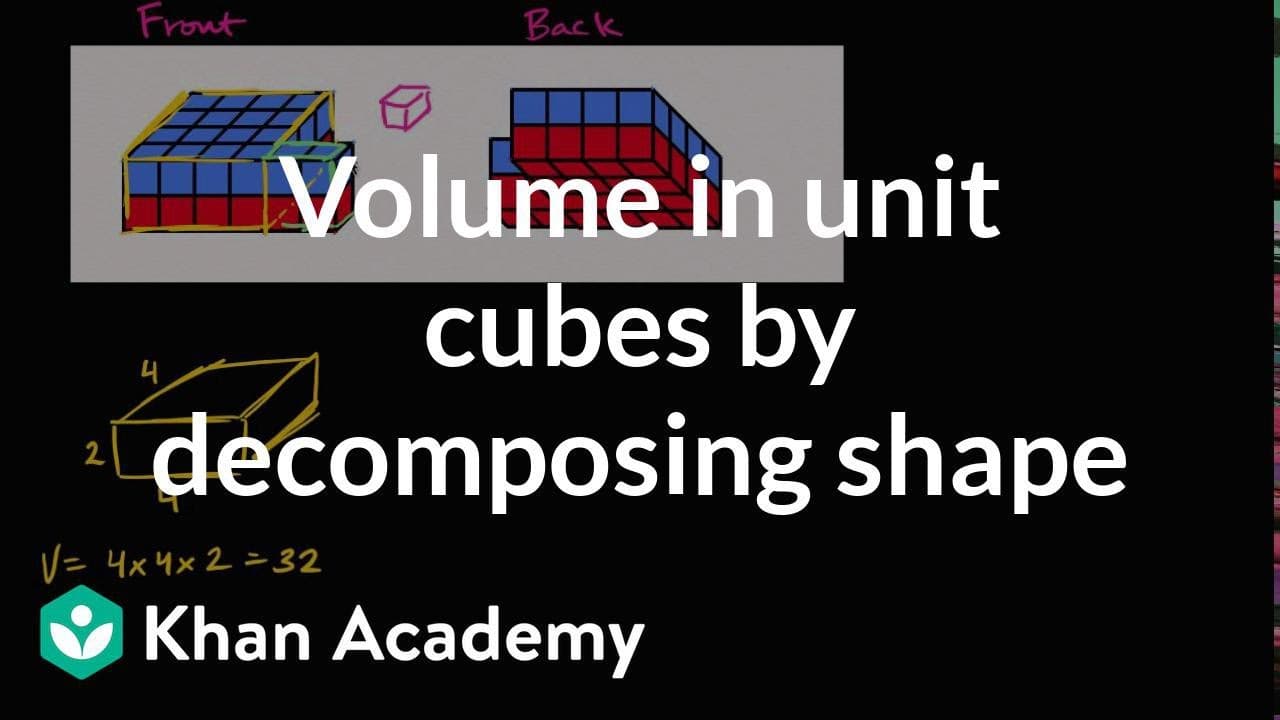
  • [Voiceover] So these are two pictures of the same figure. This is a front view of the object, and this is the back view of the object. And if a unit cube looks like this, what I want to do is I want to figure out the volume of this figure in terms of unit cubes, or in terms of cubic units. I encourage you to pause the video and think of it on you... Read More

Key Insights

  • 🔇 The volume of a figure can be found by breaking it down into smaller shapes and finding their individual volumes.
  • 🔇 The volume of a shape is calculated by multiplying its length, width, and height.
  • 🔇 The total volume of a figure is the sum of the volumes of its individual parts.

Install to Summarize YouTube Videos and Get Transcripts

Explore YouTube Video Summarizer or Get YouTube Transcript Extractor

Questions & Answers

Q: How can we find the volume of the yellow part of the figure?

To find the volume of the yellow part, we multiply its length, width, and height, which are 4 units, 4 units, and 2 units, respectively. So, the volume is 4 x 4 x 2 = 32 cubic units.

Q: What are the dimensions and volume of the other piece in the figure?

The other piece has dimensions of 2 units wide, 2 units high, and 1 unit deep. Its volume is calculated by multiplying these dimensions, which gives us 4 cubic units.

Q: How can we find the total volume of the figure?

The total volume is the sum of the volumes of the yellow part and the other piece. So, 32 + 32 + 4 = 36 cubic units.

Q: Is there another method to find the total volume?

Yes, another method is to find the volume of the blue layer, which is one unit deep, and then double it. Counting the cubes in the blue layer gives us 18 cubes. Therefore, the total volume is 18 + 18 = 36 cubic units.

Summary & Key Takeaways

  • The video shows two pictures of the same figure, a front view, and a back view, and explains how to find its volume in terms of unit cubes.

  • One method is to break the figure into a rectangular prism, find the volume of each part, and add them together.

  • Another method is to find the volume of the blue layer and double it, as the red layer has the same volume.


Read in Other Languages (beta)

English

Share This Summary 📚

Summarize YouTube Videos and Get Video Transcripts with 1-Click

Download browser extensions on:

Try YouTube Summary with ChatGPT & Claude or YouTube Transcript Generator

Explore More Summaries from Khan Academy 📚

How to Analyze Polynomial End Behavior for Graphing thumbnail
How to Analyze Polynomial End Behavior for Graphing
Khan Academy
Synthetic division | Polynomial and rational functions | Algebra II | Khan Academy thumbnail
Synthetic division | Polynomial and rational functions | Algebra II | Khan Academy
Khan Academy
Example: Correlation coefficient intuition | Mathematics I | High School Math | Khan Academy thumbnail
Example: Correlation coefficient intuition | Mathematics I | High School Math | Khan Academy
Khan Academy
Introduction to Compound Interest thumbnail
Introduction to Compound Interest
Khan Academy
Visually assessing standard deviation | AP Statistics | Khan Academy thumbnail
Visually assessing standard deviation | AP Statistics | Khan Academy
Khan Academy
How Do Double Number Lines Help Understand Ratios? thumbnail
How Do Double Number Lines Help Understand Ratios?
Khan Academy

Summarize YouTube Videos and Get Video Transcripts with 1-Click

Download browser extensions on:

Try YouTube Summary with ChatGPT & Claude or YouTube Transcript Generator

Apps & Extensions

  • Chrome Extension
  • Safari Extension
  • Edge Add-ons
  • Firefox Add-ons
  • iOS App
  • Android App

Key Features

  • YouTube Video Summarizer
  • Web & PDF Summarizer
  • Web & PDF Highlighter
  • Chat with PDF
  • Ask AI Clone
  • Audio Transcriber
  • Glasp Reader
  • Kindle Highlight Export
  • Idea Hatch

Integrations

  • Obsidian Plugin
  • Notion Integration
  • Pocket Integration
  • Instapaper Integration
  • Medium Integration
  • Readwise Integration
  • Snipd Integration
  • Hypothesis Integration

More Features

  • APIs
  • MCP Connector
  • Blog & Post
  • Embed Links
  • Image Highlight
  • Personality Test
  • Quote Shots

Company

  • About us
  • Blog
  • Community
  • FAQs
  • Job Board
  • Newsletter
  • Pricing
Terms

•

Privacy

•

Guidelines

© 2026 Glasp Inc. All rights reserved.