How To Find The Empirical Formula of a Hydrated Ionic Compound
TL;DR
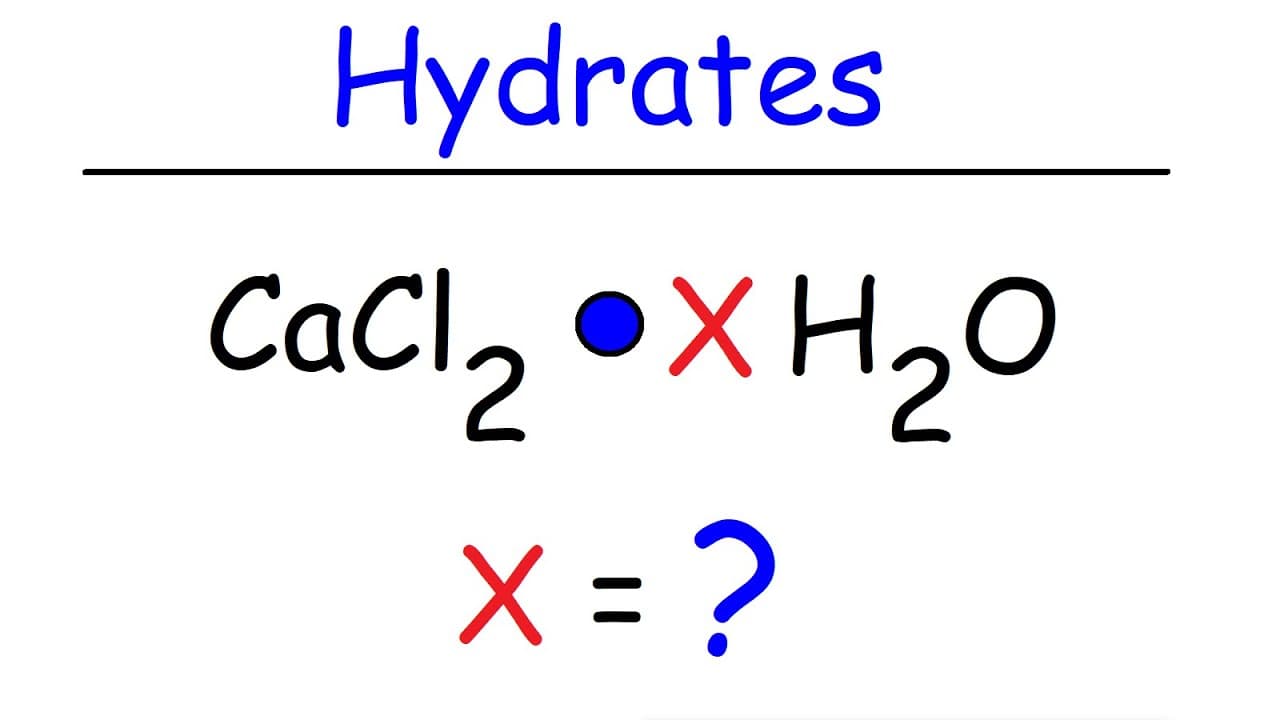
This video explains how to find the empirical formula of a hydrated compound by determining the moles of the different components.
Transcript
in this video we're going to talk about how to find the empirical formula of a hydrated compound so let's begin with this problem a hydrated salt of calcium chloride was found to have a mass of 5.4 grams after heating the substance for a long time the mass of the anhydrous salt was measured to be 2.7745 grams what was the empirical formula of the h... Read More
Key Insights
- 🥵 Heating a hydrated compound allows the removal of water, leading to the determination of the empirical formula.
- 💆 The mass of water can be calculated by finding the difference in mass before and after heating.
- 🥳 Determining the moles of each component enables the calculation of the molar ratio and, subsequently, the empirical formula.
Install to Summarize YouTube Videos and Get Transcripts
Explore YouTube Video Summarizer or Get YouTube Transcript Extractor
Questions & Answers
Q: Why is it important to determine the empirical formula of a hydrated compound?
Determining the empirical formula helps in identifying the ratio of elements present in the compound, providing crucial information about its composition.
Q: How is the mass of water in the compound calculated?
The mass of water is found by subtracting the mass of the anhydrous salt from the mass of the original compound after heating.
Q: What is the significance of calculating the moles of calcium chloride and water?
Calculating the moles allows us to determine the molar ratio between the two components, which gives us the empirical formula.
Q: Why divide each value by the smallest value?
Dividing by the smallest value helps find the simplest whole number ratio between the moles of calcium chloride and water.
Summary & Key Takeaways
-
A hydrated salt of calcium chloride was heated to remove water, and the mass of the anhydrous salt was measured.
-
The mass of water can be calculated by finding the difference between the mass of the original compound and the anhydrous salt.
-
By calculating the moles of calcium chloride and water, the empirical formula of the hydrated compound can be determined.
Read in Other Languages (beta)
Share This Summary 📚
Summarize YouTube Videos and Get Video Transcripts with 1-Click
Try YouTube Summary with ChatGPT & Claude or YouTube Transcript Generator
Explore More Summaries from The Organic Chemistry Tutor 📚





Summarize YouTube Videos and Get Video Transcripts with 1-Click
Try YouTube Summary with ChatGPT & Claude or YouTube Transcript Generator