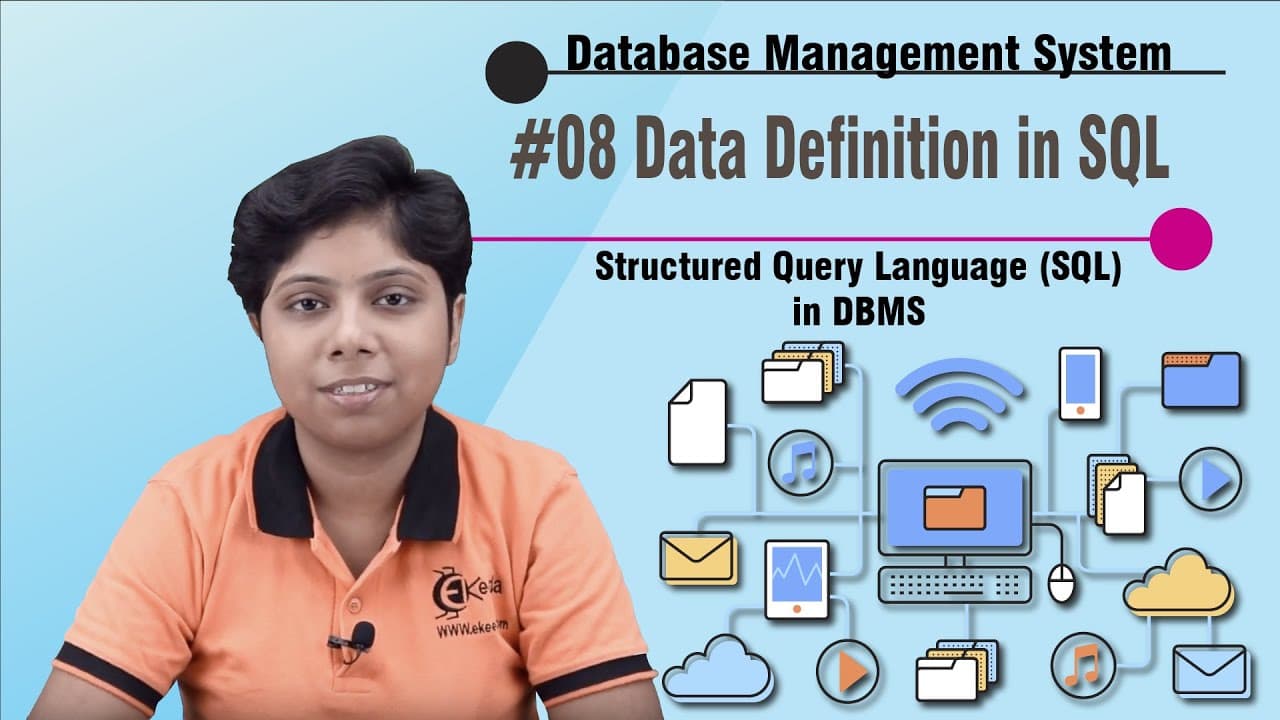
Data Definition in SQL - Structured Query Language (SQL) - Database Management System
TL;DR
This video provides an overview of SQL Data Definition Language (DDL) and its important features, including schema design, data types, integrity constraints, indices, authorization matrices, and physical storage.
Transcript
click the bell icon to get latest videos from akira hello friends today we will discuss about the data definition language part of in structured query language or Esquivel we will know that what are the important features of detail in an SQL and all of the DDL commands that we have introduced in an SQL to give part of as we are talking about the DD... Read More
Key Insights
- 🫰 DDL in SQL is used for designing the schema, specifying data types, integrity constraints, indices, and authorization matrices.
- 😥 SQL provides several basic data types, such as character, integer, numeric, and floating-point numbers.
- 🚰 DDL commands in SQL allow for creating tables, modifying schemas, adding integrity constraints, and deleting tables or tuples.
- 🤩 Integrity constraints, including primary keys, not null constraints, and referential integrity, ensure data integrity and relationships between tables.
- 👻 DDL also allows for schema modification through attribute addition or deletion.
- 🎚️ SQL DDL operates at a logical level, modifying the schema rather than the physical storage.
- 🎮 The video emphasizes the importance of proper schema design and the role of DDL in maintaining database integrity.
Install to Summarize YouTube Videos and Get Transcripts
Explore YouTube Video Summarizer or Get YouTube Transcript Extractor
Questions & Answers
Q: What is the purpose of DDL in SQL?
DDL is used to design the schema of a database, specifying attributes, data types, constraints, indices, authorization matrices, and physical storage.
Q: What are some basic data types in SQL?
SQL provides data types such as character (char and varchar), integer (int and smallint), numeric (precision and scale), and floating-point numbers (float and double precision).
Q: How do you create a table in SQL using DDL?
To create a table, you use the CREATE TABLE command followed by the table name and attributes along with their data types, separated by commas. The statement is terminated with a semicolon.
Q: How do you enforce primary key and not null constraints in SQL?
To enforce primary key constraints, you specify the attribute or combination of attributes as the primary key after all the attributes in the CREATE TABLE statement. Not null constraints are specified by adding the CONSTRAINT keyword followed by the attribute name and the NOT NULL keyword.
Q: What is referential integrity in SQL?
Referential integrity ensures that relationships between tables are maintained by enforcing foreign key constraints. You can reference a primary key from another table and ensure the data types and sizes match.
Q: How do you delete a table or a tuple in SQL?
To delete a table, you use the DROP TABLE command followed by the table name. To delete a tuple, you use the DELETE FROM command followed by the table name, applying appropriate conditions to specify which tuple(s) to delete.
Q: Can you modify an existing table schema in SQL?
Yes, you can use the ALTER TABLE command to modify a table schema. You can add attributes using the ADD keyword and specifying the attribute name and data type. To drop attributes, you use the DROP COLUMN command followed by the attribute name.
Summary & Key Takeaways
-
DDL is used to specify the design of a database schema, including defining the types of values, integrity constraints, indices, authorization matrices, and physical storage.
-
SQL provides several basic data types, including character, integer, numeric, and floating-point numbers.
-
The video explains how to use DDL to create tables, modify schemas, and add integrity constraints such as primary keys, not null constraints, and referential integrity.
-
It also covers table and tuple deletion, as well as schema modification through attribute addition or deletion.
Read in Other Languages (beta)
Share This Summary 📚
Summarize YouTube Videos and Get Video Transcripts with 1-Click
Try YouTube Summary with ChatGPT & Claude or YouTube Transcript Generator
Explore More Summaries from Ekeeda 📚




Summarize YouTube Videos and Get Video Transcripts with 1-Click
Try YouTube Summary with ChatGPT & Claude or YouTube Transcript Generator