5.3 Gravity at the surface of the Earth: The value of g.
TL;DR
Objects in space are subject to gravitational forces and accelerations, which can be calculated using the universal gravitational law.
Transcript
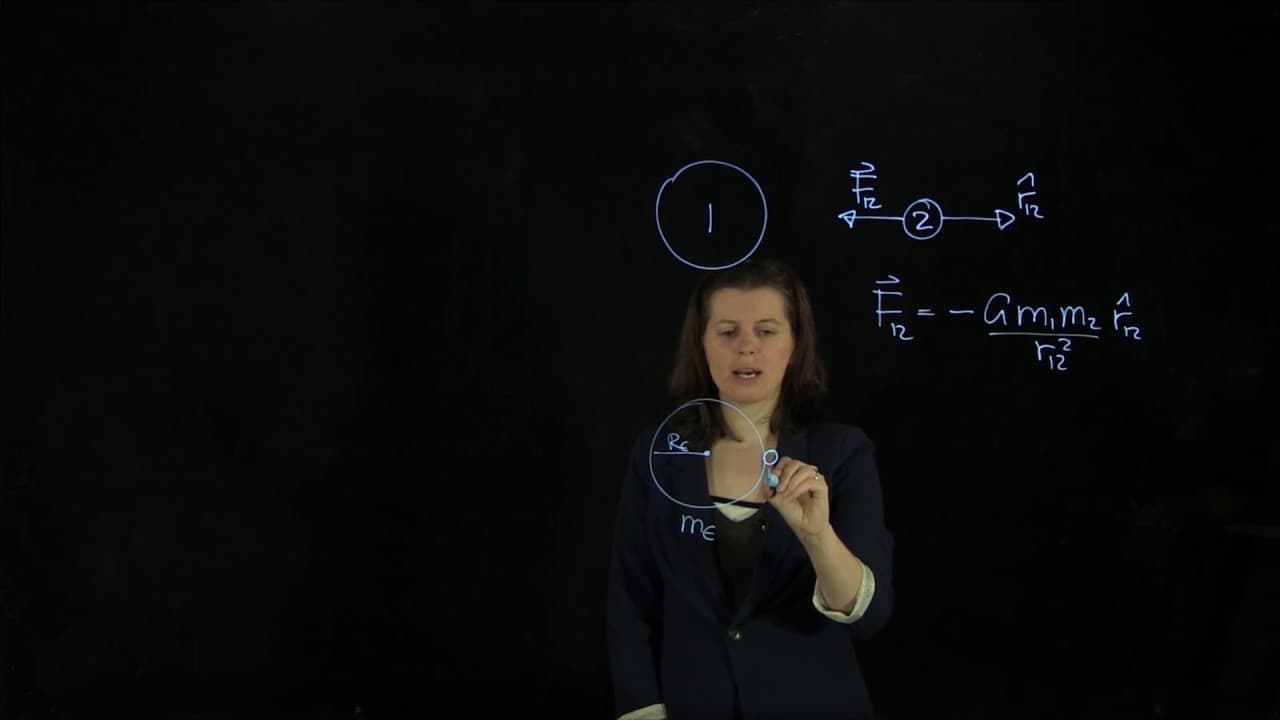
Let's consider the universal gravitational law a little bit more. Let's consider two objects in space. Let's say this is the sun, and we have the earth here or the earth and the moon. And of course, they're orbiting each other. So we can pick a coordinate system that goes radially. And so we're going to have an r hat direction here, and we're going... Read More
Key Insights
- 👾 Gravitational forces between objects in space can be described by the universal gravitational law.
- ❎ The magnitude of the gravitational force is inversely proportional to the square of the distance between the objects and directly proportional to the product of their masses.
- 💆 Gravitational acceleration can be calculated using the equation a = Gm/r^2, where a is the acceleration, G is the gravitational constant, m is the mass of the object, and r is the distance from the attracting body.
- 😀 The value of the gravitational constant (G) can be determined through experimental measurements of the force and distance between two masses.
- 💆 The gravitational acceleration experienced by an object can vary depending on the mass and radius of the attracting body.
- 🤒 The value of the Earth's gravitational acceleration is approximately 9.81 meters per second squared.
- 👮 The universal gravitational law provides a fundamental understanding of the behavior of gravity in the universe.
Install to Summarize YouTube Videos and Get Transcripts
Explore YouTube Video Summarizer or Get YouTube Transcript Extractor
Questions & Answers
Q: How can the universal gravitational law be represented mathematically?
The universal gravitational law is represented by the equation F1 2 = -Gm1m2/r12^2, where F1 2 is the gravitational force between objects 1 and 2, G is the gravitational constant, m1 and m2 are the masses of the objects, and r12 is the distance between them.
Q: How does gravitational acceleration differ from gravitational force?
Gravitational acceleration refers to the acceleration experienced by an object due to the force of gravity. It is calculated using the equation a = Gm/r^2, where a is the acceleration, G is the gravitational constant, m is the mass of the object, and r is the distance from the center of the attracting body.
Q: Can the gravitational acceleration vary depending on the object being considered?
Yes, the gravitational acceleration can vary depending on the object being considered. It would be different if we were considering the Sun, the Moon, or even an astronaut standing on the Moon's surface. The value of the gravitational acceleration depends on the mass and radius of the object.
Q: How is the value of the gravitational constant determined?
The value of the gravitational constant (G) can be experimentally determined through various methods. One way is to perform experiments involving the attraction between two masses and measure the resulting force and distance. The calculated value of G can then be compared to the known masses and distances used in the experiment.
Summary & Key Takeaways
-
The universal gravitational law explains the forces that act on objects in space, such as the interaction between the Earth and the Moon.
-
Gravitational forces are represented by the equation F1 2 = -Gm1m2/r12^2, where G is the gravitational constant and r12 is the distance between the objects.
-
Gravitational accelerations, such as the acceleration experienced by a moon rock on the surface of the Earth, can be calculated using the equation a = Gm/r^2.
Read in Other Languages (beta)
Share This Summary 📚
Summarize YouTube Videos and Get Video Transcripts with 1-Click
Try YouTube Summary with ChatGPT & Claude or YouTube Transcript Generator
Explore More Summaries from MIT OpenCourseWare 📚


Summarize YouTube Videos and Get Video Transcripts with 1-Click
Try YouTube Summary with ChatGPT & Claude or YouTube Transcript Generator